How Heat Treatment Influences the Performance of Forged Steel Blades
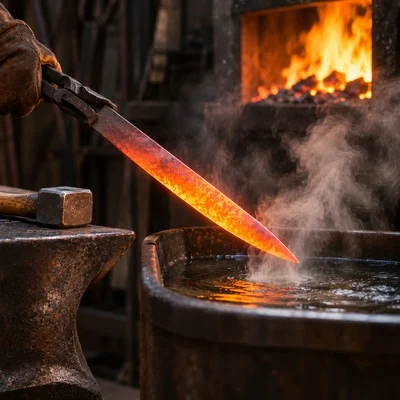
Take two blades forged from the same bar of steel, by the same hands, on the same afternoon. Grind them to the same profile. Then bend them. One flexes, springs back and keeps its edge. The other snaps like a dry twig.
What separates them usually isn't the forging at all. It's what happened afterward, in the quiet stretch of heating, quenching and tempering that most people never see. Heat treatment is where a shaped piece of steel becomes a working blade, and it has more say over performance than almost any other step in the process.
Forging Gives the Shape, Heat Treatment Gives the Character
Forging does real work. It moves metal into a usable profile, refines the structure to a degree and sets up the blade's geometry. But a freshly forged blade is full of uneven stress and coarse, inconsistent grain. Left that way, it would be too soft to hold an edge in some spots and too fragile in others.
That's why careful smiths normalize first, heating the blade above its critical temperature and letting it cool in still air, often more than once. It sounds like a minor step. It isn't. Normalizing evens out the grain and relieves forging stress, which gives everything that follows a fair starting point.
Sometimes you can even see heat treatment on the finished piece. The soft, cloudy line running along the edge of a traditional katana isn't decoration added at the end. It's a visible record of how different parts of the blade cooled during the quench, and it says a lot about how that sword was meant to behave.
The Quench Is Where Hardness Comes From
To harden steel, the smith heats it until its internal structure transforms into austenite, then cools it fast enough to trap the carbon in place. The result is martensite: very hard, very strong and, on its own, rather brittle.
Speed is everything here, and so is the choice of quenchant. Simple high-carbon steels like 1095 need a fast quench in brine, water or a fast specialist oil to reach full hardness. More heavily alloyed steels can get there with a gentler oil, or in some cases air. Pick the wrong medium and you either miss the hardness you need or crack the blade outright. Anyone who has heard that sharp little "tink" from a quench tank knows how unforgiving this moment can be.
When it goes right, the steel gets remarkably hard. Experienced bladesmiths working with 1095 aim for an as-quenched hardness of around 66 on the Rockwell C scale. Nobody wants a sword left at that level, though. It would chip on the first hard contact.
A Hard Edge With a Forgiving Spine
A blade asks steel to do two jobs that pull against each other. The edge has to be hard enough to stay sharp. The body has to be tough enough to absorb shock without breaking.
Differential hardening handles this by letting different zones of the blade cool at different rates. In the Japanese tradition, smiths coat the blade in a clay mixture, thick along the spine and thin at the edge. As the Met explains in its essay on Japanese blade making, the thinly coated edge cools quickly and hardens, while the insulated body cools more slowly into softer, more flexible structures. The hamon is simply the boundary between the two.
European smiths reached similar goals by other routes, including selective tempering and careful control of heat along the blade. Different methods, same idea: put hardness where the blade cuts and toughness where it bends.
Tempering Is Where the Blade Finds Its Balance
Tempering means reheating the hardened blade to a much lower temperature, typically a few hundred degrees Fahrenheit, and holding it there. It relieves internal stress and trades a little hardness for a lot of toughness. With 1095, smiths commonly bring that as-quenched figure down to somewhere around the high 50s or 60 HRC, depending on what the blade is for.
And what it's for matters a great deal. A small kitchen knife can run harder, since it rarely meets anything tougher than a cutting board. A long sword that might strike wood or another blade needs more give, so it's usually tempered softer. Most smiths temper in two or three cycles rather than one, which helps keep the result consistent through the whole blade. It's slow, unglamorous work, and honestly, it's where a lot of the real quality gets decided.
The Same Principles Scale All the Way Up
None of this is exclusive to bladesmithing. The same sequence of quenching and tempering governs the performance of springs, gears, tools and structural tube. Large producers invest heavily to control it, and U.S. Steel's plan to install a new quench-and-temper line at its Fairfield tubular operations is a good reminder of how much rides on getting heat treatment right at industrial scale.
A bladesmith with a forge and a small tempering oven is really solving the same problem as a plant engineer running a continuous line. Hit the right temperature, cool at the right rate, then temper to the balance the job demands. The equipment changes. The metallurgy doesn't.
Where Performance Is Really Decided
Good forging makes a blade look right. Good heat treatment makes it work. The edge that holds, the spine that flexes and recovers, the sword that survives a bad cut without folding or snapping: all of it traces back to a few carefully controlled temperatures and a handful of seconds in the quench tank. So if you ever want to judge a forged blade honestly, look past the pattern and the polish and ask how it was heat treated. That answer will tell you most of what you need to know.
 Media Pack Download
 Newsletters
 Industrial Events




Author Bio:

Owen
Content Partner, Battling Blades
Owen is a content partner at Battling Blades. He contributes content on blade craftsmanship, steelworking and the processes that shape finished blades.