Thinning Draws or Machining from Bar? Choosing the Route for a Cylindrical Housing
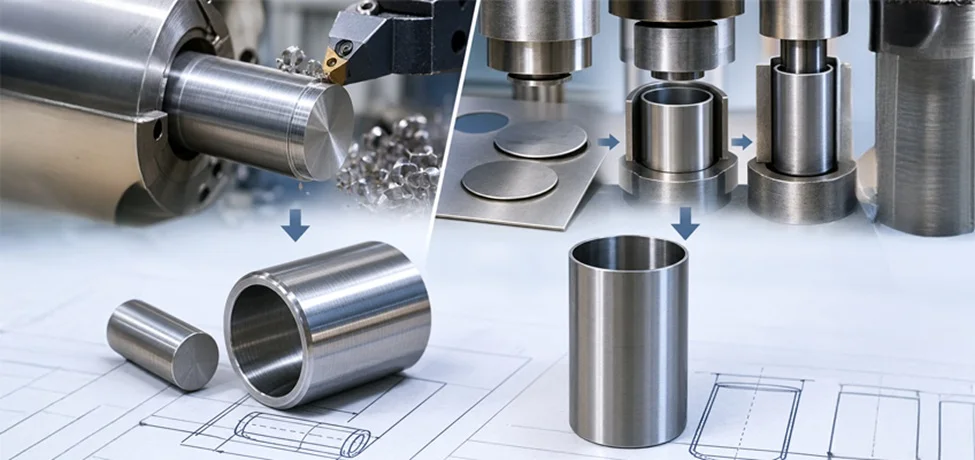
Most cylindrical housings — motor cans, sensor barrels, actuator sleeves, pump bodies — can be produced two ways: turned from bar stock, or deep drawn from sheet or strip and then thinned (ironed) to the final wall. On a drawing the two routes look almost identical. On a cost sheet they behave very differently. The choice is usually made by habit rather than by analysis, and habit is expensive.
Where the material goes
Machining starts with a solid cylinder and removes material until the shape appears. Deep drawing starts with a flat blank and moves material into shape; ironing then thins the wall by pushing the cup through a slightly smaller die. Nothing is discarded to create the wall.
For a part with a wall a few millimetres thick and a length several times its diameter, that difference dominates. In machining, the removed volume scales with the cube of the diameter. In drawing, the blank area — not the removed volume — sets the material cost. Where the housing has a closed end, drawing also avoids the separate operation that would otherwise create it.
How the wall is controlled
In turning, wall thickness follows the tool path and the machine's repeatability, so it can be tuned per part and per feature. In drawing, wall thickness follows the tool: the die gap and the ironing reduction set it. That is a genuine advantage — once the tool is right, the wall is repeatable part to part — but it also means a wall-thickness change is a tooling change, not a program change.
This is where the decision becomes a question about the design rather than the machine. If the wall has to vary along the part, if there are internal features that cannot be formed, or if the tolerance band is tighter than a drawn wall can hold, machining remains the right answer.
What drawing can and cannot do
Drawing is attractive within limits, and the limits are geometric:
- Depth-to-diameter ratio. A drawn cup can be considerably deeper than its diameter across multiple draws, but every draw is a reduction, so the number of draws — and the number of tools — rises with depth.
- Corner radii. A sharp internal corner at the base cannot be formed. It has to be generous enough for the material to flow into it, or it has to be added afterwards by machining.
- Material ductility. Low-carbon and stainless steels, copper and brass, aluminium, and magnetic and silicon steels all draw well. Higher-strength grades draw within narrower limits.
- Thickness tolerance. Ironing improves concentricity and wall control, but the blank thickness variation is inherited. Specifying a wall tighter than the incoming material supports is a specification problem, not a tooling problem.Features. Holes, slots and threads are normally added after forming, not drawn.
Where a part sits outside these limits, the honest answer is to machine it — or to draw the shell and machine only the features that need it. That hybrid route is common, and often the cheapest overall.
What to specify, and what to check
A drawing that supports a drawing-based quote states the material grade and blank thickness, the wall thickness with the feature tolerance applied, the depth and the depth-to-diameter ratio, the base corner radius, the concentricity requirement between bore and outside diameter, and the flatness of the open end. The blank thickness tolerance matters as much as the finished wall, because thickness variation is inherited rather than removed.
On the receiving side, first article inspection should measure the wall at the base radius as well as in the parallel section, because that is where thickness varies most. Concentricity between bore and outside diameter, straightness of the parallel section, and earing at the open edge are the three measurements that most reliably predict whether a drawn housing will assemble without rework. Inspection should be reported against the drawing.
The decision, in order
1. If the wall is uniform, the end is closed, and the depth-to-diameter ratio fits inside a two- or three-draw sequence, drawing is usually the lower-cost route.
2. If the wall varies, the part carries internal geometry, or the tolerance is tighter than the material's thickness variation allows, keep machining.
3. If both are true — a drawn shell with a few precision features — draw the shell and machine the features. This is the case most often mis-specified as a machining job.
4. If volume is low and geometry is simple, tooling cost can outweigh material savings. A machined batch may be cheaper than a drawn one even when the drawn route wins at production volume.
The point is to make the choice from geometry, material and volume rather than from the equipment already on the floor. The two routes compete less for the same parts than they do for the same drawing.
 Media Pack Download
 Newsletters
 Industrial Events