Why Manual Paperwork Still Creates Delays in Steel Production Workflows
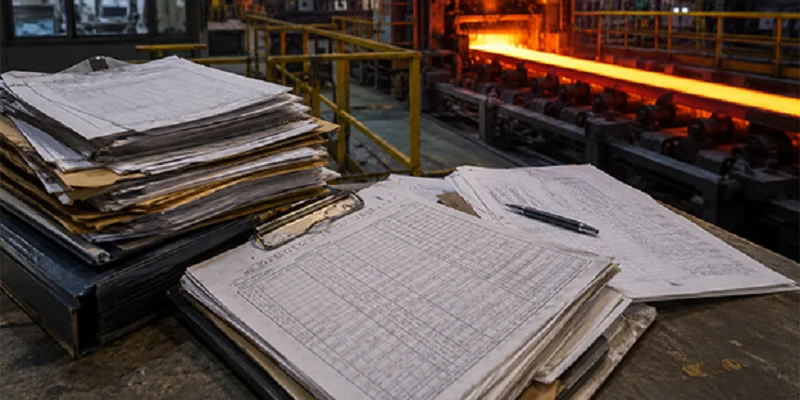
Walk through almost any steel plant floor today and you'll find state-of-the-art rolling equipment, servo-driven forming systems, and real-time quality sensors running alongside something far less advanced: a clipboard. Despite decades of investment in automation and process control, much of the documentation that governs steel production, from work orders and inspection sign-offs to mill certificates and maintenance logs, still moves through the plant on paper or in disconnected digital files.
This gap between production technology and documentation technology creates a specific kind of drag on operations. It doesn't show up as a single dramatic failure. Instead, it shows up as small, repeated delays: a shift supervisor waiting on a signed work order, a quality engineer hunting for a certificate that didn't make it back to the right file, a maintenance technician re-entering the same equipment data into three separate logs. None of these moments makes headlines, but together they add up to real lost time.
Documentation In Steel Production Workflows
Steel manufacturing generates an unusually heavy volume of paperwork relative to other industrial sectors, largely because of the traceability requirements built into the product itself. Every heat of steel needs to be tracked from melt to finished shipment, with chemical composition, mechanical test results, and processing history documented at each stage.
Buyers in construction, automotive, and energy routinely require certification against recognized standards before they'll accept material, and getting the certificate type wrong can hold up an entire shipment.
Much of this documentation still exists as static PDFs or scanned paper forms that pass between departments by email, fax, or hand delivery, printed out and rescanned whenever a change needs a signature. Much of that back-and-forth disappears once teams begin collaborating on PDFs directly, with reviewers annotating, comparing versions, and signing off on a single live copy. It doesn't require replacing the ERP or quality systems already in place, and for a quality engineer collecting sign-off from three separate reviewers, it can turn a change that once dragged across a shift into one that clears in an afternoon.
Common Paperwork Delays On The Plant Floor
A few patterns tend to repeat across steel operations, regardless of plant size or product mix.
Work order and change sign-off bottlenecks. Engineering changes or nonconformance dispositions frequently require multiple approvals. When those approvals depend on a physical signature or a document being routed to the right desk, a change that should take an hour can stretch into a shift or more.
Duplicate data entry. Operators and technicians often record the same information repeatedly, once on a paper traveler at the point of production and again into a digital ERP or quality system later. As well as the time wasted, this handoff is where transcription errors creep in. Published estimates of manual data entry accuracy put the typical field-level error rate at around 1 percent even under good conditions, a figure that compounds quickly across a document with dozens of fields.
Misfiled or delayed certificates. Material test reports and mill certificates, the documents that confirm a heat of steel meets its specified chemistry and mechanical properties, are often generated in one system and filed in another. If a certificate can't be located quickly when a customer or auditor asks for it, the delay falls on whoever has to track it down.
Maintenance records split across formats. Preventive maintenance checklists, inspection logs, and equipment history are sometimes kept in a mix of paper binders and spreadsheets, making it harder to spot a developing pattern before it causes an unplanned stop.
Impact On Production, Maintenance, And Quality
These delays rarely stay contained to the back office. A work order stuck in an approval queue can hold up a changeover. A missing certificate can prevent a shipment from going out on schedule, even when the material itself is fully compliant. And documentation gaps have a way of surfacing at the worst possible time, during an audit, a customer complaint, or an unplanned equipment failure.
The financial stakes of downtime specifically make this worth taking seriously. It’s estimated that the cost of downtime for an average large plant is now $253 million a year, a figure that reflects lost production, labor inefficiencies, and the ripple effects across a plant's broader schedule. Not every documentation delay causes a full stoppage, but slow approvals and missing records are frequently cited among the contributing factors that turn a minor issue into an extended one.
Quality outcomes carry similar exposure. Steel producers operate under strict traceability obligations, often tied to certificate standards like EN 10204 for material certification, and a mismatch between the certificate type a customer specified and what's actually on file is a common source of rejected shipments and rework. On the safety side, US-based operations also carry ongoing recordkeeping obligations under OSHA's injury and illness reporting rules, which depend on accurate, timely documentation at the plant level to stay current.
Better Document Processes For Steel Operations
None of this points to a wholesale rip-and-replace of existing systems. Most of the friction described above comes from a narrower problem: documents that exist digitally but still get handled like paper, printed for a signature, emailed for a markup, then re-scanned and refiled.
Addressing that doesn't require abandoning existing ERP or quality management systems. It typically means giving the documents that move between them a faster, more traceable path: digital markup that multiple reviewers can see and act on at once, sign-off that's logged automatically rather than tracked by memory, and version history that shows exactly what changed and when. For plants already juggling heat-specific certificates, engineering changes, and maintenance logs across multiple formats that kind of incremental change to how documents are reviewed and approved tends to remove far more delay than any single new piece of production equipment.
The plants that get the most value out of their automation investment are often the ones that treat documentation with the same rigor as the process itself. Paper and disconnected files were tolerable when production cycles moved more slowly. In a plant running tighter schedules and stricter customer specifications, those same habits are a quieter, but very real, source of delay.
 Media Pack Download
 Newsletters
 Industrial Events



Author Bio:

Emily Shaw
Founder of DocFly
Emily Shaw is the founder of DocFly, an online PDF editor. As a software developer, she built the site from scratch and is responsible for its operations and continued growth. Previously, she studied engineering at the University of Hong Kong and mathematics at the University of Manchester. In her spare time, she enjoys hiking in the countryside, and spending time with her family.