Conveyor Transfer Points in Steel Processing Plants: Chute Design, Material Flow and Spillage Control
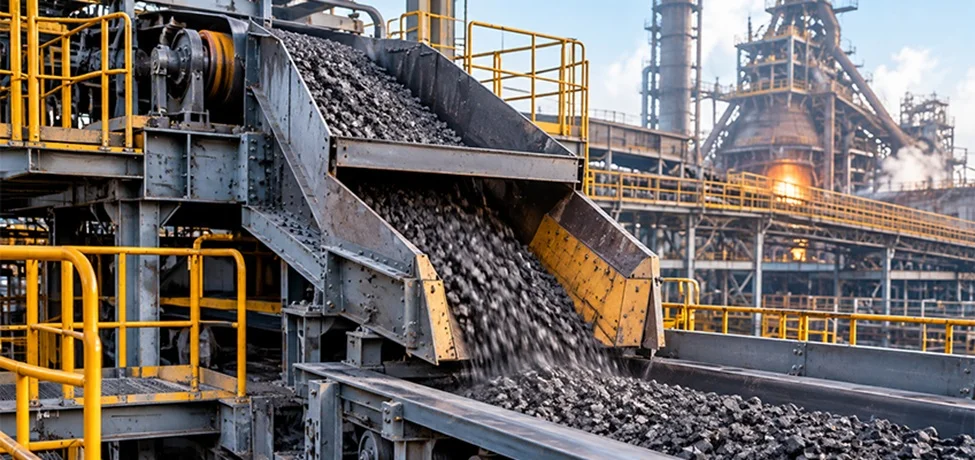
Conveyor systems are the backbone of bulk material handling, moving everything from raw materials to finished products across large industrial sites. While the belts themselves get most of the attention, the real performance of any conveyor network is often decided at its junctions. A conveyor transfer point is where material passes from one conveyor to another, usually through a chute, and it is one of the most critical areas in the entire system.
In steel processing plants, where large volumes of iron ore, coke, sinter and limestone move continuously, transfer points directly affect efficiency, safety and operating cost. Poor design at these points can lead to dust, spillage, blockages and unplanned downtime, while a well-designed transfer point keeps material flowing smoothly and reliably. This article explains how chute design, material flow and spillage control work together to improve conveyor performance.
What Is a Conveyor Transfer Point and Why Does It Matter in Steel Plants?
A conveyor transfer point is the place where material leaves one conveyor and lands on another, usually through a chute. In a steel plant, material moves through dozens of these junctions between the raw material yard, blast furnace stockhouse, sinter plant, coke ovens and steel melt shop.
They matter because the material at this point is moving, changing direction and often hitting hard surfaces all at once. Poor handling here leads to belt damage, uneven loading, mistracking, dust emissions and the spillage piles that become a safety hazard. A conveyor can be perfectly built along its length and still underperform because of one badly designed junction.
Why Steel Plant Conveyors Are Harder on Transfer Points Than Most Industries
Steel plants don’t handle one tidy material. They handle a mix, and each behaves differently:
- Iron ore lumps and pellets are heavy and abrasive, and they bounce.
- Iron ore fines and sinter fines are dusty and tend to pack into dead corners.
- Coke is brittle, so rough handling creates fines that hurt blast furnace permeability.
- Limestone, dolomite and coal vary in moisture and can turn sticky in the monsoon season.
- Hot sinter adds heat stress to the belt and the chute liners.
This is why copy-paste chute design rarely works in steel plants. Industrial conveyor chutes here have to be designed around the specific material, its moisture range, lump size and the tonnage you actually run, not the tonnage on the original data sheet.
How Does Material Behave Inside a Transfer Chute?
Material doesn’t simply fall. It leaves the head pulley on a trajectory that depends on belt speed, pulley diameter and belt angle. It then hits the chute walls or the receiving belt, loses energy and has to be re-accelerated to belt speed.
Three things usually go wrong:
1. The material lands off-centre, so the receiving belt carries an uneven load and drifts to one side.
2. It hits at high impact and the wrong angle, which damages the belt and breaks down fragile materials like coke.
3. It arrives much slower or faster than the receiving belt, which causes turbulence, dust and spillage at the loading zone.
Once you see transfer points as a flow problem rather than a structural one, the fixes become much clearer.
Conveyor Chute Design Considerations for Handling Bulk Materials
Good conveyor chute design is mostly about controlling the material’s path. These considerations matter most for steel plant duty:
Match the discharge to the receiving belt. The ideal is for material to leave the chute moving in the same direction as the receiving belt and at close to the same speed. Curved or “hood and spoon” profiles guide material down gently rather than letting it crash onto the belt.
Centre the load. A chute that places material squarely in the middle of the receiving belt prevents edge spillage and keeps the belt tracking straight. Even a small off-centre bias becomes a daily nuisance over thousands of hours.
Control the drop height. Long free falls build up impact energy and dust. Where a drop is unavoidable, rock boxes or ledges let material fall onto itself, which protects the liners and the belt.
Size the chute for the real flow. Chutes are often designed for rated capacity, then run at surge loads. Leave enough cross-section so that material doesn’t back up and bridge at the throat.
Plan for wear. For abrasive iron ore and sinter, replaceable liners in chromium carbide, ceramic or hardened steel are far cheaper than rebuilding a chute. Design for easy access so a liner change doesn’t turn into a long shutdown.
Avoid dead zones and flat surfaces. Sticky fines build up on flat ledges and shallow wall angles. Steeper, smoother walls and poly-lined or low-friction surfaces help in wet conditions.
How to Improve Material Flow at Conveyor Transfer Points in Steel Plants
If you’re asking how to improve material flow at conveyor transfer points in steel plants, start with this sequence rather than jumping to replacement:
1. Measure before you modify. Note where material is landing, where it builds up, which liners wear fastest and where dust escapes. These observations tell you more than the drawings.
2. Use simulation for critical transfers. Discrete element modelling (DEM) lets engineers test chute geometry against your actual material before steel is cut. For high-tonnage transfers feeding the blast furnace or sinter plant, it tends to pay for itself by avoiding rework.
3. Fix the flow, not just the symptom. Adding more skirt rubber to a badly designed chute treats spillage without removing its cause. Reprofiling the chute so material exits centred and at the right speed usually solves several issues at once.
4. Control moisture and fines. Where wet or sticky material is the problem, consider steeper chute angles, low-friction liners and, where appropriate, air cannons or vibrators for cleaning blockages. Fix the cause where you can, too: segregate fines, manage stockpile drainage and keep wet material out of the system.
5. Keep belt speed and loading consistent. Frequent speed changes and surge feeding upset even a good chute. Smoothing the feed at source reduces stress at every downstream transfer.
Methods to Reduce Material Spillage at Steel Plant Conveyor Transfer Points
Spillage control is where most plants feel the pain, so it deserves its own plan. The most effective methods to reduce material spillage at steel plant conveyor transfer points work as layers:
Seal the loading zone properly. Well-fitted skirtboards and skirt seals keep material on the belt as it settles. Make sure the skirt length is adequate: material needs enough distance to stabilise before it leaves the enclosure.
Support the belt where material lands. Impact beds or properly spaced impact idlers stop the belt from sagging under load. Sag opens gaps between the belt and the skirts, and that’s where fine material escapes.
Manage carry-back. Material that clings to the belt after discharge falls off along the return side and piles up under the conveyor. A primary cleaner and a secondary cleaner, kept properly tensioned, remove most of it. A cleaner that has worn out is worse than none because it creates a false sense of safety.
Control dust at the source. Enclosed chutes with dust extraction or fog-type suppression reduce airborne material, which helps with both housekeeping and environmental compliance.
Prevent blockages. Many “spillage events” actually start as blockages. When material jams in the chute, it overflows. Wide enough chute throats, smooth internal surfaces and level switches or blockage detectors give early warning before overflow occurs.
Inspect on a schedule. Skirt rubbers, liners and cleaner blades are consumables. Plants that track wear and replace parts on a planned basis have far fewer emergency cleanups than those that react after a spill.
A Practical Way to Think About It
Here is a simple mental model for any troubled transfer point: slow it down, centre it, contain it, clean it.
- Slow it down: reduce the energy of the falling material through better chute geometry.
- Centre it: place the load in the middle of the receiving belt.
- Contain it: seal and support the loading zone.
- Clean it: remove carry-back before it becomes a pile.
Most chronic transfer point problems violate one or more of these four principles.
The Cost of Ignoring Transfer Points
It’s easy to treat spillage as a housekeeping issue. In reality it is an operations issue. Spilled material is lost production. Buried idlers fail early, belts wear faster, and cleaning crews work near moving equipment, which raises safety risk. Dust emissions can also trigger regulatory attention.
Even modest improvements at the worst three or four transfer points in a plant often free up more maintenance hours than any other single change, and that’s before counting the benefit of steadier material flow to the furnaces.
Frequently Asked Questions
What causes spillage at conveyor transfer points?
The most common causes are off-centre loading, high impact at the landing point, belt sag, worn skirts, chute blockages and carry-back from a poorly maintained belt cleaner.
How do you design a good conveyor transfer chute?
Start with the material properties and the real throughput, then shape the chute so material leaves centred, at close to belt speed and in the belt’s direction. Add replaceable wear liners and avoid flat surfaces where fines can build up.
Can DEM simulation help in steel plants?
Yes. It lets engineers test chute designs against actual material behaviour, which is especially useful for blast furnace feed, sinter and coke handling where mistakes are expensive.
What is the quickest win for reducing spillage?
Check centring and skirt sealing first, then belt support under the loading zone. These are often cheaper to correct than a full chute rebuild and can deliver visible results fast.
Final Thoughts
Transfer points are small in size but large in consequence. In a steel plant, where bulk materials are abrasive, variable and high-volume, the quality of your chute design and the discipline of your spillage control show up directly in uptime, safety and cost per tonne.
Start with one problem transfer point. Observe it, fix the flow, seal the zone and keep the belt clean. Once the results are visible, the case for extending the approach across the plant makes itself.
 Media Pack Download
 Newsletters
 Industrial Events