Ironmaking Process in Steel Production: Blast Furnace, DRI, and Smelting Technologies
Introduction:
Steel remains the backbone of modern industrial development, supporting sectors ranging from construction and automotive to energy, heavy machinery, aerospace, and infrastructure. At the heart of steel manufacturing lies the ironmaking process, a critical stage that transforms iron ore into metallic iron suitable for steel production. As global steelmakers navigate increasing pressure to improve efficiency, reduce carbon emissions, and diversify raw material sources, multiple ironmaking technologies have evolved to meet varying operational and sustainability requirements.
Today, the industry primarily relies on three major ironmaking routes: the blast furnace, the direct reduced iron (DRI) route, and the smelting reduction process steel technology. Each approach offers unique advantages depending on raw material availability, energy sources, production scale, capital investment, and environmental objectives.
This article explores the fundamentals of iron production, explains how iron is produced in blast furnace in steel industry, provides the direct reduced iron process explained step by step, and examines the difference between blast furnace and DRI ironmaking methods. It also highlights emerging trends shaping the future of global ironmaking.
Why Ironmaking Is Critical in Steel Production
Steel is primarily composed of iron with controlled additions of carbon and alloying elements. Before steel can be manufactured, iron must first be extracted from naturally occurring iron ores such as hematite (Fe₂O₃) and magnetite (Fe₃O₄).
The objectives of the ironmaking stage include:
- Removing oxygen from iron ore
- Producing metallic iron suitable for steelmaking
- Controlling impurities such as sulfur and phosphorus
- Maximizing productivity while minimizing energy consumption
- Reducing environmental emissions
The quality and efficiency of the ironmaking stage directly influence downstream steelmaking performance, production costs, and overall product quality.
Understanding the Blast Furnace Ironmaking Process
The blast furnace ironmaking process has remained the industry's dominant technology for over a century, accounting for approximately 70% of global primary iron production. It is particularly suited for integrated steel plants producing large volumes of hot metal.
Raw Materials Required
The blast furnace typically operates using three primary inputs:
- Iron ore (lumps, pellets, or sinter)
- Metallurgical coke
- Limestone or dolomite as flux
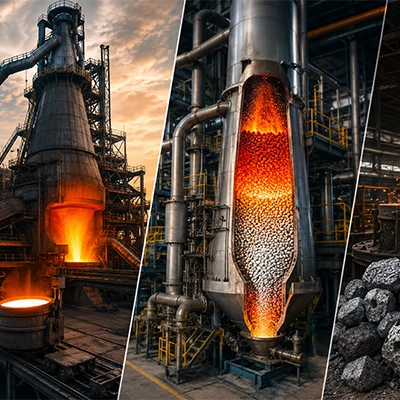
Hot air, known as the "blast," is injected through tuyeres near the bottom of the furnace.
How Iron Is Produced in Blast Furnace in Steel Industry
Understanding how iron is produced in blast furnace in steel industry involves following several sequential stages.
1. Charging the Furnace
Layers of iron ore, coke, and limestone are continuously charged from the furnace top.
2. Generation of Heat
Preheated air enters the lower furnace.
Coke reacts with oxygen:
C + O₂ → CO₂
The generated carbon dioxide reacts further with coke:
CO₂ + C → 2CO
Carbon monoxide becomes the primary reducing gas.
3. Reduction of Iron Ore
As iron ore descends, carbon monoxide removes oxygen from the ore through multiple reduction stages.
The iron oxide gradually converts into metallic iron.
4. Melting Zone
Temperatures exceed 1,500°C.
The reduced iron melts and absorbs carbon, forming hot metal or pig iron.
5. Slag Formation
Flux materials combine with silica, alumina, and other impurities to form slag.
The slag floats above molten iron due to its lower density.
6. Tapping
Molten iron and slag are periodically tapped separately.
The hot metal proceeds to the Basic Oxygen Furnace (BOF) for steelmaking.
Advantages of Blast Furnace Technology
The blast furnace continues to dominate because it offers:
- Extremely high production capacity
- Continuous operation
- Proven industrial reliability
- Efficient processing of large raw material volumes
- Integration with coke ovens and sinter plants
Challenges
Despite its maturity, blast furnace technology faces several challenges:
- High capital investment
- Significant CO₂ emissions
- Dependence on metallurgical coke
- Large energy consumption
- Complex plant infrastructure
These limitations are driving increasing investment in alternative ironmaking routes.
Direct Reduced Iron (DRI): A Modern Alternative
The direct reduced iron route has emerged as one of the fastest-growing ironmaking technologies, particularly in regions with abundant natural gas or increasing renewable hydrogen availability.
Unlike the blast furnace, DRI reduces iron ore without melting it.
The resulting product is known as sponge iron due to its porous structure.
DRI Steel Production Process
The DRI steel production process uses reducing gases instead of coke to remove oxygen from iron ore.
The primary reducing gases include:
- Hydrogen (H₂)
- Carbon monoxide (CO)
These gases are typically generated from natural gas or coal gasification.
The reduced iron is subsequently melted in Electric Arc Furnaces (EAFs).
Direct Reduced Iron Process Explained Step by Step
The direct reduced iron process explained step by step includes the following stages.
Step 1: Ore Preparation
High-quality iron ore pellets or calibrated lump ore are selected.
Low impurity content is essential for efficient reduction.
Step 2: Gas Generation
Natural gas undergoes reforming to produce:
- Hydrogen
- Carbon monoxide
These gases serve as reducing agents.
Step 3: Reduction Reactor
Iron ore enters a shaft furnace.
Reducing gases flow upward while iron ore moves downward.
The oxygen is gradually removed from the ore.
Unlike blast furnaces, the material never melts.
Step 4: Sponge Iron Formation
The oxygen-free iron retains its original shape while developing a porous internal structure.
This product is known as Direct Reduced Iron (DRI).
Step 5: Cooling or Hot Charging
The DRI may be:
- Cooled for storage
- Briquetted into Hot Briquetted Iron (HBI)
- Directly transferred while still hot into an Electric Arc Furnace
Step 6: Steelmaking
Electric Arc Furnaces melt the DRI together with scrap steel to produce finished steel grades.
Benefits of DRI Technology
The DRI steel production process offers several operational advantages.
Lower Carbon Emissions
Natural gas-based DRI plants generate substantially lower CO₂ emissions than blast furnaces.
Future hydrogen-based DRI facilities promise even greater emission reductions.
Flexible Plant Size
DRI plants are economically viable at smaller capacities compared to integrated blast furnace complexes.
Improved Steel Quality
DRI provides consistent chemistry with low residual elements, making it suitable for high-quality steel grades.
Reduced Coke Dependency
The process eliminates the need for coke ovens.
Limitations of DRI
Some limitations include:
- Dependence on high-grade iron ore
- Higher electricity consumption through Electric Arc Furnaces
- Limited competitiveness where natural gas prices are high
- Lower productivity than very large blast furnace complexes
Smelting Reduction Process Steel
The smelting reduction process steel route represents another alternative designed to eliminate conventional coke ovens while maintaining high productivity.
Instead of producing coke separately, coal is used directly.
Several commercial technologies include:
- COREX
- FINEX
- HIsmelt
These technologies simplify plant layouts while reducing certain environmental impacts.
How Smelting Reduction Works
The smelting reduction route generally involves two stages.
Pre-reduction
Iron ore is partially reduced using off-gases.
Final Smelting
The partially reduced ore enters a melter-gasifier.
Coal supplies both energy and reducing gases.
Molten iron is produced similarly to blast furnace hot metal.
Advantages of Smelting Reduction
Major benefits include:
- Elimination of coke ovens
- Lower capital investment than integrated blast furnace plants
- Ability to use non-coking coal
- Reduced emissions
- Simplified process flows
Challenges
Smelting reduction technologies still face certain limitations:
- Limited global deployment
- Higher oxygen requirements
- Technology licensing costs
- Operational complexity compared with conventional blast furnaces
Difference between Blast Furnace and DRI Ironmaking Methods
Understanding the difference between blast furnace and DRI ironmaking methods helps manufacturers choose the most suitable technology.
| Parameter | Blast Furnace | Direct Reduced Iron |
| Primary fuel | Coke | Natural gas, coal gas, or hydrogen |
| Operating temperature | Above 1,500°C | Around 800–1,100°C |
| Product | Molten pig iron | Solid sponge iron |
| Reduction medium | Carbon monoxide | Hydrogen and carbon monox |
| Melting | Yes | No |
| Furnace type | Blast furnace | Shaft furnace or rotary kiln |
| Steelmaking route | Basic Oxygen Furnace | Electric Arc Furnace |
| Carbon emissions | High | Lower |
| Capital investment | Very high | Moderate |
| Plant flexibility | Large integrated plants | Small to medium modular plants |
This difference between blast furnace and DRI ironmaking methods is increasingly important as steel producers evaluate decarbonization strategies.
Sustainability Driving Technology Choices
Environmental regulations are rapidly reshaping global iron production.
Governments and steel producers are pursuing:
- Net-zero carbon targets
- Renewable energy integration
- Carbon capture technologies
- Hydrogen-based ironmaking
- Circular economy initiatives
Hydrogen DRI is emerging as one of the most promising pathways toward near-zero-emission steel production.
Several pilot projects across Europe, North America, and Asia are demonstrating commercially viable hydrogen reduction technologies.
Digitalization in Modern Ironmaking
Modern ironmaking facilities increasingly incorporate Industry 4.0 technologies to improve operational performance.
Key innovations include:
- Artificial intelligence for process optimization
- Digital twins for furnace simulation
- Real-time sensor monitoring
- Predictive maintenance
- Automated burden distribution
- Machine learning for quality prediction
These technologies improve energy efficiency while reducing production costs and equipment downtime.
Selecting the Right Ironmaking Technology
No single ironmaking technology fits every steel producer.
Technology selection depends on several factors:
- Availability of iron ore quality
- Access to natural gas or hydrogen
- Coal availability
- Electricity costs
- Carbon pricing policies
- Plant capacity requirements
- Environmental regulations
- Long-term investment strategy
Integrated steelmakers often continue to rely on the blast furnace ironmaking process, while mini mills increasingly favor the DRI steel production process paired with Electric Arc Furnaces.
Meanwhile, smelting reduction technologies provide attractive alternatives in regions with abundant non-coking coal resources.
Future Outlook
The global steel industry is entering one of its most significant transitions since the industrial revolution. While the traditional blast furnace will continue to play a major role for decades due to its unmatched production capacity and established infrastructure, growing pressure to reduce greenhouse gas emissions is accelerating investment in cleaner ironmaking technologies.
The adoption of direct reduced iron is expected to expand rapidly, particularly as renewable hydrogen becomes more commercially available. At the same time, advancements in the smelting reduction process steel route will provide additional flexibility for regions seeking to reduce reliance on coke while maintaining competitive production economics.
Ultimately, the future of the ironmaking process will not be defined by a single technology but by a combination of blast furnace modernization, expanded DRI deployment, smelting reduction innovations, carbon capture integration, and digital process optimization. Steel producers that successfully balance productivity, operational efficiency, and sustainability will be best positioned to meet the evolving demands of global infrastructure, manufacturing, and low-carbon industrial development.
 Media Pack Download
 Newsletters
 Industrial Events