Blast Furnace Operation: How Temperature, Burden and Gas Flow Are Controlled
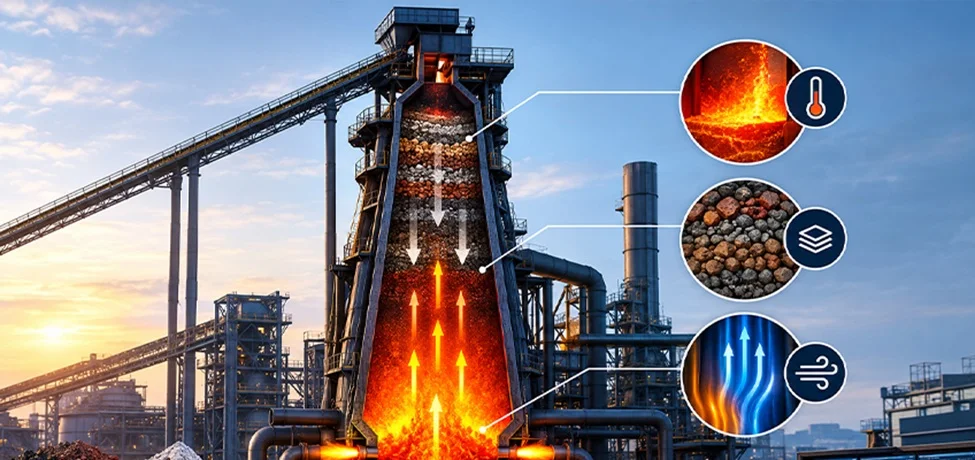
A blast furnace is a 30-meter-tall chemical reactor that never gets to rest. It runs for 15 to 20 years between relines, and every hour of that time operators are balancing three things: heat, material and gas.
Get them right and you produce steady, low-cost hot metal. Get them wrong and the furnace can hang, slip or chill. This guide explains how it works, in plain language.
What is blast furnace operation, in short?
Blast furnace operation is the continuous process of charging iron ore, coke and flux from the top while blowing hot air through the bottom, so that ore is reduced to liquid iron (hot metal) and slag.
Operators control the furnace through three linked levers:
1. Thermal state: how hot the hearth and the hot metal are
2. Burden distribution: how raw materials are layered inside the furnace
3. Gas flow: how evenly reducing gas travels upward through the stack
Change one and the other two react. That is why blast furnace control is less like flipping switches and more like steering a very large ship.
How does the blast furnace process work?
The blast furnace process is a counter-current exchange. Solids move down, gases move up.
- Top: iron-bearing material (sinter, pellets, lump ore), coke and fluxes such as limestone are charged in alternating layers.
- Bottom: preheated air at roughly 1,000 to 1,250°C is injected through tuyeres. It burns coke and injected coal, producing carbon monoxide (CO) and intense heat.
- Middle: the rising CO strips oxygen from the descending ore. This is the core reduction reaction.
- Hearth: molten iron and slag collect and are tapped through the taphole several times a day.
Temperatures range from about 150 to 250°C at the top gas outlet to over 2,000°C in the raceway in front of the tuyeres. Hot metal leaves at around 1,480 to 1,520°C.
That wide gradient is the whole point of blast furnace technology. The furnace is a heat exchanger, a chemical reactor and a melting vessel in one.
How is furnace temperature controlled?
Furnace temperature control means keeping the hearth hot enough to melt iron and slag, but not so hot that fuel is wasted.
Since you can’t put a thermometer into a running furnace, operators read the thermal state indirectly.
The main indicators
- Hot metal temperature: measured at every cast. The usual target is 1,480 to 1,520°C.
- Silicon in hot metal: a classic thermal index. Higher silicon generally means a hotter hearth. Many furnaces aim for about 0.3 to 0.8%, depending on practice.
- Raceway adiabatic flame temperature (RAFT): a calculated value, typically 2,000 to 2,300°C, that tells you how hot the combustion zone is.
- Stave and wall thermocouples: show where heat is flowing through the lining.
The levers for adjusting heat
| Lever | Effect |
| Hot blast temperature | Higher blast adds heat and saves coke |
| Blast moisture (steam) | Cools the raceway, lowers the flame temperature |
| Oxygen enrichment | Raises flame temperature and output |
| Pulverized coal injection (PCI) | Replaces coke, cools the raceway slightly |
| Coke rate | Direct fuel and heat input |
A skilled operator doesn’t wait for a problem. They watch trends, such as a falling silicon level over three or four casts, and nudge blast moisture or coal rate early. Small, early corrections beat big, late ones every time.
What is burden control, and why does it matter?
The burden is everything charged into the furnace: ore, sinter, pellets, coke and flux. Burden control is about both its quality and how it is distributed.
Quality: the foundation
Good burden gives you good permeability, which means gas can pass through easily. Key properties:
- Coke strength (CSR) and size: coke is the only solid that stays solid down to the hearth, so it holds up the whole column. Weak coke turns to fines and blocks gas.
- Sinter and pellet quality: consistent size, good reducibility and low breakdown at high temperature.
- Chemistry: slag basicity and alkali levels must stay in a controlled range.
Distribution: the art
Modern furnaces use a bell-less top with a rotating chute. Operators can program where each charge lands: near the wall, mid-radius or at the center.
- More coke at the center opens a permeable central channel and pushes gas up the middle.
- More ore at the wall reduces wall gas flow and protects the lining.
- Ore-to-coke ratio at each radius decides how hot and how reduced each zone becomes.
The aim is a stable, slightly center-weighted gas flow with a well-shaped cohesive zone, the soft, sticky layer where ore begins to melt. That zone shapes everything above and below it.
How is gas flow controlled in a blast furnace?
Blast furnace gas flow control means making the rising gas travel evenly through the burden, using as much of its chemical energy as possible before it exits.
Uneven gas flow is the root of most furnace problems. Gas takes the path of least resistance. If it channels through one section, that section runs hot and over-reduced, while the rest stays cold and under-reduced.
What operators monitor
- Blast volume and pressure drop: the pressure difference between the bottom and top of the furnace tells you how hard the gas is working to get through. A rising pressure drop is an early warning of poor permeability.
- Top gas temperature profile: probes across the throat show whether gas is flowing evenly or hugging the wall.
- Top gas composition (CO/CO₂): gas utilization, or how much CO is converted to CO₂, typically sits around 45 to 50% in efficient furnaces. Higher utilization means better fuel efficiency.
- Top pressure: raising it slows the gas down and lets you push more blast, supporting higher output.
What goes wrong
- Channeling: gas breaks through in narrow streams, wasting energy.
- Hanging: the burden stops descending because gas flow or permeability is poor.
- Slips: a hanging burden suddenly drops, causing a pressure surge.
Most of these are prevented not by emergency action but by consistent burden quality and distribution.
What factors affect blast furnace productivity?
Blast furnace productivity is usually measured in tonnes of hot metal per cubic meter of working volume per day, with efficient furnaces typically achieving around 2.0 to 2.5 t/m³/day.
The main drivers:
1. Burden permeability: the single biggest factor. Better coke and sinter let you blow more air.
2. Blast volume and oxygen enrichment: more oxygen means more combustion and more output.
3. Hot blast temperature: higher blast temperature reduces coke need.
4. Top pressure: supports higher blast rates at stable pressure drop.
5. Burden reducibility: easier-to-reduce ore needs less time and fuel.
6. Slag volume: lower slag volume means less energy spent on melting waste.
7. Casting practice: poor tapping can leave liquid in the hearth and disturb gas flow.
8. Furnace stability: every upset, whether a slip, a chill or a delay, costs production hours.
Chasing a record production number rarely pays. A furnace running smoothly at a slightly lower rate usually beats one pushed hard and fighting upsets every other day.
How are blast furnace operations-controlled day to day?
In practice, control is a loop of measuring, interpreting and adjusting:
1. Measure: sensors report temperatures, pressures, gas composition and flows continuously.
2. Interpret: operators and process models translate the data into a thermal and permeability picture.
3. Adjust: operators change blast parameters, coal rate or charging programs.
4. Verify: the next casts and probe readings confirm whether the change worked.
Many plants now add digital tools: heat-balance models, burden-distribution simulators and AI-based trend prediction. These help, but they don’t replace operator experience, because a model is only as good as the judgment guiding it.
Practical rules of thumb
- Stabilize before you optimize. A steady furnace at an average rate is better than an unstable one at a high rate.
- Fix the raw materials first. Most control problems start at the stockhouse, not the control room.
- Act on trends, not single readings. One odd cast is noise. Three in a row is a signal.
- Watch the wall. Wall heat load and gas flow tell you about lining health long before a failure.
- Make small changes, one at a time. If you change four things at once, you won’t know which one worked.
The takeaway
Blast furnace operation comes down to balance. Temperature tells you whether the furnace has enough energy. Burden distribution decides where that energy goes. Gas flow decides how well it is used. When all three are in step, the furnace runs smoothly, fuel rates fall and productivity rises.
FAQ
What are the three main controls in a blast furnace?
Thermal state (temperature), burden distribution and gas flow.
What temperature does a blast furnace run at?
Hot metal leaves at about 1,480 to 1,520°C. The raceway flame temperature reaches roughly 2,000°C or higher, and the top gas exits at around 150 to 250°C.
Why is coke so important in blast furnace operation?
Coke supplies heat and reducing gas, and it also forms the solid structure that keeps the burden permeable all the way down.
What causes poor gas flow in a blast furnace?
Weak or fine-heavy coke, poor burden distribution, excess fines in sinter or ore, and alkali buildup.
How do you increase blast furnace productivity?
Improve burden quality, raise oxygen enrichment and hot blast temperature, run higher top pressure and maintain stable distribution and casting practice.
 Media Pack Download
 Newsletters
 Industrial Events