Carbon Capture and Storage (CCS) in Steel Manufacturing: Benefits & Challenges
Decarbonization is no longer a far-off discussion to steelmakers but it is already taking a toll on investment decisions, customer expectations and even export competitiveness. The pressure is coming from every direction: regulators, ESG-focused investors, and large buyers who are now asking a simple question—how green is your steel?
This is where carbon capture steel solutions enter the picture. Not as an ideal solution but a practical one.
Carbon capture can be overlaid on current operations, contrary to emerging technologies that demand completely new production ecosystems. It is difficult not to pay attention to that alone. Still, the reality of deploying CCUS steel industry solutions is far more complicated than most headlines suggest.
Steelmaking’s Carbon Problem—Why It’s So Hard to Fix
Anyone familiar with steel production knows the issue isn’t just energy use. The real challenge lies in chemistry.
Carbon does not just get burnt in a blast furnace but it actively takes part in the iron ore reduction to iron process. It means that the process is intrinsically connected with the emission of CO 2. You can streamline it, or you can switch fuels, or you can streamline operations but you cannot get emissions to zero without reforming the process.
This is why carbon reduction steel strategies often include capture technologies. They do not attempt to reinvite steelmaking to the night. They rather concentrate on how to address the emissions after (or during) production.
This is a much more realistic starting point in terms of operations.
Where Carbon Capture Fits in Real-World Steel Plants
There’s often a misconception that carbon capture technologies for steel production are plug-and-play. They’re not.
In practice, engineers look at specific emission streams inside the plant:
- Blast furnace gas
- Basic oxygen furnace off-gases
- Power and heat generation units
Each of these streams has a different CO₂ concentration, pressure, and temperature profile. That means the capture approach has to be tailored—not standardized.
This complexity is one reason CCUS implementation in steel plants tends to move slowly. It’s not just about installing equipment; it’s about redesigning parts of the plant without interrupting production.
Why Steel Companies Are Still Considering CCUS
Given the cost and complexity, a fair question comes up: why not skip CCUS altogether and jump straight to hydrogen-based steelmaking?
The short answer is—timing.
Hydrogen steelmaking has potential, but it requires:
- Affordable green hydrogen
- Reliable renewable energy supply
- New infrastructure from scratch
Most regions are simply not there yet.
So, steel producers are looking at what can be done now. And that’s where carbon capture steel becomes relevant. It allows companies to:
- Cut emissions significantly
- Keep existing plants running
- Avoid massive upfront replacement costs
It’s not a long-term ideal. But it’s a practical move in the short to medium term.
Carbon Capture and Utilization: A Business Angle
Pure carbon storage is often seen as a cost center. No product, no revenue—just compliance.
This is why there is an increase in interest in carbon capture and utilization steel.
Companies are looking into transforming CO 2 into something useful rather than storing it:
- Synthetic fuels
- Industrial chemicals
- Construction materials
Now, let’s be realistic—these markets are still developing. They won’t absorb all emissions from the steel sector anytime soon.
But even partial utilization can improve project economics. And in an industry where margins matter, that’s a big deal.
What the Technology Setup Actually Looks Like
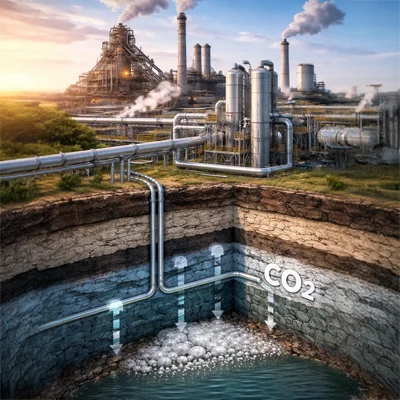
From the outside, CCUS sounds like a single system. Inside a steel plant, it’s more like a chain of systems working together.
Capture units separate CO₂ from gas streams.
Compression systems prepare it for transport.
Pipelines or shipping move it to the next location.
Storage sites lock it away underground—or send it for reuse.
Each step adds cost, energy demand, and operational risk.
This is why discussions around CCUS equipment and technology for steel mills often go beyond just capture efficiency. Integration is the real challenge.
The Cost Question No One Can Ignore
Let’s address the biggest concern directly—the economic viability of carbon capture in steelmaking.
It’s expensive. There’s no way around that.
Costs come from:
- Installing capture systems
- Running energy-intensive processes
- Building transport infrastructure
- Securing long-term storage
For large steel producers, this can run into hundreds of millions of dollars.
So why invest?
Not cutting down on emissions is becoming even more costly because in most markets. The change in the equation is due to carbon taxes, border adjustment, and ESG-based financing.
In plain words: CCUS can be expensive- but in certain instances doing nothing is more expensive.
Pros That Could Warrant the consideration
Even with the cost challenges, CCUS offers some clear advantages.
First, it delivers immediate impact. Unlike future technologies, it can reduce emissions from existing plants.
Second, it avoids disruption. Steelmakers don’t need to shut down operations or rebuild facilities from scratch.
Third, it cushions investments made in the past. Blast furnace is a high capital equipment that lasts a long time. CCUS helps extend their relevance.
And finally, it provides flexibility. Companies can reduce emissions today while keeping options open for future transitions.
The Challenges—And They’re Not Minor
That said, it’s important not to oversell CCUS.
Energy consumption is a serious issue. Capture processes require significant power, which can offset some environmental benefits if the energy isn’t clean.
Infrastructure is another bottleneck. Many regions simply don’t have pipelines or storage facilities ready.
Then there’s policy uncertainty. The companies are not ready to make huge investments without the long-term incentives that are consistent and stable.
And lastly, there is the opinion of the people. CO 2 sequestration projects are also subject to criticism such as the location in areas around communities.
These are not small hurdles—they directly impact how fast CCUS implementation in steel plants can scale.
Carbon Capture vs Hydrogen Steelmaking Comparison
The debate around carbon capture vs hydrogen steelmaking comparison often gets framed as one replacing the other. As a matter of fact, it is more subtle.
Carbon capture works with what exists. It can be deployed quicker and is less disruptive- however it does not remove carbon completely.
Alternatively, Hydrogen steelmaking has a clean end state. However it needs an entirely new ecosystem- something that will take time and a great deal of money.
So what are companies doing?
Most are not choosing—they’re hedging.
- CCUS for near-term targets
- Hydrogen for long-term transformation
It is a practical method though it may not be an easy one.
What Happens Next?
The future of carbon capture technologies in steel production will rely on the way a number of factors change:
- Cost reductions in capture systems
- Expansion of CO₂ transport networks
- Stronger policy support
- Availability of low-carbon energy
With such pieces falling into place, CCUS might shift to pilot projects to mainstream adoption.
Otherwise, it will end up being a niche solution that is utilized in certain areas.
Closing Perspective
For all the debate around technologies, one thing is clear—the steel industry doesn’t have the luxury of waiting.
Carbon capture steel solutions are not perfect. They don’t eliminate emissions completely, and they come with real costs and challenges.
But they do something important—they offer a way forward right now.
That is more important in a slow, capital intensive sector where change is vital.
It is probable that the decarbonization of steel will have many avenues operating in tandem. One of them is CCUS, not the ultimate solution, but a significant element of the transition.
 Media Pack Download
 Newsletters
 Industrial Events