Casting & Rolling 2.0: Innovations That Will Shape Tomorrow’s Infrastructure
There is no longer a bigger phrase in the scheme of things in industrial development than the phrase Casting and Rolling. The massive contribution of the world of steel casting invention and rolling mill technology has been providing the silent production to the modernization in terms of modernizing roads, bridges, rail as well as energy systems, as various nations are in a rush and race to occupy the same. But, what is happening when these thousands-of-year-old metallurgical procedures are going through a digital and smart transformation? What would happen in the event Timber Products gave Casting 4.0, AI in processing steel, and next-gen rolling mill automation these tools to help reshape the very foundation of our future infrastructure?
The Steel Spine of Tomorrow’s Infrastructure
No demand of infrastructure steel has ever been higher. Whether it is high-performance rails, renewable power facilities or earthquake-proof structures, the demands are evolving to quality, effectivity and intelligent flexibility than the previous mass demands. The major facilitators? Digital transformation in steel with a significant thrust on revolutionary changes in casting and rolling.
The change is not even technical, it is philosophical. Steel facilities across the globe have not been barely manufacturing but also learning, changing, and streamlining. But let us have a look at the innovations in the technology of steel casting and rolling mills and how they are consistent with global infrastructure aims. And what will digital steel manufacturing in the year 2025 and beyond tell?
From Furnace to Form: The Reinvention of Casting
The contemporary infrastructure relies upon the steel that cannot be compromised in terms of strength, ductility, and consistency. For infrastructure projects, smart casting - which takes into account the current situation's adaptability, predicted correction, and use of data to regulate the process - is surpassing conventional casting methods, which have served their function.
And this is where Casting 4.0 comes in - the idea of integrating all three processes in a single interdependent system automation and machine learning and real-time data analytics. Digital casting with AI in steel processing enhances the quality of steel by contributing to low impurities and grain boundary segregation in addition to standard crystallization in the steel. This is not a minor boost, but a radical increase in the durability and the lifetime of structural steel in bridges, sky vehicles, and wind turbine collection poles.
How digital casting improves steel quality lies in its ability to integrate advanced control systems and predictive analytics that oversee crystallization in real-time. Take an opportunity where AI algorithms can discover micro-cracks during solidification or in real-time they can predict the deviations in the cooling curves. It is not a vision of the future, it is already being piloted in major steel works, and breaking new ground in infrastructure steel.
The Rolling Revolution: Speed, Precision, Intelligence
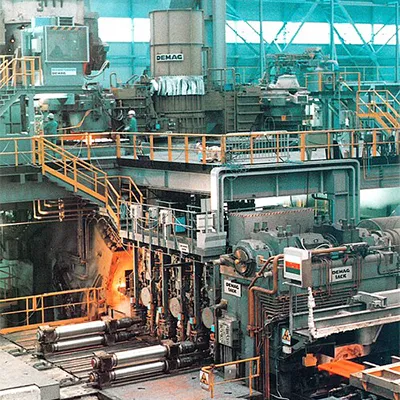
Casting constitutes the skeleton and rolling mill innovation shapes the muscles of infrastructure steel. Conventional hot and cold roll patterns are combined with next-gen rolling mill automation, perfection of thickness and composition control, flatness control and surface texture has now been achieved to a new level of control.
Current high-efficiency rolling operations incorporate a robot lifting the coil to transfer cross rolls, a dynamic speed controller and an electronically controlled oil system that expands the energy consumption and improve productivity. Yet, the core of this transformation is smart rolling 2025, which is a model based on the fact that all the stages of the rolling process are embedded with data, transparently monitored, and optimized in real-time.
It is not only optimizing the efficiency of this model; it is also deriving the parameters of rolling to the downstream construction needs. An example is rolling steel of a high-altitude railway where the pattern of tensile strengths and alloys will be engineered using the climatic data incorporated in the dissimilation of the rolling program.
Digital Steel Production: Connecting Casting and Rolling into One Intelligent System
Just think of the steel sheet that goes through an integrated pipeline cast, cooled, rolled, inspected and ready to board without a human touch and with digital signatures at each step of the way.
This would be the era of the digital steelmaking where the casting and rolling would not be independent phases but subdivisions of integration that occur on AI-driven adjustment procedures of banking and digital evolution of the steel.
What does this do to aid infrastructure? Take the example of construction of bridges. Load-bearing beams also have the ability to have the precise quality measurements programmed into the chain of casting and rolling. Whether it is the choice of raw material to be used, the decision of alloying, the mold temperature controls, or whether it is the point of rolling pressure—all the variables are automated to the end use.
Market Insights: What the Future Holds for Casting and Rolling 2.0
So, let us examine the situation in world market and in how this world market is changing with the parameters of steel casting and some new innovation of rolling mill.
| Parameter | Current (2025) | Projection (2030) |
| Implementation of Casting 4.0 technology | 35 per cent of all the steel plants all over the world | 70 per cent of all the steel plants all over the world |
| Implementation of smart rolling | 28% (Asia leads) | 65% (Global standard) |
| ROI on digital steel production | 18–25% increase in operational margin | 35–40% increase |
| Infrastructure steel demand | $720 billion | $1.2 trillion |
The rate of the steel industry's digitalization is clearly shown by these numbers. Smart money bets, quite literally, that companies that get in early on high-efficiency rolling and intelligent casting to support infrastructure work.
Why AI Matters in Steel Processing
The use of AI in steel processing is no longer up for debate. Thermal models on casting and rolling, predictive maintenance in rolling mills and even in the coordination of the supply chain - AI is the operation commander in silence.
AI can analyze the behavior of a particular batch of molten steel when cast into a particular mold at a specific set of rolling temperatures owing to superior neural networks and digital twins. These simulations save so much waste and multiply first-pass yield which comes in handy especially when handling costly infrastructure steelworks.
In addition, AI-driven smart casting systems have enabled the prediction of the mechanical properties of the steel even prior to exit mould, so that the engineers could tune the downstream procedures, again, in real-time without shutting down the plant.
Smart Rolling 2025: More Than Just Automation
So what is smart rolling really all about in 2025? It is a fully-fledged ecosystem - devices that not only run but also interact, evolve and predict. At this ecosystem:
- Digital sensors that detect pressure points are available.
- The edge computing localizes data and aligns with the cloud analysis in the globe
That is no rework, no deficiency, and steel, most importantly, that is made with purpose, designed to a specific infrastructure on which it will one day serve.
The Green Element: Sustainable Casting and Rolling
The infrastructure being constructed today has to be not only a strong one but sustainable as well. The relevant developments in the casting and rolling technologies are responding to the presence of the carbon-neutral steel production requirements. The production of steel digitally decreases the amount of energy consumed, decreases emissions, and facilitates its optimal use of recycled metal.
Regenerative breaks and chilled rollers with lower friction rollers are applied in high-efficiency rolling processes. Casting 4.0, in the meantime, also offers zero-waste working processes by means of closed-loop cooling and energy recuperation systems.
Not only is sustainable steel good to the planet, but it is becoming an entry standard in most countries. Therefore, the industries that embrace digital change in the steel processes are not only innovating; instead, they are future-proofing.
Case Study Snapshot: A Smart Steel Transformation in Action
Company: Neosteel InfraTech
Location: Germany
Challenge: Unstable use of steel to affect high-speed rails projects
Solution: Implemented integrated Casting 4.0 and smart rolling 2025 platforms
Outcome:
- Decrease in the defect rate by 42 percent
- Output increased in 27 percent
- The customization is available with 5 variations of rails
Such an example indicates that implementing AI in steel processing and using the opportunities of innovation in rolling mill can make a difference in achieving tangible results in relation to challenging infrastructure objectives.
Casting & Rolling 2.0: The Road Ahead
Transformation of casting and rolling into intelligent, adaptive and sustainable processes is not a dream anymore, but a reality. As governments spend billions to revitalize infrastructure and as the privates stake claim on smart casting for infrastructure projects, the convergence of steel casting innovations and next-gen automation of rolling mills is charting the way to a smarter planet.
However, the question that lingers is how soon the manufacturers are going to adopt digital steel manufacturing on a large scale. Will mills that are run by AI become the norm? Is machine learning to affect 100 percent of infrastructure steel needed to be customized? And how much of the future's megastructures can be realized with rolling mill technology?
The solutions are in the molten core of the progress—the amalgam of metallurgy and artificial intelligence. On that shaping-board the future is being hammered and pummelled.
We should not consider Casting & Rolling 2.0 as the updates to the manufacturing. As a matter of fact, they are the DNA of the architecture of the bridges we use to cross, the buildings we dwell in, and the infrastructure that connects the world.
The next time you stand on a steel bridge, remember—it was probably shaped not just by fire and metal, but by data, intelligence, and the unrelenting quest for innovation.
 Media Pack Download
 Newsletters
 Industrial Events