Digital Transformation in Steel: AI, IIoT & Predictive Maintenance
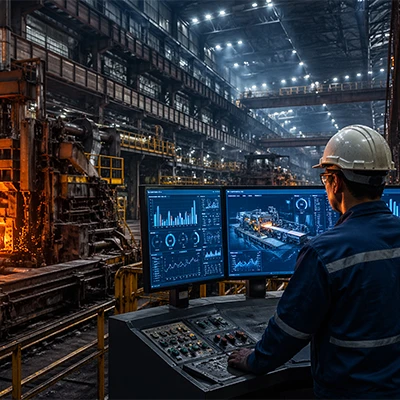
For a long time, steel plants ran on experience. Not dashboards, not predictive models—just people who knew the machines inside out. If something sounded off, they knew. If a furnace wasn’t behaving right, they could tell.
That still matters. But it’s no longer enough.
Steel production today is under pressure from every side—costs, competition, energy usage, delivery timelines. And when operations are this complex, relying only on manual oversight creates gaps. That’s where steel digitalization starts to make sense, not as a trend, but as a necessity.
Most plants aren’t “going digital” all at once. It’s happening in pieces. A sensor here, a monitoring system there. Over time, those pieces connect. And when they do, the shift becomes very visible.
What Steel Digitalization Actually Looks Like on the Ground
People have a tendency to believe that digital transformation is something large and dramatic. As a matter of fact, it is considerably more gradual.
A rolling mill installs sensors to track vibration. A blast furnace team starts monitoring temperature fluctuations more closely. Maintenance teams begin using dashboards instead of logbooks.
That’s steel digitalization in practice.
The difference is subtle at first. But over time, these small changes start affecting decisions. Instead of reacting to issues, teams begin spotting patterns. Instead of guessing, they start verifying.
And that changes how the entire plant operates.
IIoT Steel Manufacturing: Connecting What Was Never Connected
One of the first real shifts happens when IIoT steel manufacturing comes into play.
Machines that were previously working independently are now placed in a network. Motors, conveyors, pumps, compressors--all are fed into a central system.
It sounds straightforward, but in older plants, this is a big leap.
With IIoT technologies for steel production, operators don’t have to wait for periodic reports anymore. They are able to observe what is going on at the moment. In case a motor overheats or a part exhibits abnormal vibration, it cannot go to waste.
And it’s not just about catching problems.
There’s also a coordination benefit. Maintenance, operations and production teams are no longer operating in silos. All people are reading the same data, although they may interpret differently.
That alone reduces a surprising amount of friction.
The Role of AI in the Steel Industry (Beyond the Buzzword)
There’s a lot of noise around AI steel industry applications. Not all of it is useful.
But in certain areas, AI is quietly proving its value.
Steel plants generate huge volumes of data every day. Most of it used to sit unused. AI systems can analyze that data to make sense of it, not perfectly, but better than previously.
As an example, in quality control the detection of surface defects is not always consistent when done manually. AI models can assist by flagging irregularities faster. Not replacing people, but supporting them.
In production planning too, AI helps in ways that are not always obvious. It can suggest adjustments based on historical patterns—things that would take a person much longer to analyze.
Still, the most practical use case, the one that plants actually care about, is maintenance.
Predictive Maintenance Steel Strategies: A Shift in Mindset
It has never been easy to maintain steel plants.
Waiting till something goes wrong is already too late. Service too often and you waste time and resources. Finding the balance isn’t easy.
This is where predictive maintenance steel approaches are changing things.
Maintenance is condition-based instead of being fixed-timed. The equipment is continuously monitored and decisions made depending on the actual performance of the equipment.
It sounds simple. As a matter of fact, it takes time to be correct.
The sensors should be well calibrated. Data needs to be reliable. The teams must have confidence in the system. All this does not occur overnight.
But as soon as it starts working, it is possible to sense a difference.
Artificial Intelligence Predictive Steel Plant Maintenance
Now, when AI is layered onto this, the system becomes more refined.
AI predictive maintenance in steel plants does not simply consider a single parameter. It looks at combinations. Patterns. Changes over time.
As an example, a small increase in temperature may not be significant in itself. But if it happens along with a vibration shift and a drop in efficiency, that combination tells a different story.
This is where AI adds value—not by being “smart” in a generic sense, but by picking up signals that are easy to miss.
Another observation to make is that such systems get better as they are used. The more the information they are subjected to, the better they are able to differentiate between normal behavior and real problems.
It’s not perfect, though. And most plant teams are aware of that. That is why human supervision is not in vain.
Predictive Maintenance: How it Increases Steel Mill Uptime.
When you query plant managers as to the greatest benefit, uptime will most likely be mentioned.
No intricate explanations are needed to get to know how predictive maintenance can improve steel mill uptime. It’s quite practical.
When issues are detected early, they don’t turn into breakdowns. When maintenance is planned, it doesn’t interrupt production unexpectedly.
Over time, this leads to fewer disruptions.
There’s also a secondary effect. Teams become less reactive. They no longer need to be busy with emergencies all the time, but can rather look into the enhancement of processes.
The bulk of the value is in that change--reactive to planned.
Digital Twin Steel Manufacturing: Useful or Overhyped?
Digital twins are often presented as futuristic. In reality, their usefulness depends on how they are applied.
In digital twin steel manufacturing, the idea is to create a virtual representation of physical systems. This model updates in real time, based on actual plant data.
In some cases, this is extremely useful. For example, testing process changes before implementing them. Or understanding how a system behaves under different conditions.
But not every plant needs a full-scale digital twin.
For many, even a basic simulation model can provide insights. The key is not to overcomplicate things.
Benefits of AI and IIoT in Steel Production Optimization
When AI and IIoT are used together, the improvements tend to show up gradually.
The benefits of AI and IIoT in steel production optimization are rarely dramatic in isolation. But combined, they add up.
- Slightly better process control
- Slightly lower energy consumption
- Slightly fewer defects
Individually, these may not seem significant. But across an entire plant, they make a real difference.
And that’s usually how optimization works in steel manufacturing—incremental gains, not sudden breakthroughs.
Constructing a Digital Steel Mill Roadmap to Operational Efficiency.
Among the critical errors that most companies commit is attempting to do everything simultaneously.
A digital steel mill roadmap for operational efficiency doesn’t need to be complicated. In fact, simpler is often better.
Most successful implementations start small. A pilot project. A specific problem area. Something measurable.
Once that works, it builds confidence.
Scaling comes later.
Another important factor is people. The adoption of technology is seldom the largest problem, making teams to use it efficiently is.
Involvement and training are beneficial. Teams tend to believe the process, when they are included in it.
Challenges: Still Very Real
It is not a hard thing to concentrate on the good things, but there are actual problems.
The older equipment is not necessarily compatible with the new systems. Data can be messy. Cybersecurity becomes a concern once everything is connected.
And the human side.
Not all people are at ease with making a transition between experience-driven and data-driven decisions. That transition takes time.
Plants that acknowledge this early tend to handle it better than those that ignore it.
Where Things Are Heading
The direction is clear, even if the pace varies.
AI steel industry applications will continue to grow, but probably in practical, targeted ways rather than sweeping changes. IIoT technologies for steel production will become more common, especially as costs come down.
Some plants will move faster than others. That’s expected.
The speed at which transformation occurs is not important, but the effectiveness with which it is executed.
Final Thoughts
Digital transformation in steel isn’t about replacing people or completely changing how plants operate.
It’s more about improving visibility. Making better decisions. Reducing uncertainty.
Steel digitalization, supported by IIoT steel manufacturing and predictive maintenance steel strategies, is helping plants move in that direction.
And as much as most attention is paid to the technology, the actual result is operational an improved performance due to less downtime, better planning, and better performance.
That’s what makes it worth the effort.
 Media Pack Download
 Newsletters
 Industrial Events