Digital Twins & AI-Driven Process Control in Steel Manufacturing
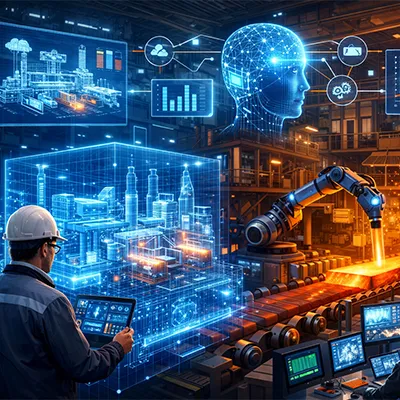
The New Digital Imperative in Steel Manufacturing
There is a structural change in the steel industry which is occasioned by rising energy prices, sustainability requirements, unstable prices of raw materials and an increased pressure towards enhancing yield and quality consistency. The traditional process control methods are still strong but can no longer be used in modern as well as complex steel plants. This has increased the pace of digitalization in the steel sector and new sophisticated technologies like artificial intelligence and digital twin technology are now the pillars of a smart steel manufacturing set up.
The intersection point of this change is the digital twin technology application in the steel plants and AI-controlled processes. A combination of these technologies allows simulating in real-time, making decisions beforehand, and optimizing autonomously throughout the steelmaking processes, starting with the processing of raw materials and ending with casting and rolling.
Understanding Digital Twin Technology in Steel Plants
A digital twin is a dynamic computerized simulation of an actual physical object, process or complete production system. In the steel manufacturing, a digital twin is in constant connection with plant data available through sensors, distributed control systems, historians, and manufacturing execution systems. Digital twins continuously change as real time passes unlike their counterparts, which are the static process models, and represent real operating conditions.
Digital twin technology applied in steel plants is applied in modeling blast furnaces, basic oxygen furnace, electric arc furnace, continuous casting machine, reheating furnace, and rolling mill. These computer models have complex thermodynamic, chemical and mechanical interactions, which cannot be easily optimized using traditional control logic.
Definition: Digital Twin in Steel Manufacturing
A steel manufacturing digital twin is a virtual physical steelmaking process that is real-time, data-driven and allows simulation, performance monitoring, predictive analysis, and optimization of a physical steelmaking process all the way through the asset lifecycle.
The Role of AI in Steel Manufacturing
The use of AI in the production of steel changes the way the process data is processed and taken, according to the actions. Artificial intelligence algorithms can see patterns in large amounts of data produced by steel plants and can find connections that cannot be seen by the conventional statistical framework. Such insights are utilized to optimize the parameters of the available processes, anticipate the failure of equipment and enhance the quality of products.
AI-based models continually learn as they are available operational data, and thus they are especially useful in highly variable environments, including changes in the quality of raw materials or shifting production times. It is an essential facilitator of smart manufacturing in the steel sector because of AI-driven process control.
AI-Driven Process Control: From Reactive to Autonomous Operations
Traditional automation systems of steel plants use setpoints and rule-based logic. Although they are effective, they are reactive in nature. Process control with AI will lead to the introduction of a proactive and adaptive strategy, where the control strategies are constantly optimized by taking into account real-time feedback and predictive results.
The AI-based process control is actively used in the field of steel production, where it is being implemented in the temperature regulation of furnace, optimization of the slag chemistry, speed of casting, and the force in the rolling. AI systems have the potential to suggest or automatically implement the best control measures, which can enhance throughput, minimize energy use and defects by constantly assessing the thousands of process variables.
Predictive Analytics in Steel Manufacturing
Predictive analytics in steel manufacturing is also a crucial practice in minimization of the unsteadfast unplanned downtime and enhancement of the assets. Using historical or real-time data, AI models forecast degradation and process variance and quality risks before they happen.
Predictive analytics are used in blast furnaces and electric arc furnaces to predict refractory wear, electrode usage and abnormal energy usage. In rolling mills it allows an early warning of bearing failures, roll faces defects and misalignment problems. The abilities enhance maintenance planning to a large extent and minimize the loss of production.
Industry 4.0 in Steel Plants: A Connected Ecosystem
Industry 4.0 in steel plant is indicated as the adoption of cyber-physical systems, industrial internet of things, cloud computing, and advanced analytics in one production system. The intelligence layer of this ecosystem is the digital twins and AI, which transforms raw data into actionable information.
The Industry 4.0-based smart steel manufacturing systems allow the uninterrupted flow of data not only between production and quality and the maintenance and supply chain departments but also across them. Such connectivity will facilitate optimization at the enterprise level but not single process optimization.
Digital Transformation in Steel Plants: Beyond Technology Adoption
Industry 4.0 in steel plant is indicated as the adoption of cyber-physical systems, industrial internet of things, cloud computing, and advanced analytics in one production system. The intelligence layer of this ecosystem is the digital twins and AI, which transforms raw data into actionable information.
The Industry 4.0-based smart steel manufacturing systems allow the uninterrupted flow of data not only between production and quality and the maintenance and supply chain departments but also across them. Such connectivity will facilitate optimization at the enterprise level but not single process optimization.
Process Optimization in Steel Plants Using Digital Twins
When combined with AI models, process optimization in steel plants is much more efficient. Digital twins enable operators and engineers to be able to simulate a scenario of what-if without interfering with the real operations. Then AI algorithms are used to assess the thousands of potential operating conditions in order to find the best settings.
As an illustration, a digital twin can be used to simulate various cooling techniques in continuous casting to reduce the surface cracks and ensure that the productivity is not compromised. In hot rolling mills, AI-enriched digital twins are used to optimize the pass schedules to produce uniform thickness and mechanical properties using minimum energy consumption.
Comparative View: Traditional Control vs AI-Driven Digital Twin Systems
| Aspect | Traditional Process Control | AI-Driven Digital Twin Systems |
| Decision logic | Rule-based and static | Adaptive and self-learning |
| Response to variability | Reactive | Predictive and proactive |
| Process visibility | Limited to KPIs | Real-time, multi-dimensional |
| Optimization scope | Localized | Plant-wide and enterprise-level |
| Scalability | Low | High across multiple plants |
Smart Manufacturing in the Steel Industry: Real Business Outcomes
The steel industry is a smart manufacturing area where the implementation of digital twins and process control using AI can bring tangible business value when utilized at large scale. There is better consistency in yield, less scrap rates, less energy used, and better product traceability among the steel producers.
Moreover, predictive analytics in the steel manufacturing industry allows condition based maintenance that makes maintenance costly and prolongs equipment life. These advantages have direct implications on profitability and competitiveness in a market that is overtaken by very thin margins.
Implementation Roadmap for Steel Producers
The way to AI-enabled digital twins is usually a gradual one. The first processes are aimed at integrating the data and improving its quality, making sensor data, process historians, and MES systems trustworthy and available. The second step is the creation of digital models of vital processes with high fidelity and training AI algorithms on past data.
By building up confidence, the process control of AI shifts to an advisory system, then to semi-autonomous, and ultimately autonomous with oversight by humans. This incremental development decreases the risk, but provides incremental value with each step.
Q&A: Key Questions Steel Executives Are Asking
How mature is digital twin technology in steel plants today?
The technology of digital twins has left the pilot projects stage and is currently being implemented into the production settings of the mainstream steel producers, especially in the furnace, casting, and rolling processes.
Does AI-driven process control replace human operators?
AI is not used to substitute the operators, but to supplement their decision-making abilities. Human knowledge is needed in strategic oversight, exceptional management, and continuous improvement.
What are the biggest challenges in AI adoption?
The most popular are data quality, complexity of integration, change management, and skills gaps. These are only a few aspects that need to be dealt with at the initial stages to attain sustainable digital transformation in steel plants.
The Strategic Importance of Digitalization in the Steel Industry
The concept of digitalization in the steel industry is turning out to be a strategic requirement as opposed to a competitive advantage.
With the growing environmental regulations and cost pressures associated with global steel markets, the most important thing is the capacity to have an efficient and predictable operation.
The processing of data with digital twins and AI-controlled process allows the steel manufacturers to achieve the goals of productivity, quality, and sustainability at the same time. Through the integration of intelligence in the fundamental business operations, steel plants would have stability in the face of market changes and production problems.
Conclusion: Shaping the Future of Smart Steel Manufacturing
Process control made possible through AI is transforming how steel is produced, and it is digital twin technology in the steel plants. These technologies give unmatched visibility into the complex processes, allow making decisions predictively and independently, and allow optimizing the enterprise on a global scale.
The digital transformation in steel plants will become increasingly quantified by the capability to transform data into useful intelligence as Industry 4.0 in this sector further develops. The steel manufacturers who invest now in intelligent steel production strategies and artificial intelligence driven digital twins will be in a better position to dominate the efficiency, sustainability, and innovation in the future.
 Media Pack Download
 Newsletters
 Industrial Events