The Role of AI in Predictive Maintenance for Steel Plants

The production of steel is very demanding and complex and pieces of equipment in plants are always exposed to strong pressure and temperature. This is because, in such facilities, any form of downtime or breakdowns is characterized by huge financial losses and time wastage. In particular, the maintenance prediction, based on Artificial Intelligence (AI), gives the proper solution to mentioned challenge. It enables the steel plants to plan for the future failure incidences and make necessary adjustments in the maintenance practices leading to improved performance and decreased costs.
What is Predictive Maintenance?
Predictive maintenance is the cutting-edge technologies of real-time tracking of applications that anticipate early signs of equipment degradation. This is unlike conventional methods that involve periodic service or repair of equipment once it fails or a regular servicer is done on it. This approach means that services and maintenance are given at the right time and not in cases where it may disrupt production hence reducing on the time that some of the machinery take without being used.
The Role of AI in Predictive Maintenance
AI is used in enhancing the aspect of the predictive maintenance through managing of large data attained from the several installed sensors on the machines. Any of these sensors gather data such as temperature, vibration, pressure, and noise level among others. Analyzing this data, the AI algorithms find the irregularities which may lead to different problems. Such a detection helps plant operators to solve problems that may occur before they can lead to huge losses in the plants.
The AI models are updated gradually, and they learn from the data that they are fed with depending on that information, they work on and thereby increasing their efficiency or rather incrementing in the accuracy that they possess. They can also make use of data from records of previous maintenance processes, statistical reports of the performance of the machine and many other factors like the environmental conditions in order to make more accurate predictions. All these factors when integrated enable the AI systems to deliver the health status of steel plant equipment on real-time basis to facilitate correct interventions.
Benefits of AI-Driven Predictive Maintenance in Steel Plants
1. Reduced Downtime: Here are some of the advantages of AI; one of them is the ability of minimizing the number of times a machine will break down unexpectedly. Maintenance planning enables an organization to foresee which of or when its equipment may develop a fault and complete such work during a planned shutdown so that it does not interrupt production.
2. Cost Savings: Mainly, higher costs are associated with facing unexpected breakdowns; this is in addition to the costs incurred in repairing the machines. AI prevents these breakdowns hence assisting steel plants in cutting on their expenses. In the same regard, predictive maintenance helps minimize frequent physical assessments and unrequired maintenance exercises, adding to the cost slashing benefits.
3. Extended Equipment Lifespan: This might help in maintaining the equipment’s with a view of making sure they are well functioning to enable them serve their functions longer as supported by data. The use of AI systems can assist in uncovering problems that are on their initial stages hence preventing major hitches that can be detrimental to the machines and their performance.
4. Improved Safety: Predictive maintenance by the help of AI reduces risks associated with wearing out or malfunctioning equipment by pointing out such equipment. Minimizing the risks is an effective way of avoiding such mishaps hence enhancing safety at plants and similar facilities.
5. Increased Efficiency: It is also possible to ensure that maintenance schedules as well as spare parts inventory is also improved through AI systems. In this method of forecasting, plants can be able to estimate when it will be necessary to replace a certain part or components in order to avoid over stocking or depletion of the needed components. This results in establishment of flows that leads to des Closet, reduced wastage of time and hence increased efficiency.
Real-World Applications of AI in Steel Plants
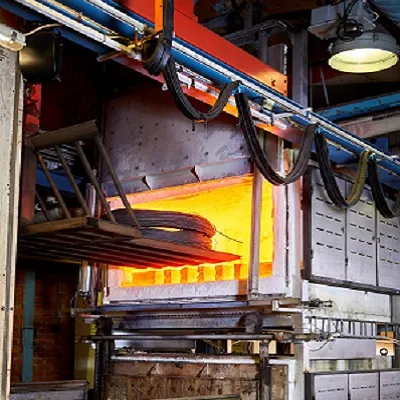
Some of the steel manufacturers have already implemented artificial intelligence predicting the maintenance system effectively. For example, the AI systems are focused on the monitoring of the conditions of blast furnaces, rolling mills, and cooling systems. These machines are essential in production of steel and failure in any of them would cause a major setback in production. They also include elements such as temperature or pressure; it can thus alert maintenance personnel before it runs a problem.
In some plants, the AI systems have gone further to ensure that they are connected to mechanical management technologies that are robotic. Such robots can perform inspections and also simple work of repairing in a more effective and precise manner which will reduce the time required to carry out maintenance.
Challenges and Future of AI in Predictive Maintenance
However, the use of AI in predictive maintenance has some implications as explained below. The first challenge that arises is the high costs involved in the initial stages such as the fixing of sensors and incorporation of the artificial intelligence into the production facilities. Moreover, steel plants require technical know-how to both maintain and upgrade these systems, which are based on Artificial Intelligence.
Nonetheless, as we move on and the AI technology becomes enhanced, the cost will come down and subsequently we will see more steel plants that are implementing predictive maintenance. Future advancements in the area of AI may involve the new complex procedures that can predict not just the time of failure of the machine but it can also predict the reason for the same and can facilitate better repair.
Conclusion
AI application in predictive maintenance of steel plant has brought about a revolutionary change. The application of the AI to assess the operation of machinery in the plant translates to early identification of incipient failures, the vertical and horizontal cost reduction, enhanced equipment longevity, and operational safety. In the future as AI technology develops further this will actually enhance the efficiency that is within predictive maintenance and therefore will keep steel plants competitive in a global world.
 Media Pack Download
 Newsletters
 Industrial Events