Recycled & Circular Steel: Scrap Converts into a Strategic Resource.
Steel has been the bread and butter behind industrial development as the backbone of the building, vehicle, machinery, and the infrastructure. However, when faced with decarbonization and shortages of resources, the classical scheme of linear steel production, i.e. mine, make, use and dispose, is no longer timely. The shift of the world towards a recycled steel economy is reshaping the view of scrap metal by the industry, turning it into one of the most important strategic assets in the future.
With recycled steel becoming popular in the industry, countries and manufacturers are finding that a sustainable growth is not only based on the new green technologies, but on smarter utilization of the available materials, as well. This move towards regeneration and not extraction is paving the way to a low-carbon, resource-efficient age in the manufacturing of steel.
1. Out of Linear into Circular: Paradigm Shift.
Conventionally product steel production has been an energy consuming process that largely depends on virgin ore of iron and coking coal. The circular economy in steel production however alters that. The industry is no longer concentrating on extraction; rather it is re-engineering its value chain with reuse, recovery, and recycling.
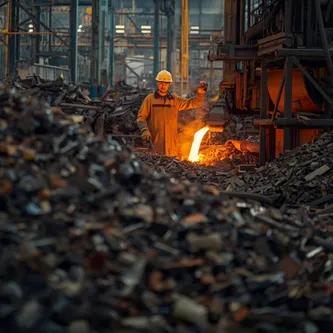
The scrap steel, be it that of demolished buildings, of vehicles at the end of life, or of outdated appliances, is used as a renewable feedstock in a circular model. This is melted in electric arc furnaces (EAFs) that consume less energy and produce less emissions as compared to the traditional blast furnaces.
The advantages of recycled steel in building and manufacturing do not just go down to realize savings in terms of cost but also allow manufacturers to lessen their reliance on raw materials and guarantee supply stability in an unpredictable international market.
2. The reason why Scrap steel is now a Strategic Resource.
The increasing interest in recycling of steel scrap is not only environmental, but it is economic and geopolitical. The new green ore is becoming scrap. With countries competing to be carbon neutral, access and quality of scrap is becoming a determining competitive edge.
| Key Comparison | Traditional (Virgin Ore-Based) | Recycled (Scrap-Based) |
| Raw Material Source | Iron Ore, Coal | Post-consumer and Industrial Scrap. |
| Energy Use | High | 60–70% Lower |
| CO2 Emissions | High | Up to 80% Lower |
| Cost Varying | Associated with Global Mining | Associated with Local Recycling Streams. |
| Circularity Score | Low | High |
The nations such as United States, Japan and Germany have incorporated scrap management networks which enable them to process millions of tons of steel in an efficient manner every year. However, developing markets like India and China are developing the domestic recycling infrastructure to achieve the environmental and economic objectives.
3. Recycled Steel Environmental and energy advantages.
To make one ton of steel using scrap, it conserves approximately 1.5 ton of CO 2, 1.4 tons of iron ore and 740 kg of coal. It transforms sustainable steel as one of the decarbonization pillars in industries.
Energy Efficiency
Electric arc furnaces that are utilized in recycling steel consume as much as 70 percent of the energy that blast furnaces consume. Moreover, renewable electricity is also being incorporated more actively in the work of EAF and is consistent with wider net-zero objectives.
Water and Waste Reduction
Circular systems also minimize wastages and water. Through recycling of mill scale, slag and dust, the whole production cycle becomes clean and efficient. Most mills are now turned into a zero-waste mill, with all by-products having a second use - cement additives are used as road aggregates.
4. Circular Steel in Construction: The Changing of the Future.
Recycled steel in construction has more benefits than sustainability reporting. Design-for-disassembly is becoming more and more popular in modern architecture it is a structural component that can be reused or recycled after the end of the building.
This practice will prolong material existence, minimise landfill waste, and decrease infrastructure embodied carbon. On the one hand, such countries as Sweden, Finland, and the Netherlands have been the first to adopt building codes that promote the use of circular materials.
In addition, recycled steel is now of very high quality and therefore meets and in most cases surpasses mechanical and safety standards demanded in building. Recycling streams are also guaranteed of the consistency of quality and traceability due to advanced sorting and spectroscopic technologies.
5. Circular Steel Supply Chains Innovation.
A real-life circular system is based on innovation. Circular steel Supply Chains are being innovated on many fronts:
- AI and IoT in Scrap Sorting: Automated systems are able to identify alloys, eliminate contaminants and ensure the optimal flow of materials to maximize the yield and purity.
- Material Traceability on Blockchain, allows following steel provenience to reuse, which is necessary to have certified sustainable sourcing.
- Digital Twins and Predictive Analytics: The virtual production systems can be digitalized, allowing manufacturers to simulate the energy and material flows and make them more circular.
- Under Recycling: The steel mills are integrating the recycling facilities into their supply chain because the scrap is being reused and not lost.
All these innovations have shown that the concept of sustainability and profitability is no longer a contradictory force, but rather a convergent force of competitive advantage.
6. The Carbon Impact: How Recycled Scrap Steel Decreases some of the emissions.
The World Steel Association believed that the global emissions by the steel sector could be reduced by 30 percent by 2050 by using more scrap-based steel. That is why the carbon emission cutting by the recycled scrap steel is the focus point of the industrial economy climate policy.
The key mechanisms include:
- Less Fossil Fuel Consumption: EAFs remove coking coal which is the most carbon intensive steelmaking input.
- Localized Supply Chains: Cuts emissions with regard to transportation.
- Material Efficiency: It has reduced waste which translates to lower emission per ton of steel.
In addition, a host of businesses are additionally combining green hydrogen and carbon rejection with scrap-based EAFs - and more narrowing the divide between decarbonization and circularity..
7. Policymaking & Regulation Motivating the Circular Shift.
Governments are also paying more attention to the circular economy in the production of steel as the way to the carbon neutrality and independence in resources.
Global Policy Highlights
- European Union: The Circular Economy Action Plan requires the use of quotas of recycled content in construction materials.
- Japan: The basic act of establishing the sound material-cycle society encourages recycling and recovery of resources.
- India: Scrap collection, segregation, and recycling centers were formalized throughout the country by The Steel Scrap Recycling Policy (2019).
- United States: The transition to EAF is encouraged by tax incentives advantageous to use recycled steel and a higher level of emissions.
All these structures are building a strong ecosystem in which recycled steel is not just superior in terms of environment but also in terms of economics.
8. Circular Steel Model Economic Value.
Circularity economics is not restricted to sustainability. By 2030, recycled steel market will cross USD 150 billion, and this will be brought about by the construction, automotive, and packaging industries.
Key Drivers:
- Reduction of raw material dependency.
- Overall, greater demand of green-certified materials.
- Monetary rewards in regard to carbon efficient production.
- Increased awareness by the people and investors.
The scrap collection, processing, and logistics are also employed by the circular steel model in emerging economies, which qualifies it as a driver of inclusive industrial growth.
9. Sustainable Steelmaking in the Future.
Sustainable steelmaking of the future can be characterized by the flexibility, digitalization, and recycling and innovation synergy. Direct reduction systems based on hydrogen and EAF with hybrids will prevail by 2040.
| Emerging Technologies | Impact |
| Hydrogen-DRI + EAF | Facilitates the process of making steel without fossils. |
| Smart Scrap Sorting | Opportunity of better material purity. |
| Carbon sequestration in EAFs | Reduces direct CO 2. |
| Lifecycle Assessment | Software Measures sustainability. |
With the increased demands of global infrastructure, recycled and circular steel will be a resounding solution to balancing economic growth and environmental friendliness.
10. Strategic Opportunities and threats.
Even though the movement is solid, the process of circular steelmaking has a number of challenges:
- Scrap Quality Variability: The alloy content may be varied thereby influencing the efficiency of the melt.
- Collection & Logistics: Scrap segmentation is not very efficient in certain areas.
- Technological Gaps: High start-up costs of digital and hydrogen-based solutions
These obstacles, however, can also be used as a basis of cooperation and innovation. The competition on the way to sustainable policies in steel manufacturing will reward the first mover - those who can make the concept of circularity a tangible benefit.
Conclusion
The shift to recycled steel and a circular steel economy is a paradigm shift in the production, consumption and conservation of resources around the world. Scrap has ceased to be a by-product, it is now a strategic input that is the cornerstone of a low-carbon sustainable future.
With the principles of circularity transforming all aspects of the steel value chain, such as advanced recycling technologies, policy frameworks, and AI-based optimization, all of them are being redefined. The future of the industry does not lie in the manufacture of additional steel but in the manufacture of smarter, cleaner, and indefinitely reusable steel.
The future of sustainable steelmaking is becoming a reality, and the current steel eaters who are adopting the world of circular innovation will mark the world of industrial in the future.
 Media Pack Download
 Newsletters
 Industrial Events