Steel Surface Finishing Processes for Superior Product Quality and Performance
Steel is one of the most versatile materials in modern manufacturing, but raw steel straight off the mill rarely meets the performance, durability, or aesthetic standards that today's industries demand. Between the rolling mill and the finished product lies a critical stage that often goes unnoticed by end users but is absolutely essential to product longevity: surface finishing. For manufacturers, fabricators, and procurement teams alike, understanding the science and practicality behind these processes can make the difference between a product that lasts decades and one that fails prematurely.
This article takes a closer look at the key industrial surface finishing methods for steel products, why they matter, and how they contribute to corrosion protection technologies in steel manufacturing.
Why Surface Finishing Matters in Steel Manufacturing
Every steel component—whether it's a structural beam, an automotive part, a pipeline section, or a piece of industrial machinery—starts its life covered in mill scale, rust, oil residues, and other surface contaminants. These imperfections aren't just cosmetic issues. Left untreated, they compromise weld quality, reduce coating adhesion, accelerate corrosion, and shorten the service life of the finished product.
Surface finishing addresses all of these concerns. It's the collective term for a range of mechanical and chemical processes used to clean, smooth, texture, or protect steel surfaces before further processing or final use. Done correctly, it improves not only the appearance of steel products but also their functional performance, weldability, paint adhesion, and resistance to environmental degradation.
For businesses that manufacture or supply steel components, investing in proper finishing isn't an optional add-on—it's a core part of quality control that directly affects customer satisfaction, warranty costs, and brand reputation.
Shot Blasting: The Foundation of Surface Preparation
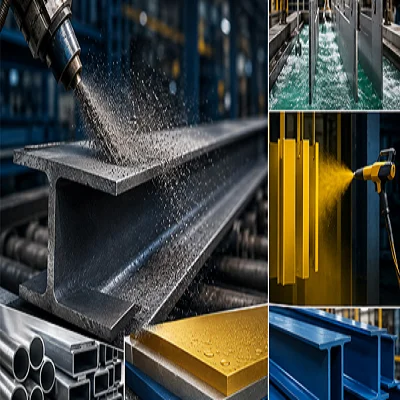
Among the most widely used abrasive surface treatment methods, shot blasting stands out for its efficiency and effectiveness. This process involves propelling small metal, ceramic, or synthetic abrasive particles at high velocity onto the steel surface using centrifugal wheels or compressed air systems.
The impact of these abrasive particles removes mill scale, rust, old paint, and other surface contaminants while simultaneously creating a uniform surface profile. This profile—often measured in terms of roughness or anchor pattern—is critical because it gives subsequent coatings something to physically grip onto, rather than simply sitting on a smooth, slippery surface.
Shot blasting is typically the first major step in surface preparation for structural steel, pipes, and heavy fabrication work. It's fast, scalable for high-volume production, and can be automated for consistent results across large batches. Manufacturers often specify particular blast profiles (measured in microns) depending on the coating system that will follow, since different anti-corrosion coatings and paints require different levels of surface roughness for optimal bonding.
Beyond cleaning, shot blasting also serves a secondary purpose: it can relieve surface stress and improve fatigue resistance in certain steel components, which is particularly valuable in applications subject to repeated mechanical loading.
Pickling: Chemical Precision for Surface Cleanliness
While shot blasting relies on mechanical abrasion, pickling takes a chemical approach to surface preparation. This process involves immersing steel in an acid bath—typically hydrochloric or sulfuric acid—to dissolve mill scale, rust, and oxide layers that form during hot rolling or storage.
Pickling is especially valuable for products where a smooth, chemically clean surface is required without the texture changes that come from mechanical abrasion. It's commonly used for steel strips, coils, wire, and sheet products that will undergo further cold rolling, galvanizing, or coating operations.
The precision of pickling makes it ideal for applications where dimensional tolerances matter. Unlike shot blasting, which can slightly alter surface geometry through impact, pickling removes contaminants at a molecular level while preserving the underlying steel's dimensional integrity. After the acid treatment, steel is typically rinsed and neutralized to halt the chemical reaction and prevent over-etching, which could otherwise weaken the surface.
Many manufacturers use pickling in combination with other methods—for instance, pickling followed by oiling to provide temporary corrosion protection during transport and storage, or pickling as a preparatory step before hot-dip galvanizing.
Steel Coating: Building the Protective Barrier
Once a steel surface has been properly prepared through shot blasting, pickling, or a combination of both, the next step is often steel coating. This is where the real long-term protection begins. Coatings serve as a barrier between the steel substrate and the surrounding environment, shielding it from moisture, oxygen, chemicals, and abrasion that would otherwise lead to corrosion and degradation.
There's a wide spectrum of coating technologies available today, each suited to different operating conditions:
- Hot-dip galvanizing immerses steel in molten zinc, forming a metallurgically bonded coating that offers excellent long-term corrosion resistance, particularly for outdoor structural applications.
- Powder coatings apply a dry, electrostatically charged powder that's cured under heat to form a durable, uniform finish—popular for both functional protection and aesthetic appeal.
- Liquid epoxy and polyurethane coatings offer flexibility in application and are often used in industries requiring specific chemical resistance, such as oil and gas or marine environments.
- Zinc-rich primers provide sacrificial protection, corroding preferentially to protect the underlying steel even if the coating is scratched or damaged.
The choice of coating depends heavily on the end-use environment, expected service life, budget constraints, and regulatory requirements. For instance, steel used in coastal or marine environments demands significantly more robust anti-corrosion coatings than steel used in dry, indoor industrial settings.
Anti-Corrosion Coatings: The Long Game Against Degradation
Corrosion remains one of the costliest challenges in industrial infrastructure worldwide, quietly eating away at billions of dollars' worth of steel assets every year. This is precisely why anti-corrosion coatings have become such a critical focus area within corrosion protection technologies in steel manufacturing.
Modern anti-corrosion systems go beyond simple barrier protection. Many now incorporate multi-layer approaches, combining a primer, an intermediate coat, and a topcoat, each serving a distinct function. The primer typically provides adhesion and corrosion inhibition, the intermediate coat adds thickness and additional barrier protection, and the topcoat offers resistance to UV exposure, weathering, and chemical attack.
Innovations in this space continue to evolve. Some coatings now include corrosion-inhibiting pigments that release protective compounds when the coating is compromised, effectively self-healing minor damage before it can propagate into significant rust formation. Others are engineered specifically for extreme environments—offshore platforms, chemical processing plants, or regions with high humidity and salt exposure—where standard coatings would fail prematurely.
For manufacturers and specifiers, selecting the right anti-corrosion system involves balancing initial cost against total lifecycle cost. A cheaper coating that requires reapplication every few years often ends up costing more over the product's service life than a premium system applied correctly from the start.
Surface Preparation: The Non-Negotiable First Step
It's worth emphasizing a point that runs through every process discussed so far: surface preparation is the foundation upon which all subsequent finishing depends. No matter how advanced or expensive a coating system is, it will fail prematurely if applied over a poorly prepared surface.
Industry standards, such as those published by organizations like SSPC (The Society for Protective Coatings) and NACE International, define specific cleanliness levels for steel surfaces before coating application. These standards exist because inadequate surface preparation is consistently identified as the leading cause of premature coating failure across industrial sectors.
Proper surface preparation isn't just about cleanliness—it's about creating the right physical and chemical conditions for adhesion. This includes removing not just visible contaminants but also invisible residues like salts, oils, and moisture that can undermine coating performance from beneath the surface, sometimes causing failures months or years after application.
Improving Steel Quality Through Advanced Finishing Processes
As industries push for longer-lasting, higher-performing steel products, the finishing processes themselves continue to advance. Automated shot blasting systems now offer more precise control over blast profiles, reducing material waste and improving consistency across production runs. Pickling operations are being optimized with better acid recovery and regeneration systems, reducing environmental impact while maintaining cleaning effectiveness.
On the coating side, research into nanotechnology-based coatings, environmentally friendly waterborne formulations, and smart coatings capable of monitoring corrosion in real time are reshaping what's possible in corrosion protection technologies in steel manufacturing.
For businesses sourcing steel products or components, these advances translate directly into practical benefits: fewer warranty claims, reduced maintenance costs, longer asset lifespans, and improved safety outcomes in structural applications. Improving steel quality through advanced finishing processes isn't just a technical achievement—it's a competitive advantage in markets where reliability and durability increasingly influence purchasing decisions.
Choosing the Right Finishing Partner
Given the technical complexity involved in surface finishing, working with an experienced finishing partner matters as much as the processes themselves. A qualified provider will understand not just how to execute shot blasting, pickling, or coating application, but how to match these processes to the specific end-use environment, regulatory requirements, and performance expectations of each project.
Questions worth asking potential suppliers include: What surface preparation standards do they follow? What quality control measures are in place to verify blast profiles or coating thickness? Do they have experience with the specific coating systems required for your application? Can they provide documentation and testing to support warranty claims down the line?
Final Thoughts
Surface finishing may happen behind the scenes, but its impact on steel product performance is anything but hidden. From the abrasive precision of shot blasting to the chemical cleanliness achieved through pickling, and from foundational steel coating to sophisticated anti-corrosion coatings, each step in the process contributes to a final product that performs reliably in demanding real-world conditions.
For manufacturers, fabricators, and procurement professionals, understanding these processes provides a stronger foundation for making informed decisions—whether that means specifying the right surface preparation standard, selecting an appropriate coating system, or evaluating a potential supplier's capabilities. As the industry continues refining these industrial surface finishing methods for steel products, the companies that prioritize proper finishing will be the ones delivering steel products built to last.
 Media Pack Download
 Newsletters
 Industrial Events