The Rise of AI-Driven Metallurgical Processes: Precision and Efficiency in 2025
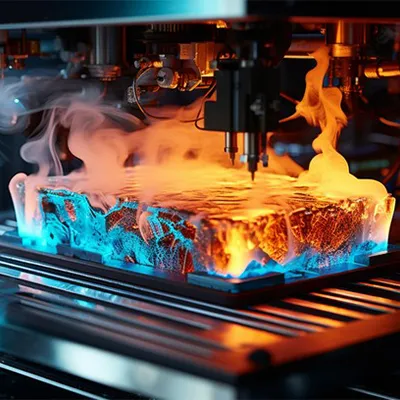
The metallurgy industry, which historically is regarded as furnace related, smelting and is hand controlled, is in a seismic shift. This disruption has its core at the field of AI in Metallurgy, which is rising very fast combining materials science and advanced artificial intelligence solutions. With 2025 setting in, AI-based Metallurgical Processes are reinventing precision, scalability and efficiency in ways that have never been witnessed before. But how have we come to this? More to the point, what does the future hold?
The New Era: AI Meets Metallurgy
In order to get the scale of this transformation one will need to first appreciate what exactly AI in Metallurgy is all about. It is not something that futurists merely sprinkle around as a buzzword; what would adapt to the peculiarities of metal processing and refinement are the incorporation of Machine Learning in Metallurgy, neural networks, predictive analytics, assorted analytic tools of process optimization.
Traditionally, metallurgical processes highly depended on human competencies, empirical data and manual controls. Structural process modifications (as opposed to proactive process modification) were reactive. It is the year 2025, and the scene is similar, only in this case, Metallurgical Process Automation is replacing activities such as real-time monitoring of the temperature and predictive smelters and furnace maintenance, etc. Things change not just technologically, but philosophically. Precision Metallurgy with AI is one of the elements being adopted in the industry where AI is not acting as a substitute of human judgment but rather supplementing it using data-driven intelligence and prediction.
What is driving the Shift Toward AI-Driven Metallurgical Processes?
There are a number of reasons that have spurred this change. The rising industries such as renewables, aerospace, and electric cars triggered the global increase in the requirement of high-performance alloys and rare metals. These are industries that require very specific metals. To meet such stringent specifications, there is a need to be repeatable, accurate, and consistent, and these properties are characteristic of AI-driven metallurgical processes.
How Does AI Improve Metallurgical Processes?
It can be found in the inherent capabilities of AI. The AI model processes huge masses of data to spot trends that cannot be seen by a human being. Such insights have the capability to identify anomalies on a real-time basis, minimize defects, maximize energy consumption and even propose real-time micro-adjustments on the furnace operations.
Under Machine Learning in Metallurgy, the system optimizes itself by learning the previous results and becoming better as each time the predictions are made and the metallurgical cycle is improved.
Market Trends and Adoption Rates in 2025
As a comparison to see the development of the industry, one may highlight the aspects of traditional metallurgy and the guaranteed advancement with the help of artificial intelligence:
| Aspect | Traditional Metallurgy | AI-Driven Metallurgical Processes |
| Process Adjustments | Manual, delayed | Real-time, predictive |
| Quality Control | Post-production inspection | AI-Enabled Quality Control in Metallurgy, real-time |
| Energy Consumption | High, inflexible | Optimized with AI algorithms |
| Labor Intensity | High | Reduced via Metallurgical Process Automation |
| Data Utilization | Minimal | Extensive use of big data and ML |
Assessment of the industry - A 2025 report issued by industry analysts projects that more than 60 per cent of global metal production sites will adopt some type of AI in Metal Manufacturing. High on the list are smart steel plants and smelting of aluminum. Places such as Europe, East Asia and North America are making large investments in the technology in order to achieve their sustainability objectives as well as remain competitive.
AI-Enabled Quality Control in Metallurgy: A Game Changer
It has been observed that one of the most revolutionary effects has been the AI-Enabled Quality Control in Metallurgy. Conventionally, quality control was carried out through batch gleanings, surface examination and mechanical tests which were cumbersome and prone to human failings. The AI systems are now applying computer vision, hyperspectral imaging, and acoustic sensors to the stage of metal analysis during the production.
Using these tools, it is possible to identify the microscopic weaknesses or compositional aberrations even before the final product was made. They can give real time alerts and provide advisory corrective actions and thus bring down the scrap, improve product integrity and reduce cost. It also goes beyond efficient, it is transformative.
Besides, Precision Metallurgy AI permits customization to scale. It could be different volumes of carbon in steel or alterations of alloy percentages on aerospace grade titanium, but AI will guarantee the desired tolerance is met in an outcome, which was practically unattainable previously on this level of granularity.
The Benefits of AI in Metallurgy: Beyond Efficiency
Indeed, when thinking of the Benefits of AI in Metallurgy, one is tempted to go with figures such as cost reduction or efficiency. AI does more than automate, it makes better. It allows the operations to be responsive to changes such as the quality of ore, market needs, and sustainability objectives.
One of its driving forces is sustainability, in particular, in 2025. As emissions regulations get more stringent and society becomes more concerned with green manufacturing, AI in the Metal Manufacturing industry is enabling businesses to manage their carbon footprint and minimize it. The usage of raw material can be optimized by AI algorithms, alternative alloys can be recommended and even the environmental effects can be modelled in real time.
It is also making the work place safer. Automatic systems with the help of Metallurgical Process Automation can perform hazardous jobs like removal of slag, inspection of furnace, pouring of molten metal - minimizing the danger of any accidents.
Future of AI in Metallurgy 2025 and Beyond
The Future of AI in Metallurgy 2025 seems to be more autonomous, interconnected, and intelligent and aware of what is going on. Due to the implementation of Industry 4.0 and digital twin technology, metallurgical plants will start working as smart ecosystems. All this will be predicted by these interdependent systems down to the logistics of ore sourcing and the demand of the end-product making sure that stock flows are fast and efficient.
Prepare to see the emergence of decentralized models of AI - systems, which do not collectively interact, but run independently at different stages of the supply chain, exchange knowledge through cloud-based platforms. Blockchain might as well come into play providing high value metals with traceability and authenticity services.
Educational establishments and research laboratories are also immersing themselves in the deeper waters of AI in Metallurgy, developing open data access and human cooperation structure. This is something that is meant to democratize the use of AI tools so that small and mid-sized foundries have their fair share of the cake as large global players.
Brought together with quantum computing in the next years, the application of AI in Metal Manufacturing can also help to even further improve simulation possibilities and reduce the time needed between designing and deploying metal materials to a drastic proportion. Many years of work at laboratory level metallurgy could be achieved in days, even hours.
Obstacles and the Path Ahead
Even while AI-based metallurgical processes have a lot of potential, using them is not always simple. The availability of data and quality is also an issue most notably in older plants where digital infrastructure is not as established. The other problem is the need to train the labor force in dealing with and using the system of AI. Also, it is ROI - AI systems need preliminary investment into sensors, infrastructure, and cloud architecture.
Notwithstanding, the industry is unstopped. It is undeniable that it has gathered momentum with attractive application and rising success stories. The skepticism is opening up to excitement as the organizations get a taste of the answer to How Does AI Improve Metallurgical Processes.
Conclusion: The Iron-Clad Future
AI in Metallurgy is more than the tales of robots and information; it is the story of how to reimagine what can be possible. Ranging between the reductions of process wastefulness to the opening of possible new materials, the AI-enabled Metallurgical Processes are offering the following level of industrial perfection.
Metallurgical Process Automation, Machine Learning in Metallurgy, AI-Enabled Quality Control in Metallurgy are coming of age and as they do it is not only that the industry is becoming more efficient in metallurgical processes; it is becoming more efficient at metallurgy.
This revolution is an indication of an exciting new world - a world where Precision Metallurgy and AI is essentially a need rather than a want.
With the benefits of AI in Metallurgy coming increasingly clear to stakeholders spread across the world, a question no longer arises of whether or not AI will shape the industry but when it will come to it.
 Media Pack Download
 Newsletters
 Industrial Events