Types of Rolling Mills Explained: Two-High, Four-High, Cluster, Tandem, and Universal Mills
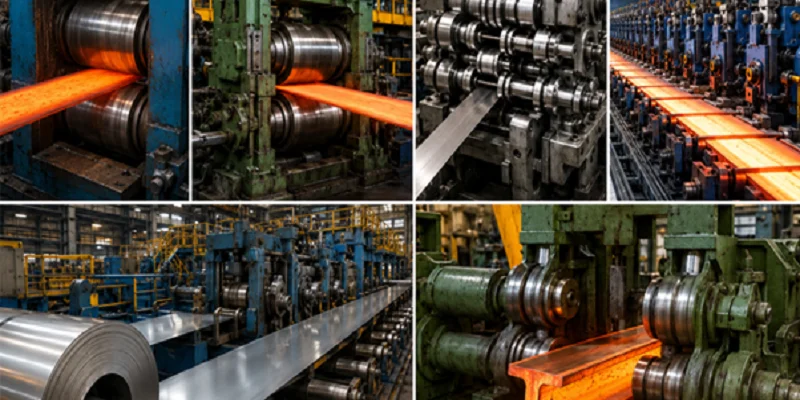
If you've ever wondered how a red-hot slab of steel turns into a thin, uniform sheet or a precisely shaped beam, the answer lies in rolling mills. These machines are the backbone of the metal forming industry, and choosing the right configuration can make or break a production line's efficiency, cost, and product quality.
In this article, we'll break down the major types of rolling mills — Two-High, Four-High, Cluster, Tandem, and Universal — explain how each works, and help you figure out which rolling mill is best for steel production based on your specific manufacturing needs.
What Is a Rolling Mill?
A rolling mill is a piece of rolling mill equipment designed to reduce the thickness of metal (or change its cross-sectional shape) by passing it between one or more pairs of rolls. The process, known as rolling, applies compressive force to the metal, elongating it while reducing its thickness or reshaping its profile.
Rolling mills are used across industries — from steel and aluminum production to copper and brass processing — and the specific mill design chosen depends on factors like the material being rolled, the desired thickness reduction, production volume, and final product specifications.
Understanding the different steel mill configurations available is essential for engineers, plant managers, and procurement teams trying to optimize throughput without sacrificing quality.
Two-High Rolling Mill
The Two-High mill is the simplest and oldest rolling mill design. It consists of just two horizontal rolls, positioned one above the other, rotating in opposite directions to draw the metal through the gap between them.
How it works: The workpiece is fed into the gap (called the "roll bite" or "nip"), and as it passes through, the rolls compress it, reducing thickness and increasing length.
Two variations exist:
- Non-reversing Two-High mill — the rolls always rotate in the same direction, so the metal only passes through once per pass, requiring the workpiece to be returned to the starting side for another pass.
- Reversing Two-High mill — the rotation direction can be reversed, allowing the metal to pass back and forth through the rolls multiple times without repositioning.
Best suited for:
- Small-scale operations
- Initial breakdown rolling of ingots and blooms
- Applications where simplicity and low capital cost matter more than speed
Limitations: Because of its basic design, the Two-High mill has limited capacity for handling large reductions in a single pass, making it less efficient for high-volume, high-precision modern steel production.
Four-High Rolling Mill
The Four-high mill is one of the most widely used configurations in modern flat rolling operations. It uses four rolls stacked vertically: two smaller work rolls at the center that directly contact the metal, and two larger backup rolls above and below them that provide structural support.
Why the design matters: Smaller work rolls reduce the force needed to deform the metal and allow for tighter thickness control, but they're also more prone to bending under pressure. The larger backup rolls counteract this bending, keeping the work rolls rigid and ensuring uniform thickness across the width of the sheet.
Best suited for:
- Cold and hot rolling of steel sheets and strips
- High-precision flat products where thickness tolerance is critical
- Medium to high production volumes
Advantages:
- Excellent thickness control
- Reduced roll deflection
- Suitable for a wide range of gauge thicknesses
This configuration is a favorite in steel and aluminum sheet mills because it strikes a strong balance between precision and productivity — a key reason it frequently comes up in discussions comparing rolling mill equipment options.
Cluster Mill
A Cluster mill takes the Four-High concept further by using multiple backup rolls to support very small-diameter work rolls. The most common version, the Sendzimir mill (or Z-mill), can have up to 20 rolls arranged in a cluster formation.
How it works: Tiny work rolls allow for extremely high pressure to be applied over a very small contact area, enabling the rolling of exceptionally thin and hard materials that would be difficult or impossible to process with larger rolls. The surrounding backup rolls provide the necessary rigidity.
Best suited for:
- Rolling thin foils and strips
- Hard-to-deform metals like stainless steel, titanium, and specialty alloys
- Precision cold rolling applications
Advantages:
- Capable of achieving very thin gauges
- Handles high-strength materials effectively
- Excellent surface finish quality
Trade-off: Cluster mills are more complex and expensive to operate and maintain compared to simpler configurations, so they're typically reserved for specialty and high-value production runs rather than general-purpose steel manufacturing.
Tandem Mill
A Tandem mill isn't a single mill but a series of rolling mill stands arranged in a continuous line, with the metal passing through each stand sequentially. Each stand progressively reduces the thickness of the material until the final desired gauge is achieved.
How it works: Instead of rolling the metal back and forth through one set of rolls (as in a reversing mill), a Tandem mill setup pushes the material forward through multiple stands in one continuous pass, with each stand performing a specific reduction. This dramatically increases production speed.
Best suited for:
- High-volume, continuous production of steel and aluminum strip
- Applications where speed and consistency are top priorities
- Large-scale industrial operations
Advantages:
- Significantly higher throughput compared to single-stand mills
- Consistent product quality across long production runs
- Reduced handling time between passes
Because of its speed and efficiency, the Tandem mill is often the configuration of choice for large steel producers manufacturing coiled sheet products at scale. It's a strong answer to the common question of which rolling mill is best for steel production when volume and consistency are the primary goals.
Universal Mill
The Universal mill is a specialized configuration designed for rolling structural shapes rather than flat sheets. It uses both horizontal and vertical rolls simultaneously — horizontal rolls control the height of the section while vertical (edger) rolls control the width and shape the edges.
How it works: This dual-roll arrangement allows the mill to shape complex profiles like I-beams, H-beams, and other structural sections in fewer passes than would be needed with horizontal rolls alone.
Best suited for:
- Structural steel production (beams, columns, rails)
- Applications requiring precise cross-sectional geometry
- Construction and infrastructure-grade steel products
Advantages:
- Produces accurate, symmetrical structural shapes
- Reduces the number of passes needed for complex profiles
- Improves dimensional consistency in structural products
If your production focus is structural steel rather than flat sheet or strip, the Universal mill is typically the go-to configuration.
Comparison of Rolling Mill Configurations
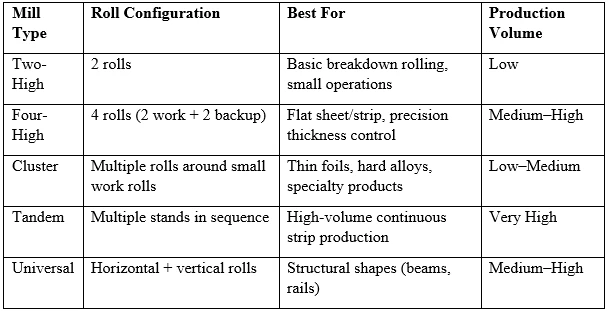
This comparison of rolling mill configurations highlights that there's no single "best" mill for every situation — the right choice depends entirely on the product being manufactured, the material properties, and the production scale required.
How to Select the Right Rolling Mill for Manufacturing
Choosing the right equipment isn't just about picking the most advanced option — it's about matching the mill to your actual production needs. Here's a practical framework for how to select the right rolling mill for manufacturing:
- Identify your final product. Flat sheet and strip production favor Four-High or Tandem mills, while structural shapes require a Universal mill.
- Consider material hardness and thickness targets. Thin, hard, or specialty alloys typically need a Cluster mill for precision.
- Evaluate production volume. High-volume continuous operations benefit most from Tandem mills, while smaller batch operations may only need a Two-High or Four-High setup.
- Factor in budget and maintenance capacity. Cluster and Tandem mills offer superior performance but come with higher capital and maintenance costs compared to simpler Two-High configurations.
- Account for quality requirements. If tight thickness tolerances and surface finish are critical, Four-High or Cluster mills generally outperform basic Two-High setups.
Frequently Asked Questions
What is the main difference between a Two-High and Four-High rolling mill?
A Two-High mill uses only two rolls that directly contact the metal, while a Four-High mill adds two backup rolls to support smaller work rolls, improving thickness control and reducing roll deflection.
Which rolling mill is best for steel production?
For high-volume flat steel production, a Tandem mill is generally the most efficient due to its continuous multi-stand design. For structural steel, a Universal mill is the better fit.
What makes a Cluster mill different from other rolling mills?
A Cluster mill uses very small work rolls surrounded by multiple backup rolls, allowing it to apply high pressure over a small area — ideal for rolling thin foils and hard, high-strength alloys.
Can one plant use multiple types of rolling mills?
Yes. Many large steel plants use a combination of mill types across different production stages — for example, a Two-High mill for initial breakdown, followed by a Tandem mill for finishing.
Final Thoughts
Rolling mills come in a variety of configurations, each engineered to solve specific manufacturing challenges. Two-High mills offer simplicity, Four-High mills deliver precision, Cluster mills handle specialty thin-gauge work, Tandem mills maximize throughput, and Universal mills shape structural steel with accuracy.
Understanding these steel mill configurations — and how they align with your product goals, volume requirements, and budget — is the foundation of building an efficient, cost-effective rolling operation. Whether you're setting up a new production line or upgrading existing rolling mill equipment, matching the mill type to your manufacturing needs will always be the deciding factor in long-term success.
 Media Pack Download
 Newsletters
 Industrial Events