PERFORATED SHEETS
Formats
The standard format of a sheet is 1000x2000 mm. In this format we have a wide selection of punctures ready in stock. However, we can perform perforated sheets and strips in any format, from minimum widths up to a maximum width of 2000 mm.
Thicknesses
> We can drill from a minimum thickness of 0.2 mm up to a maximum thickness of 15 mm. As for the availability of sheet metal ready in stock, the thicknesses range from 0.5mm to 10mm.
Holes
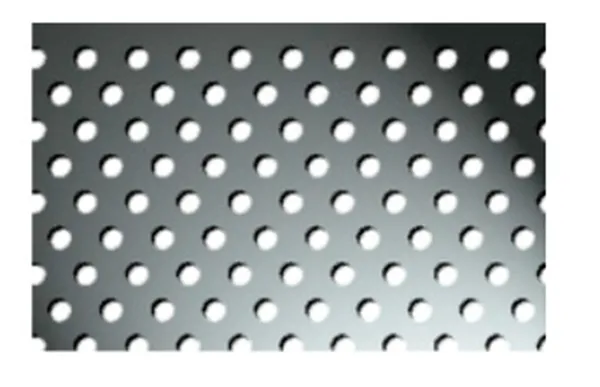
The holes can be ROUND, SQUARE, RHOMBUS, RECTANGULAR, OBLONG, FANTASY DRAWINGS, and any technically possible drilling according to the customer's design. We also have many diameters of DRAWN round holes. As a result of the punching the hole is always slightly conical, but the taper is all the more accentuated the thicker the sheet is. The precise diameter of the hole must be measured from the entry side of the punch, not from the exit side.
Hole-thickness ratio
Drilling becomes easier and cheaper if the diameter of the hole increases with respect to the thickness of the sheet. For example, on a sheet with a thickness of 1mm, drilling with a diameter of 8mm is simpler and cheaper than the same sheet with holes with a diameter of 1mm. Over the last few years, GATTI PRECORVI SPA has specialized in very small holes (up to a diameter of 0.5mm on a thickness of 0.5mm).
Empty-to-full ratio in the perforated area
In a perforated sheet, the vacuum to full ratio (VSP) is constant. Through this website we provide you with a useful program for calculating the drilling percentage. But be careful, when calculating the VSP it must be kept in mind that this data refers only to the perforated area of the sheet and does not take into account the edges or non-perforated bands.
Edges and non-perforated areas
The advantage of PERFORATED SHEET compared to metal mesh and expanded metal is the fact that it can have perimeter edges or bands inside the NOT PERFORATED sheet. STANDARD perforated sheets (1000x2000 mm) are mainly produced with two small non-perforated edges on the two largest sides of the sheet, when the thickness is less than 3 mm, while sheets with a thickness greater than 3 mm have an unperforated perimeter frame.
Beginning and end of a perforated area
For reasons connected with the construction of the molds, the center distances between the punches inserted therein are multiples of those between the holes that will actually be obtained. Therefore the right drilling step is formed, very often, after the second or third line of holes. Therefore, there may be, in many cases, a drainage of holes that will appear alternating at the beginning and at the end of the perforated area (false strike, or double strike, or INCOMPLETE DRILLING). Of course we have many molds that can perform the drilling in a COMPLETE way (without false or double blows).
After perforation, each perforated sheet exhibits deformations and tensions, more or less accentuated according to the material used (CARBON STEEL, STAINLESS STEEL, ALUMINUM, etc.) All perforated sheets are leveled after perforation and this operation is now part of of the supply standard. Only when there are very severe face milling requirements do customers need to mention this when ordering.
We then carry out many additional operations to drilling such as:
- precision squaring
- oblique shearing or according to shapes
- specials
- molding
- calendering
- bending
- drawing
- welding
- assembly
- satin finishing and polishing
- painting
- galvanizing
- anodic oxidation or anodization