Chromium Mining and Ore Beneficiation: Processing Methods, Technologies and Applications in Stainless Steel Production
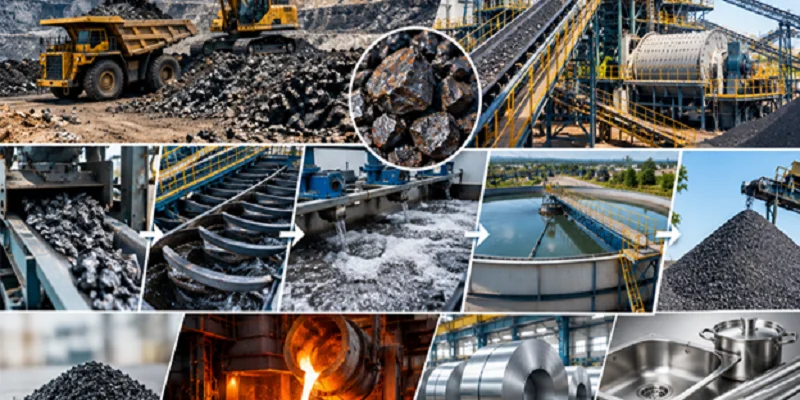
Chromium doesn't get much credit outside of industrial circles, but without it, your kitchen sink, surgical tools, and the body panels on half the vehicles around you wouldn't exist in their current form. Chromium ore - mined as chromite - is the raw material behind nearly all the world's stainless steel, and the way it's mined and processed has a direct effect on the cost, quality, and sustainability of everything downstream.
This article breaks down how chromium ore mining actually works, the technologies used in chromium ore processing, and why chromite ore beneficiation has become such a critical step in modern metallurgy.
What Is Chromium Ore, exactly?
Chromium doesn't occur as a pure metal in nature. It's extracted from chromite (FeCr₂O₄), an iron-chromium oxide mineral found in layered igneous rock formations. Major deposits are concentrated in a handful of countries - South Africa's Bushveld Complex, Kazakhstan, India, Turkey, and Zimbabwe collectively account for the vast majority of global chromite reserves.
Not all chromite is created equal. Ore grade is typically classified by its Cr:Fe ratio and chromium oxide (Cr₂O₃) content, which determines whether it's suited for metallurgical, chemical, or refractory applications. Metallurgical-grade ore, the kind used in steelmaking, generally needs a Cr₂O₃ content above 40-46% after processing.
How Chromium Mining Works
Chromium mining follows two broad extraction routes, and the choice between them comes down to deposit depth, ore body shape, and economics.
Open-pit mining is the dominant method globally, especially in South Africa and Kazakhstan, where chromite seams lie close to the surface in wide, tabular layers. It's cheaper per ton and allows for large-scale mechanized extraction using excavators and haul trucks.
Underground mining becomes necessary when chromite seams dip deep below the surface or when surface mining would be environmentally or economically impractical. This method is more common in parts of India and Zimbabwe, where narrow, high-grade seams justify the added cost of shaft or decline mining.
Both methods start the same way: drilling, blasting (where needed), loading, and hauling raw ore to a processing facility. What happens next - the beneficiation stage - is where the real technical complexity begins.
Chromium Ore Processing: From Raw Rock to Usable Concentrate
Raw chromite as it comes out of the ground is almost never pure enough or sized correctly for direct use. Chromium ore processing exists to solve two problems: separating chromite from waste gangue minerals, and getting the particle size right for downstream smelting.
The typical processing sequence looks like this:
- Crushing and screening — reduces run-of-mine ore to a manageable size
- Grinding/milling — further liberates chromite grains from surrounding rock
- Beneficiation (separation) — concentrates the chromite and removes waste
- Dewatering and drying — prepares the concentrate for transport or smelting
- Agglomeration (pelletizing/sintering) — needed for very fine concentrates before they go into a furnace
The beneficiation step is where most of the innovation and cost sits, which brings us to the technologies actually used to separate chromite from everything else.
Chromium Ore Beneficiation Technologies
Because chromite has a notably higher specific gravity (around 4.1-4.9) than most of the silicate gangue minerals surrounding it, chromium ore beneficiation relies heavily on gravity-based separation, supplemented by magnetic and flotation methods for finer particles.
Gravity Separation
This is the workhorse of chromite ore processing. Common equipment includes:
- Spiral concentrators — use centrifugal force and water flow to separate dense chromite from lighter waste as material moves down a helical channel
- Shaking tables — vibrate ore across a sloped surface, stratifying particles by density
- Jigging — uses pulsating water currents to separate particles based on density differences
- Heavy media separation (HMS) — uses a dense fluid medium (often ferrosilicon suspension) so chromite sinks while lighter gangue floats
Magnetic Separation
Chromite has weak magnetic properties, so low- and high-intensity magnetic separators are often used either as a standalone step or in combination with gravity methods, particularly to remove iron-rich impurities.
Froth Flotation
For very fine chromite particles (below 75 microns) that gravity methods struggle to recover efficiently, froth flotation using specific collectors and depressants can significantly improve recovery rates - especially important as easily accessible coarse-grained deposits become scarcer.
Tailings Reprocessing
A growing area of chromium mining technology involves reprocessing historical tailings dumps using modern spiral and flotation circuits. Older processing plants often left significant chromite value behind simply because the technology of the time couldn't recover fine particles efficiently - today's finer separation techniques are turning old waste piles into viable secondary resources.
Emerging Technology Trends
The direction of chromium ore mining and processing methods is shifting toward:
- Fine particle recovery — as high-grade coarse ore depletes; plants are investing more in flotation and enhanced gravity separators (like Falcon or Knelson concentrators) to capture value from fines
- Automation and sensor-based sorting — ore sorting technology using X-ray transmission (XRT) or near-infrared sensors is allowing plants to reject waste rock before it even enters the grinding circuit, cutting energy costs significantly
- Water and tailings management — dry processing and improved water recycling systems are becoming standard as environmental regulations tighten around mine sites
- Process optimization through modeling — plants increasingly use simulation software to fine-tune circuit design before committing to capital expenditure
The Role of Chromium Ore in Stainless Steel Production
Here's the part that ties it all together. Roughly 80-90% of the world's mined chromite ends up as an input for ferrochrome - an iron-chromium alloy produced by smelting chromite concentrate with a reducing agent (usually coke) in an electric arc furnace.
Ferrochrome is then added directly into steelmaking furnaces, where chromium's defining property comes into play: it forms a thin, self-healing chromium oxide layer on the surface of steel, which is what gives stainless steel its corrosion resistance. Without a minimum chromium content (typically around 10.5%), steel is just steel - it rusts like any other alloy.
This makes the role of chromium ore in stainless steel production essentially non-negotiable. There's no viable large-scale substitute that delivers the same corrosion resistance at comparable cost, which is part of why chromium supply chains are treated as strategically important by manufacturing economies worldwide.
Beyond stainless steel, chromium (via ferrochrome or chromium chemicals) also finds its way into:
- Tool and specialty steels
- Superalloys for aerospace applications
- Chrome plating and pigments
- Refractory bricks for high-temperature industrial furnaces
- Leather tanning chemicals (a smaller, non-metallurgical use)
Why This Matters for the Industry Right Now
Global stainless-steel demand keeps climbing, driven by construction, infrastructure, automotive lightweighting, and renewable energy equipment (solar frames, wind turbine components, and hydrogen infrastructure all lean heavily on stainless and duplex steels). That demand puts continuous pressure on chromite supply chains - and pressure on mining and processing operations to extract more value from lower-grade ore, recover more fines, and do it with a smaller environmental footprint.
That's really the throughline across modern chromium ore mining and processing methods: it's no longer just about digging up high-grade rock. It's about squeezing maximum recoverable chromite out of increasingly marginal deposits using smarter separation technology.
Frequently Asked Questions
What is chromium ore used for?
Chromium ore (chromite) is primarily smelted into ferrochrome, which is added to molten steel to produce stainless steel. It's also used in chemical production, refractory materials, and leather tanning.
What is the difference between chromite and chromium?
Chromite is the naturally occurring mineral ore (FeCr₂O₄) mined from the ground. Chromium is the metallic element extracted and refined from that ore, usually via ferrochrome production.
What is chromite ore beneficiation?
Chromite ore beneficiation is the process of concentrating raw chromite ore by removing waste rock (gangue) through methods like gravity separation, magnetic separation, and froth flotation, increasing the Cr₂O₃ content to a usable grade.
Why is gravity separation the main method used in chromium ore processing?
Chromite has a significantly higher specific gravity than the silicate minerals it's typically found with, making density-based gravity separation methods (spirals, jigs, shaking tables) highly effective and cost-efficient compared to other separation techniques.
How much chromium is needed to make stainless steel?
Steel generally needs a minimum of about 10.5% chromium content to be classified as stainless steel, as this is the threshold at which a stable, corrosion-resistant chromium oxide layer forms on the surface.
Which countries produce the most chromium ore?
South Africa, Kazakhstan, India, and Turkey are among the largest chromite-producing countries, with South Africa's Bushveld Complex holding the largest known reserves globally.
 Media Pack Download
 Newsletters
 Industrial Events