From Iron Ore Deposit to Steel Mill: Extraction, Beneficiation and Concentrate Production
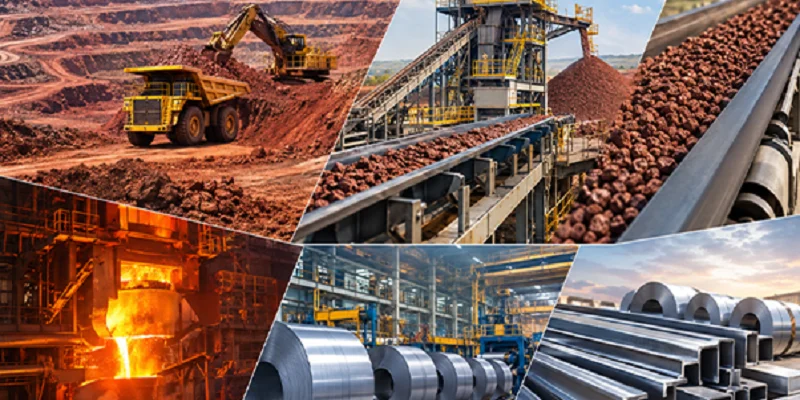
Steel touches almost everything we build, drive, or live inside - and it all starts with a rock pulled out of the ground. Iron ore mining and iron ore processing form the backbone of the global steel industry, feeding the blast furnaces and electric arc furnaces that turn raw ore into the beams, rails, cars, and appliances that shape modern life. Yet most people never think about what happens between a mountain of red-brown rock and a finished steel coil. This article breaks down exactly how that transformation happens - from extraction to beneficiation to the final concentrate that mills demand.
What Is Iron Ore and Why It Matters
Iron ore is a naturally occurring mineral deposit from which metallic iron can be economically extracted. The most commercially important forms are hematite (Fe₂O₃) and magnetite (Fe₃O₄), found in massive deposits across Australia, Brazil, China, India, and South Africa. Global iron ore production exceeds 2.5 billion tonnes annually, and nearly all of it is destined for one purpose: steelmaking.
Steel demand isn't slowing down. Infrastructure growth in Asia, renewable energy buildout (wind turbines and transmission towers are steel-hungry), and continued urbanization worldwide mean iron ore remains one of the most heavily traded commodities on earth. Understanding how it's mined and refined isn't just academic - it explains why steel prices move the way they do and why ore quality is such a competitive battleground among mining companies.
Iron Ore Mining Methods
There are two primary approaches to getting iron ore out of the earth, and the choice depends almost entirely on how deep and how concentrated the deposit is.
Open-Pit Mining
The overwhelming majority of iron ore - roughly 90% globally - comes from open-pit mining. This method is used when ore bodies sit close to the surface in large, wide deposits. Massive benches are cut into the earth in a stepped, terraced pattern, and ore is removed using a combination of drilling, blasting, and excavation.
The typical open-pit workflow looks like this:
- Drilling and blasting - Holes are drilled into the rock face and packed with explosives to fracture the ore body into manageable chunks.
- Loading - Massive hydraulic shovels and front-end loaders scoop broken ore into haul trucks that can carry 300+ tonnes per load.
- Hauling - Ultra-class haul trucks move ore from the pit to a primary crusher or stockpile area.
- Waste rock management - Overburden and low-grade waste rock are separated and moved to designated dumps, an increasingly regulated and environmentally sensitive part of the operation.
Open-pit mines like those in Australia's Pilbara region or Brazil's Carajas complex can run for decades and produce hundreds of millions of tonnes of ore each year.
Underground Mining
Where high-grade ore lies deep beneath the surface, underground mining becomes economically viable despite its higher cost. Techniques such as sublevel caving and room-and-pillar mining are used to access ore bodies without stripping away enormous volumes of overlying rock. This method is far less common for iron ore than for other metals, but it remains critical in regions like Sweden's Kiruna mine, one of the largest underground iron ore operations in the world.
Modern Iron Ore Mining Technology
Iron ore mining technology has changed dramatically over the past two decades. Autonomous haul trucks now operate without drivers across sites in Australia and Canada, guided by GPS and centralized control rooms hundreds of kilometers away. Drone-based surveying has replaced much of the manual site mapping once done on foot. Real-time ore-grade sensors mounted on excavators allow operators to sort ore from waste rock at the point of extraction, cutting down on unnecessary processing later.
Predictive maintenance software, powered by IoT sensors on trucks and crushers, is also reshaping how mines avoid costly downtime. These aren't incremental improvements - they represent a genuine shift toward safer, more efficient, and lower-emission mining operations.
How Iron Ore Is Processed for Steelmaking
Raw ore straight from the pit is almost never suitable for a blast furnace. It contains impurities, inconsistent particle sizes, and iron content that varies widely from deposit to deposit. This is where iron ore processing takes over, transforming rock into a standardized, high-quality product that steel mills can rely on.
Step 1: Crushing and Screening
The first stage reduces large rocks into smaller, more manageable fragments. Primary crushers break down boulder-sized ore, followed by secondary and tertiary crushers that refine the size further. Screening equipment then separates material by particle size, sending oversized chunks back for additional crushing.
Step 2: Grinding
For ore that requires finer separation - particularly magnetite ores - grinding mills pulverize the material into a fine powder. Ball mills and autogenous grinding mills are common here, and this stage consumes a significant share of a processing plant's total energy budget.
Step 3: Iron Ore Beneficiation
Iron ore beneficiation is arguably the most important step in the entire chain. It refers to the range of processes used to improve the iron content of the ore while removing silica, alumina, phosphorus, and other unwanted minerals. Beneficiation matters because low-grade ore, if shipped or smelted as-is, wastes energy and reduces furnace efficiency.
Several iron ore beneficiation technologies for steel production are used, often in combination:
- Magnetic separation - Exploits the magnetic properties of magnetite to pull iron-rich particles away from non-magnetic gangue material using drum separators.
- Gravity separation - Uses differences in particle density (via spirals, jigs, or heavy-media cyclones) to separate heavier iron-bearing particles from lighter waste.
- Froth flotation - Chemically treats finely ground ore slurry so that unwanted minerals attach to air bubbles and float away, leaving concentrated iron behind. This is especially effective for hematite ores with fine impurities.
- Dense media separation (DMS) - Uses a fluid medium of controlled density to separate ore particles based on specific gravity, commonly applied to coarser ore fractions.
The choice of beneficiation technology depends on the ore's mineralogy, the deposit's grade, and the economics of the specific mine. Many modern plants combine two or three of these methods in sequence to maximize recovery.
Step 4: Dewatering and Filtration
After beneficiation, the resulting slurry needs to be dewatered before it can be shipped or further processed. Thickeners and vacuum filters remove excess water, producing a filter cake with manageable moisture content - critical for both transport efficiency and downstream pelletizing.
Step 5: Pelletizing and Sintering
Fine iron ore concentrate isn't ideal for direct use in a blast furnace, since fine particles restrict airflow. To fix this, the concentrate is agglomerated into two main forms:
- Sintering combines fine ore with coke breeze and limestone, then ignites the mixture to fuse particles into a porous, permeable mass.
- Pelletizing rolls fine, moist concentrate into small round pellets, which are then hardened in induration furnaces at high temperatures.
Both methods improve the permeability of the charge material in a blast furnace, boosting reduction efficiency and lowering coke consumption.
Iron Ore Processing Equipment Used Across the Chain
A modern processing plant is a coordinated system of heavy machinery, each piece engineered for a specific stage. Common iron ore processing equipment includes:
- Jaw crushers and cone crushers for primary and secondary size reduction
- Vibrating screens for particle classification
- Ball mills and rod mills for grinding
- Magnetic drum separators for magnetic beneficiation
- Spiral concentrators and shaking tables for gravity separation
- Flotation cells for chemical beneficiation
- Thickeners and filter presses for dewatering
- Balling drums or disc pelletizers for pellet formation
- Rotary kilns or traveling grate furnaces for induration
Selecting the right combination of equipment is a major capital decision for any mining company, since processing costs often rival extraction costs over a mine's lifetime.
From Concentrate to Steel: Why Quality Matters
The end goal of every step described above is producing high-quality iron ore concentrates - material with iron content typically above 65%, low impurity levels, and consistent particle characteristics. Steel mills pay a premium for higher-grade concentrate because it directly reduces energy consumption, slag volume, and CO₂ emissions during ironmaking.
In the blast furnace, iron ore (as sinter, pellets, or lump ore) is charged alongside coke and limestone. The coke provides both heat and the reducing agent (carbon monoxide) needed to strip oxygen from iron oxide, leaving molten iron behind. This molten iron, or "hot metal," is then converted into steel through basic oxygen furnaces or, increasingly, through electric arc furnaces using scrap and direct-reduced iron.
The quality of the original ore and how well it was beneficiated ripples all the way through this chain, affecting everything from furnace productivity to the final mechanical properties of finished steel products.
The Future of Iron Ore Mining and Processing
Sustainability pressures are reshaping the industry. Mining companies are investing heavily in electrified haul trucks, renewable-powered processing plants, and dry beneficiation techniques that reduce water usage in arid mining regions. There's also growing interest in producing higher-grade concentrates specifically suited for direct reduction ironmaking, a lower-emission alternative to traditional blast furnaces that's gaining traction as steelmakers work toward decarbonization targets.
Digitalization is accelerating too. Digital twins of processing plants let engineers simulate changes before implementing them physically, cutting both cost and risk. AI-driven ore-sorting systems are improving recovery rates while reducing the volume of waste rock that needs to be processed at all.
Frequently Asked Questions
What is the difference between iron ore mining and iron ore processing?
Mining is the physical extraction of ore from the earth through open-pit or underground methods. Processing refers to everything done afterward - crushing, grinding, beneficiation, and pelletizing - to turn raw ore into a refined product suitable for steelmaking.
Why is iron ore beneficiation necessary?
Raw ore usually doesn't contain enough iron, or contains too many impurities, to be used directly in a furnace. Beneficiation increases iron content and removes unwanted minerals, improving furnace efficiency and reducing emissions.
What are the main iron ore beneficiation technologies?
The primary methods are magnetic separation, gravity separation, froth flotation, and dense media separation. Most plants use a combination depending on the ore's mineral composition.
How is iron ore processed for steelmaking?
It's crushed, ground, beneficiated to remove impurities, dewatered, and then formed into sinter or pellets before being charged into a blast furnace or direct reduction furnace to produce metallic iron.
What equipment is used in iron ore processing plants?
Crushers, grinding mills, magnetic separators, flotation cells, thickeners, and pelletizing drums are among the most common pieces of equipment across the processing chain.
Final Thoughts
From the first blast in an open pit to the glowing pellets fed into a blast furnace, iron ore mining and processing methods represent one of the most technically sophisticated supply chains in heavy industry. Every stage - extraction, crushing, beneficiation, and agglomeration - exists to solve one problem: turning an inconsistent, impure raw material into something a steel mill can rely on, ton after ton. As technology advances and sustainability becomes non-negotiable, the companies that master efficient, cleaner iron ore processing will be the ones shaping the next era of global steel production.
 Media Pack Download
 Newsletters
 Industrial Events