Hot Rolling vs Cold Rolling: Differences, Applications, Advantages, and Material Properties
If you've ever compared a price sheet for steel and wondered why two coils of seemingly identical metal cost so differently, the answer usually comes down to one thing: how they were rolled. Hot rolled steel and cold rolled steel start life as the same raw material, but the way they're processed changes almost everything about how they look, perform, and where they end up being used.
Understanding the difference between hot rolled and cold rolled steel isn't just a manufacturing detail — it directly affects cost, strength, surface finish, and whether a part will hold tight tolerances or crack under stress. This guide breaks down hot rolling vs cold rolling in plain language, covering the steel processing methods behind each, their material properties, and practical guidance on when to choose hot rolling or cold rolling for your next project.
What Is Hot Rolled Steel?
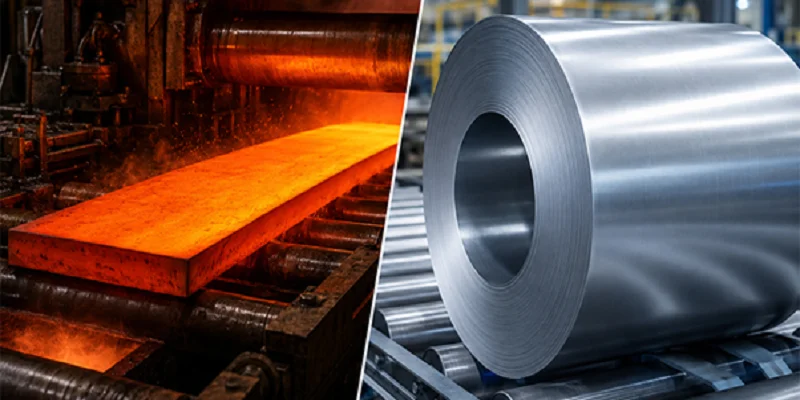
Hot rolled steel is produced by heating a steel slab or billet above its recrystallization temperature, typically around 1700°F (926°C), and then passing it through massive rollers to shape it into sheets, bars, or beams. Because the steel is still soft and pliable at this temperature, it can be rolled quickly and formed into large sections without excessive force.
As the steel cools after rolling, it shrinks slightly and loses precise control over its final dimensions. This is why hot rolled products typically have a rougher, slightly scaled surface and looser tolerances compared to their cold rolled counterparts. You'll often recognize hot rolled steel by its blue-gray, oxidized finish and rounded edges.
Key Characteristics of Hot Rolled Steel
- Lower production cost due to fewer processing steps
- Rougher surface finish with a layer of mill scale
- Looser dimensional tolerances
- More ductile and easier to weld
- Internal stresses are minimal since the steel cools naturally
What Is Cold Rolled Steel?
Cold rolled steel starts as hot rolled steel that undergoes additional processing at or near room temperature. After the initial hot rolling and cooling, the steel is further rolled through a process called cold reduction, which involves annealing and passing it through rollers again without reheating.
This extra step in metal forming work-hardens the steel, increasing its strength while also giving it a smoother, more refined surface and much tighter dimensional accuracy. Cold rolled steel typically has sharper edges, a shinier finish, and consistent thickness — qualities that make it a favorite for precision applications.
Key Characteristics of Cold Rolled Steel
- Smooth, polished surface finish
- Tighter tolerances and more consistent dimensions
- Higher tensile and yield strength than hot rolled steel
- More brittle, with reduced ductility
- Higher production cost due to the additional processing
Hot Rolling vs Cold Rolling: The Core Differences
At a glance, both processes shape raw steel into usable forms, but the temperature at which they're processed creates a ripple effect across nearly every property of the finished material. Here's a straightforward steel rolling comparison to clarify the distinctions.
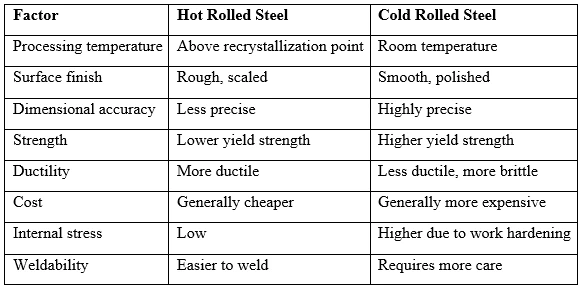
This table captures the essence of rolled steel properties, but the real-world implications go deeper. Hot rolled steel's forgiving nature makes it ideal for structural work where exact dimensions matter less than raw strength and cost efficiency. Cold rolled steel's precision and surface quality make it the go-to choice when appearance, tight fit, or exact measurements are non-negotiable.
Material Properties Explained
Strength and Hardness
Cold rolling work-hardens steel through mechanical deformation at low temperatures, which realigns the grain structure and increases tensile strength. Hot rolled steel, by contrast, recrystallizes during processing, which relieves internal stress and results in a softer, more uniform grain structure. This is why cold rolled steel generally outperforms hot rolled steel in strength-to-weight applications, while hot rolled steel wins when flexibility and impact resistance matter more.
Surface Finish and Appearance
Because hot rolled steel cools from a very high temperature, it develops a layer of iron oxide scale on its surface, giving it a matte, textured look. Cold rolled steel skips this scaling process, resulting in a clean, smooth, almost polished appearance right off the line — a major reason it's preferred for visible or consumer-facing components.
Dimensional Tolerance
Hot rolled steel shrinks unevenly as it cools, making it harder to predict exact final dimensions. Cold rolled steel, processed at stable room temperatures, holds tolerances far more reliably, which is critical in industries where even a fraction of a millimeter can affect assembly.
Applications: Where Each Type Shines
Hot Rolled Steel Applications
Hot rolled steel dominates industries where strength, size, and cost matter more than precision or surface finish:
- Structural beams and I-beams for construction
- Railroad tracks
- Agricultural equipment
- Pipes and tubing for general industrial use
- Automotive frames and chassis components
- Shipbuilding
Cold Rolled Steel Applications
Cold rolled steel is chosen when tight tolerances, smooth surfaces, or enhanced strength are essential:
- Appliance panels and housings
- Furniture and shelving
- Automotive body panels and trim
- Precision machine parts
- Electrical enclosures
- Metal furniture and office equipment
When comparing hot rolled vs cold rolled steel for industrial applications, the decision often comes down to whether the part is structural (favoring hot rolled) or cosmetic/precision-based (favoring cold rolled).
Advantages and Trade-Offs
Hot Rolled Steel Advantages:
- Lower cost per unit, especially for large-scale structural projects
- Easier and faster to produce in bulk
- Greater ductility reduces the risk of cracking during heavy forming
- Simpler to weld without special preparation
Cold Rolled Steel Advantages:
- Superior surface finish reduces the need for secondary finishing
- Tighter tolerances minimize machining and rework
- Higher strength allows for thinner, lighter parts in some designs
- Better suited for aesthetic or consumer-visible applications
The trade-off is straightforward: hot rolling favors speed, cost, and flexibility, while cold rolling favors precision, strength, and appearance — at a higher price point.
When to Choose Hot Rolling or Cold Rolling
Deciding between the two isn't about which process is "better" overall — it's about matching the process to your project's actual requirements.
Choose hot rolled steel when:
- The project involves large structural components
- Exact dimensions are less critical than overall strength
- Budget constraints are a primary concern
- The material will undergo further processing or won't be visible in the final product
Choose cold rolled steel when:
- Surface appearance and finish quality matter
- Tight dimensional tolerances are required
- The application demands higher yield strength in a compact form
- The part will be visible in the final product without additional coating or finishing
Frequently Asked Questions
What is the main difference between hot rolled and cold rolled steel?
The main difference is the temperature at which the steel is processed. Hot rolled steel is shaped above its recrystallization temperature, giving it a rougher finish and looser tolerances, while cold rolled steel is processed at room temperature, resulting in a smoother finish, tighter tolerances, and higher strength.
Is cold rolled steel stronger than hot rolled steel?
Yes, cold rolled steel generally has higher tensile and yield strength because the cold rolling process work-hardens the material. However, hot rolled steel is more ductile and better suited for applications requiring flexibility.
Which is cheaper, hot rolled or cold rolled steel?
Hot rolled steel is typically cheaper because it requires fewer processing steps. Cold rolled steel costs more due to the additional rolling, annealing, and finishing involved.
Can hot rolled steel be converted to cold rolled steel?
Yes. Cold rolled steel is essentially hot rolled steel that has undergone further processing at room temperature to improve its surface finish, strength, and dimensional accuracy.
Which type of steel is better for construction projects?
Hot rolled steel is generally preferred for construction due to its lower cost, greater size availability, and strength suitable for structural beams, columns, and frameworks.
Final Thoughts
Both hot rolled and cold rolled steel serve essential roles across manufacturing, construction, and industrial design. The right choice depends on your project's specific demands: budget, strength requirements, surface finish expectations, and tolerance precision all play a part in the decision.
Understanding these differences in steel processing and metal forming doesn't just help you make a smarter purchasing decision — it ensures the material you choose actually performs the way your project needs it to, from the first cut to the final assembly.
 Media Pack Download
 Newsletters
 Industrial Events