Steel Rolling Process: The Complete Guide to Hot Rolling, Cold Rolling, Rolling Mills, and Finishing Operations

If you've ever wondered how a glowing slab of raw steel turns into the sheets, coils, bars, and structural beams that hold up buildings, bridges, and cars, the answer lies in one of manufacturing's oldest and most important techniques: steel rolling. It's a process that sounds simple on paper — squeeze metal between rollers until it's thinner — but in practice, it's a carefully engineered science that determines the strength, finish, and usability of nearly every piece of steel we rely on.
In this article, we'll break down the steel rolling process from start to finish, explain the difference between hot rolling and cold rolling, walk through the different types of rolling mills, and look at how finishing operations turn rolled steel into a market-ready product.
What Is Steel Rolling?
Steel rolling is a metal forming process where steel is passed through one or more pairs of rollers to reduce its thickness, make it uniform, and shape it into a desired form — sheets, plates, bars, rods, or structural sections. It's a type of metal rolling used across nearly every industry that touches steel, from automotive and construction to shipbuilding and appliance manufacturing.
At its core, the rolling process works on a simple mechanical principle. Steel is fed between two rotating rollers set at a fixed gap. As the metal passes through, the rollers apply compressive force, squeezing the steel and forcing it to elongate and thin out — much like rolling dough with a rolling pin, except with forces measured in thousands of tons rather than a light push from your hand.
This process isn't just about reducing thickness. It also refines the internal grain structure of the steel, improves mechanical properties like strength and ductility, and produces the smooth, consistent surface that downstream industries demand.
The Steel Rolling Process Explained Step by Step
To really understand the complete steel rolling process, it helps to walk through it in order, from raw material to finished product.
1. Raw Material Preparation
The process begins with a semi-finished steel product — usually an ingot, slab, billet, or bloom — produced from a steelmaking furnace. These raw shapes are far too thick and rough to be usable, so they need significant reduction and shaping before they become a finished product.
2. Reheating
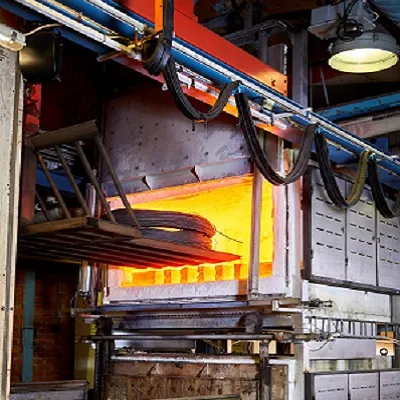
Before rolling begins, the steel is typically reheated in a furnace to a temperature between 1,100°C and 1,250°C. This step, common in hot rolling operations, makes the steel soft and pliable, dramatically reducing the force needed to deform it and lowering the risk of cracking.
3. Primary Rolling (Roughing Pass)
The heated steel first passes through a roughing mill, where it undergoes its first major reduction in thickness. This stage transforms the slab or billet into an intermediate shape that's closer to the final product but still requires further refinement.
4. Intermediate and Finishing Rolling
The steel then moves through a series of additional rolling stands, each one reducing thickness a little further and improving shape accuracy. By the final stands, the steel has reached close to its target dimensions and surface quality.
5. Cooling
Once rolling is complete, the steel is cooled — either naturally on a cooling bed or through controlled cooling systems, depending on the desired final properties. Cooling rate has a major effect on the steel's hardness, strength, and grain structure.
6. Coiling or Cutting
Depending on the end product, the rolled steel is either coiled (for sheet and strip products) or cut into fixed lengths (for bars, plates, and structural sections).
7. Finishing Operations
Finally, the steel goes through finishing steps such as pickling, trimming, leveling, and surface treatment to meet exact specifications before it's shipped to customers.
Hot Rolling vs. Cold Rolling: What's the Difference?
One of the most common questions in steel manufacturing is the difference between hot rolling and cold rolling. While both processes reduce steel thickness using rollers, the temperature at which they operate creates very different outcomes.
Hot Rolling
Hot rolling takes place above the steel's recrystallization temperature, typically over 900°C. Because the steel is soft at this temperature, it can be shaped easily and with less force. Hot rolling is generally used to produce:
- Structural beams and channels
- Rail tracks
- Large plates
- Coils used for further cold processing
Advantages of hot rolling:
- Lower production costs
- Faster processing of large volumes
- Easier to shape thick or large sections
- Reduces internal stresses in the steel
Trade-offs:
- Less precise dimensional tolerances
- Rougher surface finish
- Steel sh slightly as it cools, so exact sizing is harder to control
Cold Rolling
Cold rolling is performed at or near room temperature, usually on steel that has already been hot rolled. Because the metal is worked below its recrystallization temperature, it requires significantly more force, but the results are far more refined.
Advantages of cold rolling:
- Tighter dimensional tolerances
- Smoother, more polished surface finish
- Improved strength through work hardening
- Better suited for products requiring precision, such as automotive panels and appliances
Trade-offs:
- Higher energy and equipment costs
- Steel becomes harder and less ductile, sometimes requiring annealing (a heat treatment) to restore workability
In short: hot rolling is about efficient, large-scale shaping, while cold rolling is about precision, strength, and finish. Most cold-rolled products actually start their life as hot-rolled steel, making the two processes complementary rather than competing.
Types of Rolling Mills
Rolling mills come in several configurations, each designed for a specific purpose within the broader rolling process. Understanding the types of rolling mills helps explain why different steel products require different equipment.
Two-High Rolling Mill
The simplest configuration, consisting of two rollers rotating in opposite directions. Steel passes back and forth between them, commonly used in early-stage roughing operations.
Three-High Rolling Mill
Adds a third roller, allowing steel to pass through in one direction and return through a different pair of rollers without reversing the roller rotation — improving efficiency.
Four-High Rolling Mill
Uses two smaller working rollers supported by two larger backup rollers. This design reduces roller deflection, allowing for thinner, more precise rolling — commonly used in cold rolling operations.
Cluster Mills (Sendzimir Mills)
Feature multiple backing rollers supporting a small-diameter working roller, ideal for rolling very thin, hard, or high-strength materials like stainless steel.
Tandem Rolling Mills
A series of rolling stands arranged in a continuous line, where steel passes through multiple reduction stages in a single pass. Tandem mills are widely used in modern high-volume steel production because they combine speed with consistency.
Planetary Rolling Mills
Use a large number of small rollers arranged around backup rolls, capable of achieving large reductions in a single pass — often used for specialty applications.
Each mill type is chosen based on the required output — whether that's thick structural plate, thin precision sheet, or specialty alloy products.
How Rolling Mills Improve Steel Quality and Production Efficiency
Modern rolling mills do far more than just flatten steel — they're central to how manufacturers improve both quality and efficiency across the production line.
Grain refinement: Rolling breaks down the coarse, cast grain structure of raw steel into a finer, more uniform structure, which directly improves strength and toughness.
Dimensional consistency: Automated gauge control systems in modern mills continuously monitor and adjust roller pressure, ensuring consistent thickness across long production runs.
Surface quality: Advanced rolling mills incorporate descaling and lubrication systems that reduce surface defects, giving the final product a cleaner, more consistent finish.
Energy and material efficiency: Continuous and tandem mill designs minimize reheating cycles and reduce material waste, cutting both energy consumption and production costs.
Higher throughput: Computer-controlled rolling mills can process steel at very high speeds while maintaining tight tolerances, allowing manufacturers to meet large-scale demand without compromising quality.
Customization: Modern mills can be adjusted for a wide range of steel grades, thicknesses, and widths, letting manufacturers serve everything from heavy construction projects to precision automotive parts on the same production infrastructure.
Together, these improvements mean that today's steel rolling mills aren't just faster than older equipment — they consistently produce a higher-quality, more reliable product.
Frequently Asked Questions
What is the main purpose of steel rolling?
The main purpose is to reduce the thickness of steel while improving its shape, surface finish, and mechanical properties, turning raw semi-finished steel into usable sheets, bars, plates, or structural sections.
What is the difference between hot rolling and cold rolling in steel manufacturing?
Hot rolling is done above the steel's recrystallization temperature, making it easier to shape but resulting in a rougher finish and looser tolerances. Cold rolling is done near room temperature, producing tighter tolerances, a smoother surface, and increased strength through work hardening.
Which type of rolling mill is used for thin steel sheets?
Four-high mills and cluster (Sendzimir) mills are commonly used for rolling thin, precise steel sheets, especially in cold rolling operations.
Does hot-rolled steel need further processing?
Often, yes. Many hot-rolled products are later cold rolled to achieve tighter tolerances and a smoother finish for applications like automotive body panels or appliance housings.
Why is grain structure important in rolled steel?
A finer, more uniform grain structure — achieved through rolling — improves the steel's strength, ductility, and overall mechanical performance compared to the coarser structure of cast steel.
Final Thoughts
The steel rolling process is a foundational part of modern manufacturing, transforming rough, semi-finished steel into precise, high-performing material used across nearly every industry. Whether it's the raw strength of hot-rolled structural beams or the polished precision of cold-rolled sheet metal, rolling mills play a critical role in shaping the steel that builds our world.
Understanding the difference between hot and cold rolling — and the specialized mills behind each — makes it easier to see why steel rolling remains one of the most essential processes in industrial production today.
 Media Pack Download
 Newsletters
 Industrial Events