Steel Rolling Process: Types, Mills, and Finishing Operations Explained
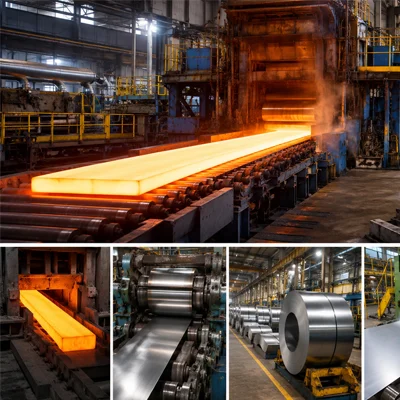
Steel is one of the most commonly used engineering materials in the world, and is the foundation of most industries, including construction, automotive manufacturing, energy, transportation and heavy machinery. But steel does not come out of a furnace in the form of sheets or plates, coils or structural parts. It needs to pass through a number of shaping and refining processes before it is completed. The steel rolling stage is one of the most important manufacturing processes among these stages.
The steel rolling process takes semi-finished steel products like slabs, blooms, and billets, and converts them into products of appropriate use and dimensions, with better mechanical properties and surface quality. Modern rolling operation is needed by the use of sophisticated rolling mill systems which are capable of producing ultra-thin steel sheets, and heavy structural beams.
This article will discuss the working principle of steel rolling, the main types of steel rolling mills, hot vs. cold rolling, and the steel finishing processes used to further process rolled products for final use.
What Is Steel Rolling?
Steel rolling is a metal forming process that steel is rolled through rotating rolls under compression. These forces thin out the material, take the shape of the material and enhance dimensional uniformity.
The main purpose of steel rolling is to transform the cast steel into final or semi final steel shapes and its mechanical properties. The process can yield a variety of products such as:
- Steel sheets
- Steel coils
- Plates
- Bars
- Rods
- Structural sections
- Rails
- Tubes
Today, rolling accounts for the majority of steel shaping operations worldwide because it offers high productivity, excellent material utilization, and consistent quality.
How Steel Rolling Process Works in Hot and Cold Rolling Mills
The steel is normally cast into slabs, blooms or billets, to start the steel rolling process. These semi-finished products are then passed through a series of rolling mills to further shape and size the product.
There are different production routes for different products, but the general process is similar.
1. Steel Casting
Molten steel is produced in steelmaking furnaces and cast into semi-finished forms such as:
- Slabs for flat products
- Blooms for structural sections
- Billets for bars and rods
These cast products serve as the raw material for rolling operations.
2. Reheating
Slabs or billets are heated in reheating furnaces up to the temperatures ranging from about 1,100°C to 1,300°C before hot rolling.
Heating makes the steel soft and makes it easier to roll.
3. Primary Rolling
The heated steel is then fed to roughing mills and the thickness is greatly decreased. This material is gradually formed into an intermediate product by multiple rolling passes.
4. Secondary Rolling
The steel then moves through finishing stands where tighter dimensional control is achieved. Additional reductions improve thickness uniformity and product quality.
5. Cooling
The steels can be given controlled cooling, depending on the desired product properties.
6. Finishing Operations
Various steel finishing processes are conducted after rolling for a better appearance, surface quality, corrosion resistance and dimensional accuracy.
Hot Rolling and Cold Rolling Process
There are two main steel manufacturing processes: hot rolling and cold rolling. Each process serves different production requirements and application needs.
Hot Rolling
In hot rolling, the rolling of the steel is done above recrystallization temperature (above 900°C).
When the temperature is raised to a high level, steel becomes very malleable and can be bent easily.
Hot rolling is the first step in hot rolling and cold rolling, as it is an effective method for reducing thickness and generates a large amount of steel products.
Common hot rolled products include:
- Structural steel
- Plates
- Rails
- Hot rolled coils
- Pipes
- Construction materials
Advantages of Hot Rolling
- Lower production costs
- High productivity
- Suitable for large thickness reductions
- Improved material workability
- Faster processing speeds
Limitations of Hot Rolling
- Lower dimensional precision
- Rougher surface finish
- Scale formation on the surface
- Less precise thickness control
Cold Rolling
Cold rolling is done after hot rolling and steel is processed at or close to room temperature.
Steel is then taken to cold rolling mills where it is rolled into finer and thinner steel in a controlled manner.
The surface finish, dimensional accuracy and mechanical properties are significantly improved with the cold rolling process.
Common cold rolled products include:
- Automotive body panels
- Appliance components
- Precision engineering products
- Electrical enclosures
- Thin steel sheets
Advantages of Cold Rolling
- Superior surface quality
- Better dimensional tolerances
- Increased strength through strain hardening
- Excellent flatness
- Enhanced appearance
Limitations of Cold Rolling
- Higher production costs
- Additional processing requirements
- Lower reduction capability per pass
Difference between Hot Rolling and Cold Rolling in Steel Manufacturing
The steel rolling can be achieved by two ways: hot rolling and cold rolling.
| Factor | Hot Rolling | Cold Rolling |
| Processing Temperature | Above recrystallization temperature | Near room temperature |
| Surface Finish | Rougher | Smoother |
| Dimensional Accuracy | Moderate | High |
| Production Cost | Lower | Higher |
| Mechanical Strength | Standard | Higher |
| Thickness Control | Moderate | Excellent |
| Typical Applications | Structural products | Precision products |
While hot rolling is preferred for heavy-duty structural applications, cold rolling is chosen when tight tolerances and superior surface quality are required.
Steel Rolling Mill Types
Different products require different rolling configurations. As a result, manufacturers utilize various steel rolling mill types to meet production requirements.
Two-High Rolling Mill
This is the simplest rolling mill configuration, consisting of two opposing rolls.
It is commonly used for basic reduction operations and small-scale production environments.
Three-High Rolling Mill
A three-high mill uses three vertically stacked rolls.
The steel can pass through the mill in both directions without reversing roll rotation, improving productivity.
Four-High Rolling Mill
This configuration uses two smaller work rolls supported by larger backup rolls.
Four-high mills are widely used in steel sheet production due to their ability to maintain thickness accuracy.
Cluster Rolling Mill
Cluster mills use multiple backup rolls supporting smaller work rolls.
They are ideal for producing very thin steel sheets and precision strip products.
Tandem Rolling Mill
Tandem mills consist of multiple rolling stands arranged in sequence.
Steel passes continuously through each stand, allowing significant thickness reductions at high production speeds.
Modern steel sheet production process facilities commonly use tandem mills to achieve efficient large-scale production.
Universal Rolling Mill
Universal mills use horizontal and vertical rolls simultaneously.
These mills are commonly used for structural sections, beams, and rails.
Step by Step Steel Sheet and Coil Production Process in Rolling Mills
Steel sheets and coils represent some of the most widely used flat steel products globally. Their manufacturing involves several carefully controlled stages.
Step 1: Slab Preparation
The continuous cast slabs are tested and ready for rolling.
Step 2: Reheating
The slabs are reheated to the rolling temperature in reheating furnaces.
Step 3: Roughing Mill Reduction
Initial thickness reductions are achieved through roughing mill stands.
Step 4: Finishing Mill Rolling
The material enters finishing stands where final thickness targets are achieved.
Step 5: Run-Out Table Cooling
Controlled cooling systems regulate temperature and metallurgical properties.
Step 6: Coiling
The rolled strip is wound into coils for transportation and downstream processing.
Step 7: Pickling
Surface scale generated during hot rolling is removed using acid treatment.
Step 8: Cold Rolling (Optional)
For applications requiring higher precision, the material undergoes cold rolling.
Step 9: Annealing
In heat treatment, internal stresses are removed and ductility restored.
Step 10: Final Finishing
The material receives finishing treatments before packaging and shipment.
This step by step steel sheet and coil production process in rolling mills ensures product consistency and quality across various industrial applications.
Steel Finishing Operations
Steel finishing is the final stage of production and plays a crucial role in determining product performance and appearance.
Several finishing operations may be applied depending on the intended application.
Pickling
Pickling removes oxide scale and surface contaminants generated during hot rolling.
It cleans and prepares the surface of steel for subsequent processing steps.
Annealing
After cold rolling, a process of annealing softens the steel and make it more formable.
This heat treatment also enhances ductility and generates less residual stress.
Temper Rolling
This process is called skin-pass rolling; it has the result of making the material flatter, smoother, and more uniform in size.
Galvanizing
A protective zinc coating is applied for better corrosion resistance.
Galvanized steel is commonly used for building, vehicles, infrastructure, etc.
Coating and Painting
Organic coatings improve appearance and provide additional environmental protection.
Slitting and Cutting
Coils are cut into specific widths or lengths based on customer requirements.
Inspection and Quality Control
Final inspections verify:
- Thickness accuracy
- Surface quality
- Mechanical properties
- Dimensional tolerances
- Coating performance
These steel finishing operations ensure the final product meets customer specifications and industry standards.
Applications of Rolled Steel Products
Rolled steel products are essential across numerous industries.
Construction
- Structural beams
- Reinforcement materials
- Roofing products
- Bridges
Automotive
- Body panels
- Chassis components
- Wheels
- Structural reinforcements
Energy
- Wind towers
- Pipelines
- Power generation equipment
Manufacturing
- Machinery components
- Industrial equipment
- Storage systems
Consumer Goods
- Appliances
- Furniture
- Electronics enclosures
Rolled steel is one of the most versatile materials in engineering today for its use in manufacturing.
Conclusion
The steel rolling process is an important point in the process of casting steel to high quality industrial steel. By properly controlled deformation, the rolling mills generate the sheets, coils, plates, bars, and structural sections to fit the rigorous demands of the modern industries.
To better understand the operation of the steel rolling process, manufacturers need to know which of the two types of rolling mills, hot or cold, is the best option for the steel they are using. Hot rolling is used for large-scale shaping and is relatively cheap, but cold rolling can get a higher precision and surface quality.
Advances in these rolling technologies, combined with other sophisticated steel finishing processes like pickling, annealing, galvanizing and coating, ensure that steel products have the strength, durability and precision they demand in construction, automotive, energy and manufacturing applications. With the continuous development of steel production, the efficient and high-quality production of steel will be the core of the steel rolling mill in the future.
 Media Pack Download
 Newsletters
 Industrial Events