Industrial Metal Pallets and Collapsible Steel Containers: Load Optimization, Storage and Reusable Handling Solutions
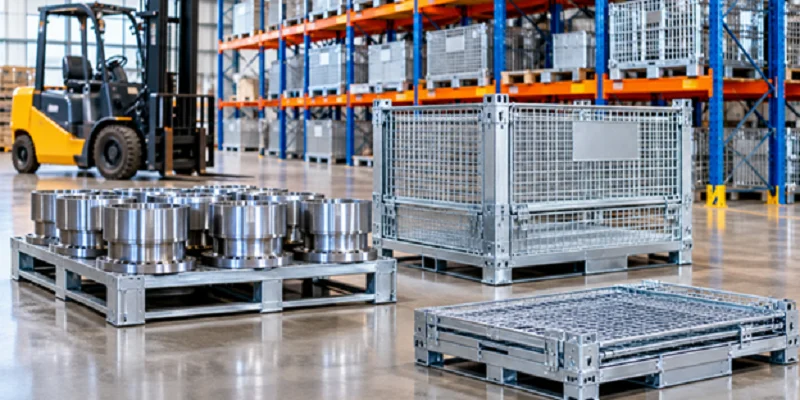
Industrial operations depend on pallets and containers that can handle heavy loads day after day. When that equipment isn't up to the job, the costs show up everywhere: damaged goods, wasted floor space, slower handling and constant replacement spending.
Industrial metal pallets and collapsible steel containers address these problems by combining strength, reusability and space efficiency in one system. They carry heavier loads than most alternatives, stay in service for years longer than timber, and fold down when empty to free up storage and cut return freight.
Here's how they work, where they beat the alternatives, and how to decide whether they fit your operation.
What Are Industrial Metal Pallets and Collapsible Steel Containers?
Industrial metal pallets are load-bearing platforms made from steel or aluminum, used to lift, move and store goods with forklifts, pallet jacks or cranes. Because they're built for heavy-duty work, they handle loads that would crush or crack a standard wooden pallet.
Collapsible steel containers are rigid, mesh or solid-sided steel storage containers with hinged walls that fold flat when empty. Think of them as a heavy-duty crate with a clever trick. They hold bulky parts, castings, tools or bagged materials in transit, then collapse to a fraction of their height for the return trip or for storage.
Together, they form the backbone of modern metal material handling: sturdy platforms below, stackable, reusable containers above. They're a core part of any serious industrial storage solution.
Metal Pallets Versus Wooden Pallets for Heavy Industrial Applications
Wood is cheap upfront, and for light, one-way shipments it still makes sense. But once loads get heavy and repeated, the math changes.
Strength and load capacity. Wooden pallets typically top out at modest static loads and degrade with every forklift strike. Steel pallets can carry several tons without flexing, and they keep that capacity for years. If you move engine blocks, dies, coils or machined components, that margin matters for safety, not just convenience.
Lifespan. A wooden pallet might survive a handful of trips before boards crack, nails loosen and splinters appear. A well-made metal pallet can stay in circulation for a decade or more. Spread the purchase price over thousands of trips and the cost per use drops sharply.
Hygiene and safety. Wood absorbs moisture, oil and chemicals. It harbors pests and mold, and loose nails and splinters injure workers and damage products. Steel doesn't absorb anything, wipes or washes clean, and doesn't need fumigation for export in many cases.
Fire and environment. Metal pallets don't feed a warehouse fire the way timber does, which can matter for insurance and compliance. They also tolerate heat, cold, rain and chemical exposure far better.
Consistency. Every steel pallet has the same dimensions and the same strength. That makes them far friendlier to automated conveyors, robotic pickers and racking systems, where a warped wooden board can jam a line.
The honest trade-off: metal pallets cost more to buy and weigh more. For short-lived, one-way exports, wood may still win. For closed-loop, heavy, repeated movement, such as plant-to-plant shuttles, supplier returnables or in-house storage, steel usually comes out ahead within the first year or two.
Benefits of Collapsible Steel Containers for Industrial Material Storage
The biggest advantage is simple: they stop empty containers from wasting space.
A rigid container takes up the same room whether it's full or empty. Collapsible steel containers fold flat, often reducing their footprint by around 70-80 percent. A truck that used to return half-full with bulky empties can now carry several times as many back to the supplier. That means fewer trips, lower freight cost and less handling.
Other benefits worth noting:
- Durability. Steel mesh and welded frames shrug off drops, forklift bumps and rough yard conditions that would destroy plastic or cardboard.
- Stackability. Most designs stack securely, often three or four high when loaded. That turns vertical space, which most warehouses underuse, into usable storage.
- Visibility and airflow. Mesh sides let staff see contents at a glance and allow ventilation, which helps with parts prone to moisture or corrosion.
- Protection. Components stay organized and shielded from crushing, which cuts damage and rework.
- Customization. Dividers, lids, drop-down gates, castor wheels and inserts let you tailor a container to specific parts.
For plants managing thousands of components, these benefits add up quickly. Fewer damaged parts and fewer lost containers mean less friction on the line.
How Reusable Steel Containers Improve Warehouse Storage and Handling Efficiency
Efficiency in a warehouse is mostly about three things: space, time and predictability. Reusable steel containers improve all three.
Space. Stackable, uniform containers let you build tall, stable storage blocks instead of sprawling floor piles. When empty, they fold away, freeing aisles and staging areas. Many operations find they can store the same volume of goods in noticeably less floor space.
Time. Standardized containers move the same way every time. Forklift operators know exactly where to place forks. Pickers know what's inside by sight or label. Loading and unloading speed up because there's no repacking, restraining or wrestling with odd-shaped boxes.
Predictability. Because steel containers are tough and trackable, many companies tag them with barcodes or RFID. That makes it easy to see where every unit is, how long it's been out and when it's due back. The result is fewer lost assets and smoother supplier loops.
Safety. A stable, uniform load is a safer load. Containers with solid frames reduce tip-overs and shifting cargo, which protects both people and product.
Sustainability. This is reusable industrial packaging at its most practical. Instead of discarding thousands of single-use pallets, boxes and wraps each year, a company reuses the same assets for a decade or more. That cuts waste, reduces purchasing churn and supports environmental reporting goals, a growing priority for many buyers and regulators.
Load Optimization: Getting More From Every Trip
Load optimization is a fancy phrase for a simple goal: move more value with less waste, less damage and fewer journeys.
Here's how steel pallets and containers help.
Right-sizing. Choose pallet and container dimensions that match your trucks, racks and shipping containers. A few centimeters of mismatch, repeated across thousands of units, can mean wasted cubic space on every shipment.
Weight distribution. Steel's rigidity keeps weight evenly supported, so you can load to capacity without worrying about bowing or collapse. That's especially helpful for dense items like castings, bearings and tooling.
Vertical stacking. Check the rated stacking capacity of your containers and use it. Safe stacking turns height into capacity without needing a larger building.
Nesting and folding. Return legs are where many logistics budgets quietly leak. Collapsing containers for the trip back lets you consolidate returns into fewer trucks.
Process fit. The best container is one that matches your workflow, whether that's line-side feeding, forklift shuttle, AGV transport or manual picking. Consider handling method, part weight, frequency and environment before choosing.
Choosing the Right Solution
Before buying, ask a few practical questions:
- What's the real load? Account for the heaviest item, plus dynamic forces during forklift handling and transport, not just static weight.
- How many cycles? The more trips an asset makes, the stronger the case for steel.
- Is it a closed loop? Reusable assets pay off fastest when you can reliably get them back.
- What's the environment? Wet, chemical, hot or food-adjacent settings may call for specific coatings, galvanizing or stainless options.
- What equipment will handle them? Confirm compatibility with your forklifts, racking, conveyors and automation.
- What's the total cost of ownership? Compare cost per trip over the full lifespan, including repairs, replacements and lost units, not just the purchase price.
A short pilot with a small batch is often the smartest first step. It reveals real-world handling issues before you commit.
Frequently Asked Questions
Are metal pallets better than wooden pallets?
For heavy, repeated industrial use, usually yes. They're stronger, longer-lasting, cleaner and more consistent. For light, one-way shipping, wood may still be more economical.
How much weight can a steel pallet hold?
It depends on the design, but industrial steel pallets commonly support loads in the range of one to several tons. Always check the manufacturer's rated static, dynamic and racking capacities.
Do collapsible steel containers really save space?
Yes. When folded, they take up a fraction of their working volume, which cuts storage space and return freight costs.
Are reusable steel containers cost-effective?
Generally, yes, when used in a closed loop with many cycles. The higher purchase price is spread across years of use, lowering the cost per trip.
Can metal pallets and containers be customized?
Most manufacturers offer custom sizes, coatings, dividers, lids and handling features to suit specific parts and workflows.
Final Thoughts
Industrial metal pallets and collapsible steel containers aren't a flashy upgrade, but they quietly fix some of the most expensive, frustrating problems in industrial logistics: wasted space, damaged goods, unreliable packaging and endless replacement costs.
If your operation moves heavy parts, runs repeated supply loops or struggles with storage density, a switch to reusable steel handling is worth a serious look. Start with your heaviest, most frequent flows, measure the results, and expand from there. In most plants, the pallets that last longest are the ones that end up costing the least.
 Media Pack Download
 Newsletters
 Industrial Events