Iron Ore Sintering and Pelletizing: Their Role in Ironmaking
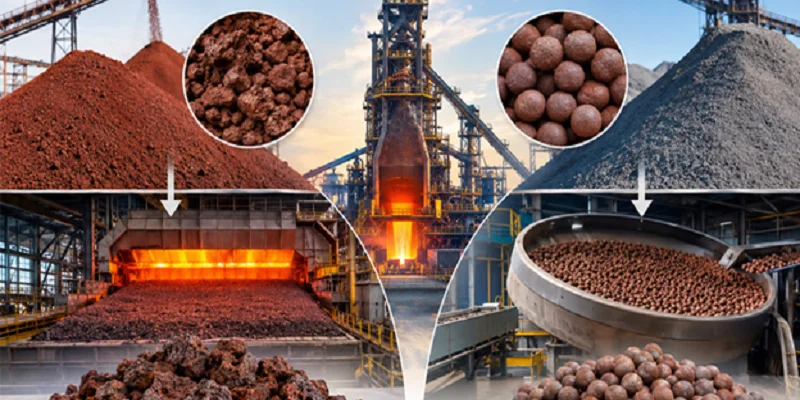
Quick answer: Iron ore sintering and iron ore pelletizing are agglomeration processes that turn fine ore into strong, porous lumps a blast furnace can actually use. Sinter is made by fusing fines with coke breeze and flux. Pellets are rolled into balls and hardened by heat. Both improve gas flow, lower coke consumption, and raise furnace productivity.
Why Can't a Blast Furnace Just Use Fine Iron Ore?
Every tonne of blast furnace iron depends on one unglamorous condition: hot gas must move freely through a towering column of raw material. Pack that column with fine ore dust and the gas stalls, the furnace turns sluggish, and output drops. Fill it with strong, evenly sized lumps and the whole system breathes. Closing that gap, between ore that chokes a furnace and ore that feeds one, is the job of agglomeration.
A blast furnace is a tall, hot, gas-driven reactor. Hot air rushes up from the bottom while raw materials slide down from the top. For that to work, the material column needs gaps, plenty of them, so gas can travel through evenly. Fine iron ore, anything below roughly 6 to 8 mm, packs tightly and chokes the gas flow. The furnace slows down, runs unevenly, and sometimes becomes dangerously unstable.
The catch is that modern mining produces a lot of fines. Crushing and screening ore generates them by the million tonnes. Throwing them away would be wasteful and expensive. So, the industry does something smarter: it glues them back together. That's iron ore agglomeration, and it is the quiet backbone of ironmaking.
What Is Iron Ore Agglomeration?
Iron ore agglomeration is the process of binding fine iron ore particles into larger, stronger, more permeable pieces that can survive handling and perform well inside a blast furnace. The two dominant routes are:
- Sintering, which produces sinter
- Pelletizing, which produces iron ore pellets
(A third route, briquetting, exists but plays a much smaller role.)
Think of sintering as baking and pelletizing as rolling a snowball and then firing it like pottery. Different methods, same goal: turn useless dust into premium furnace feed.
The Iron Ore Sintering Process, Step by Step
The sintering process takes place in a sinter plant, usually attached to an integrated steel mill. It handles ore fines of roughly 0.15 to 8 mm. Here's how it flows:
- Raw material preparation. Iron ore fines, limestone or dolomite (flux), coke breeze (fuel), and recycled mill wastes like dust and scale are stored in bins.
- Blending and mixing. The materials are proportioned carefully, then mixed with water in a drum. The moisture helps tiny particles clump into small "micro-pellets."
- Charging on the strand. The mix is spread about 500 to 700 mm deep on a moving grate called a sinter strand.
- Ignition. A burner hood lights the top layer at around 1,100 to 1,200 °C.
- Downdraft burning. Fans pull air down through the bed. The flame front travels downward, reaching 1,300 to 1,480 °C. Particle surfaces partially melt and fuse, forming bonds without melting the whole mass.
- Breaking, cooling, and screening. The finished sinter cake is crushed, cooled, and screened. Undersize material returns to the start as "return fines," and the right-sized sinter heads to the blast furnace.
The result is a hard, porous, slightly rough-textured lump. Because limestone is already built in, sinter is usually self-fluxing, meaning it brings its own slag-forming material into the furnace.
The Iron Ore Pelletizing Process, Step by Step
Pelletizing is a different animal. It uses much finer ore, typically below 0.15 mm, the kind of powder you can barely feel between your fingers. Pellet plants are often built right at the mine, which is why iron ore pellets are traded globally.
- Grinding and concentration. Ore is ground very fine and upgraded (beneficiated) to remove impurities.
- Mixing with binder. Bentonite clay, or sometimes an organic binder, is added in small amounts, usually around 0.5 to 1 percent.
- Balling. The mix is rolled in a rotating disc or drum. Like a snowball growing as it rolls, it forms "green pellets" 8 to 16 mm across.
- Induration (hardening). Green pellets are dried, preheated, and fired at roughly 1,250 to 1,350 °C on a traveling grate or in a grate-kiln system, then cooled.
- Screening and shipping. Hard, round, uniform pellets are screened and sent to steel plants.
Pellets are famously consistent: similar size, high iron content (often 63 to 67 percent Fe), low impurities, and excellent strength for long-distance transport.
Sinter vs. Pellets: What's the Difference?
| Feature | Sinter | Iron Ore Pellets |
| Feed size | Fines, about 0.15 to 8 mm | Ultra-fine concentrate, below 0.15 mm |
| Where it's made | Usually at the steel plant | Usually at the mine or port |
| Bonding method | Partial melting at the surface | Clay-bonded, then fired (sintered in solid state) |
| Shape | Irregular, angular lumps | Uniform spheres |
| Fluxing | Often self-fluxing | Can be acid or fluxed |
| Fe content | Around 55 to 58 percent | Around 63 to 67 percent |
| Strength for transport | Moderate | Excellent |
| Reducibility | Very good | Good to very good |
Neither is "better" in all cases. They solve slightly different problems, which is exactly why steelmakers often use both.
The Role of Sinter and Pellets in the Blast Furnace Burden
The blast furnace burden is the mix of materials charged from the top: iron-bearing materials, coke, and flux. A typical iron-bearing mix looks something like this:
- Sinter: 50 to 70 percent in many European, Indian, and Chinese furnaces
- Pellets: 20 to 40 percent, sometimes more
- Lump ore: the remainder
There is no universal recipe. Some furnaces in North America and Scandinavia run on mostly pellets. Many Asian furnaces lean heavily on sinter. The ideal burden depends on ore availability, cost, coke price, and furnace design.
So what is the role of sinter and pellets in ironmaking? Three things:
- They create permeability. Uniform lumps leave open channels for gas flow.
- They deliver iron efficiently. Pellets bring high iron grade, sinter brings flux and recycles waste.
- They keep the furnace stable. Consistent size and strength reduce dust, hanging, and slips.
How Sintering and Pelletizing Improve Ironmaking
Here's the practical payoff, the part your plant manager actually cares about.
- Better gas flow and higher productivity. Good permeability lets the furnace burn more fuel and make more hot metal per day. Productivity gains of several percent from improved burden quality are common.
- Lower coke rate. Agglomerated materials reduce more easily and more evenly, so less coke is needed per tonne of hot metal. Since coke is one of the biggest cost items in ironmaking, even small savings matter.
- Use of low-grade and fine ores. Without agglomeration, a huge share of the world's ore would be unusable. Sintering and pelletizing turn byproducts into value.
- Waste recycling. Sinter plants absorb mill scale, flue dust, and sludge, closing material loops that would otherwise end up in landfills.
- Consistent chemistry. Blending before sintering smooths out quality swings, giving the furnace a steadier diet and the operators fewer surprises.
- Easier logistics. Pellets travel by ship and rail without crumbling, making global trade practical and giving mills more supplier choice.
In short, iron ore agglomeration for the blast furnace is less about preparing ore and more about preparing the furnace to perform.
Challenges and What's Changing
Nothing here is perfect, and an honest article should say so.
- Emissions. Sinter plants release dust, SOx, NOx, and dioxins. Modern plants use electrostatic precipitators, desulphurization, and waste-gas recirculation to cut this.
- Energy use. Both processes are energy-intensive. Waste-heat recovery and biomass substitution for coke breeze are growing trends.
- Decarbonization. Direct reduction (DRI) shafts prefer high-grade pellets, so demand for DR-grade pellets is rising as steelmakers chase lower-carbon routes.
- Raw material decline. High-quality ore is getting scarcer, so agglomeration is becoming more important, not less.
Expect more pellets, cleaner sinter plants, and smarter process control using AI and real-time sensors.
Frequently Asked Questions
What is iron ore sintering?
Iron ore sintering is a thermal agglomeration process where fine ore, flux, and coke breeze are heated on a moving grate until particles fuse into porous lumps called sinter.
What is iron ore pelletizing?
It is the process of rolling fine, beneficiated ore with a binder into small balls and hardening them in a furnace to make iron ore pellets.
Why are sinter and pellets used instead of raw ore?
Raw fines block gas flow in the blast furnace. Agglomerated materials are stronger, more uniform, and more permeable.
Which is better for a blast furnace, sinter or pellets?
Neither wins outright. Sinter is cost-effective and self-fluxing; pellets offer higher iron content and consistency. Most furnaces use a blend.
What is a sinter plant?
A sinter plant is a facility, usually inside an integrated steel mill, where ore fines are blended, ignited, and cooled into sinter for the blast furnace.
What size are iron ore pellets?
Typically, 8 to 16 mm in diameter.
Do all steel plants use sinter?
No. Some rely mainly on pellets and lump ore, while others depend heavily on sinter, depending on raw material access and economics.
Final Thoughts
Iron ore sintering and pelletizing rarely get the spotlight, yet every tonne of blast furnace hot metal depends on them. They turn fine, awkward, low-value ore into the reliable furnace feed that keeps coke consumption down, productivity up, and operations steady.
If you remember one thing, make it this: the blast furnace is only as good as what you feed it. Sinter and pellets are how the industry feeds it well.
Working in steel, mining, or raw materials? Share your own experience with burden mixes in the comments. The best insights usually come from the people running the plant.
Reference ranges are typical industry values and vary by plant, ore type, and operating practice. Verify against your own data before publishing technical claims.
 Media Pack Download
 Newsletters
 Industrial Events