Ironmaking Process: From Iron Ore Preparation to Hot Metal Production
What Is the Ironmaking Process? (Quick Answer)
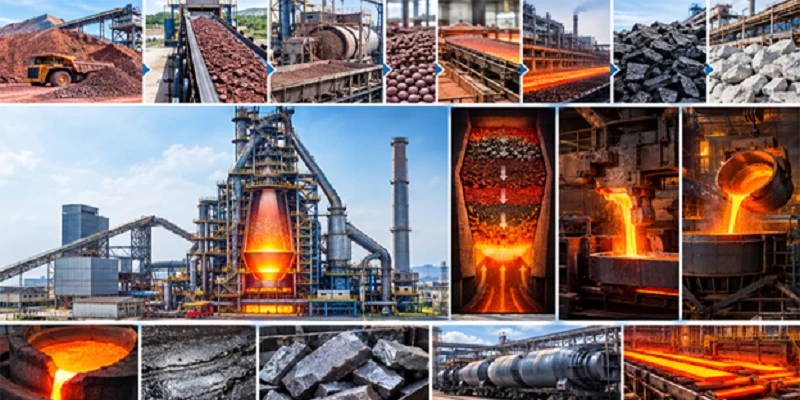
The ironmaking process converts iron ore into liquid iron, called hot metal, by removing oxygen from the ore at very high temperatures. In most steel plants, this happens in a blast furnace, where iron ore, coke, and limestone are heated with hot air. The resulting hot metal, at about 1,500°C, goes on to the steelmaking shop.
In one line: iron ore preparation → charging → reduction → melting → tapping hot metal.
Why Ironmaking Matters More Than You Think
Every steel beam, car door, and railway track starts its life as iron ore. Before steel can exist, ironmaking has to happen first, and it's the most energy-intensive and carbon-heavy part of the whole chain.
That is why ironmaking sits at the center of today's conversations about green steel. If you work in a steel plant, study metallurgy, or write about the industry, understanding this stage is the key to understanding everything downstream.
Let's walk through it the way it actually happens on the plant floor.
Ironmaking Stages in Steel Production: The Big Picture
| Stage | What Happens | Output |
| 1. Raw material preparation | Ore is crushed, screened, and agglomerated | Sinter, pellets, lump ore |
| 2. Coke making | Coal is heated without air | Coke |
| 3. Charging | Materials are loaded into the furnace top | Layered burden |
| 4. Reduction | Gases strip oxygen from the ore | Solid then molten iron |
| 5. Melting and slag formation | Impurities separate as slag | Hot metal + slag |
| 6. Tapping | Liquid iron is drained from the furnace | Hot metal |
Step 1: Iron Ore Preparation
Raw iron ore doesn't go straight into a furnace. Typical ore grades run around 60–65% iron, and the rest is gangue: silica, alumina, and other unwanted minerals. Poorly prepared ore chokes the furnace, wastes fuel, and hurts productivity.
Crushing and screening. Large lumps are broken down and sorted by size. Fines (tiny particles) are separated because they block gas flow inside the furnace.
Beneficiation. Low-grade ore is washed, magnetically separated, or floated to raise its iron content.
Agglomeration. Fines are too valuable to throw away, so plants turn them into usable lumps in two ways:
- Sintering: Fine ore is mixed with coke breeze and flux, then ignited on a moving strand. The particles fuse into porous sinter.
- Pelletizing: Ore is ground, rolled into small balls, and hardened by firing. Pellets are uniform and strong, and they're popular in direct reduction too.
A plant that gets its burden right has already won half the battle.
Step 2: Coke and the Other Inputs
Coke is baked coal, produced in coke ovens at around 1,000°C without oxygen. It does three jobs in the blast furnace:
- Supplies heat when it burns
- Produces carbon monoxide, the main reducing gas
- Acts as a physical support, keeping the burden porous so gas can rise through it
Alongside coke, plants add flux (limestone or dolomite), which binds impurities into slag. Many furnaces also inject pulverized coal (PCI) through the tuyeres to cut coke consumption.
As a rough rule of thumb, producing one tonne of hot metal takes about 1.5–1.6 tonnes of iron-bearing material, around 0.4–0.5 tonnes of coke, plus coal injection and flux. Exact numbers vary by plant.
Step 3: Inside the Blast Furnace
A blast furnace is a tall, steel-shelled, refractory-lined shaft, sometimes over 30 meters high, running continuously for years. Think of it as a giant counter-current reactor:
- Solids move down (ore, coke, flux) from the top.
- Gases move up from the bottom.
The charging system
Materials are loaded at the top in alternating layers of ore and coke. This layered structure keeps gas moving evenly, which is critical for stable operation.
The hot blast
Near the bottom, preheated air at roughly 1,000–1,250°C is blown in through nozzles called tuyeres. It burns the coke and creates flame temperatures above 2,000°C. This is the engine of the whole furnace.
Step 4: Iron Ore Reduction (The Heart of Iron Production)
Iron ore reduction simply means removing oxygen from iron oxide. Iron ore is mostly hematite (Fe₂O₃), and reduction happens in stages as the ore descends and gets hotter:
Fe₂O₃ → Fe₃O₄ → FeO → Fe
The main chemistry:
- Coke combustion: C + O₂ → CO₂
- Gas regeneration: CO₂ + C → 2CO
- Indirect reduction: Fe₂O₃ + 3CO → 2Fe + 3CO₂
- Direct reduction (lower zone): FeO + C → Fe + CO
Carbon monoxide does most of the heavy lifting in the upper and middle zones. Deeper down, solid carbon takes over the remaining reduction.
Simple analogy: picture ore as iron "wearing" oxygen. The furnace strips it off using carbon-based gases, and the iron comes out bare and molten.
Step 5: Melting, Slag Formation, and Hot Metal Production
As reduced iron reaches the hotter zone, it melts and absorbs carbon (about 4–4.5%), along with small amounts of silicon, manganese, phosphorus, and sulfur. That is hot metal, sometimes still called pig iron when cast into solid form.
At the same time, flux reacts with gangue to form slag, a lighter liquid that floats above the hot metal. Slag isn't waste in the traditional sense; it's widely used in cement and road construction.
Tapping
Every few hours, operators open the taphole and let hot metal and slag flow out into runners. Hot metal is separated from slag and poured into torpedo ladles, which carry it to the steel melting shop at roughly 1,450–1,500°C.
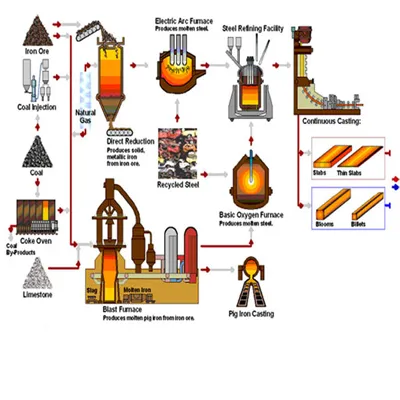
From there, it's refined into steel in a basic oxygen furnace (BOF). This route is called BF-BOF, and it still produces the majority of the world's steel.
Ironmaking Plant: What Does a Full Facility Include?
A modern ironmaking plant is much more than a furnace. Typical units include:
- Raw material handling yard and stockhouse
- Sinter plant and/or pellet plant
- Coke oven battery
- Blast furnace with stoves (hot blast heaters)
- Gas cleaning system and top-gas recovery turbine
- Cast house for tapping and slag handling
- Hot metal transport and desulphurization station
Blast furnace gas isn't wasted. It's cleaned and reused to preheat air, generate power, and fuel other plant processes, which is a big part of ironmaking efficiency.
Technologies Used in Modern Ironmaking
The blast furnace is still dominant, but it's no longer the only option. Here are the main ironmaking technologies in use or emerging:
1. Modern blast furnace upgrades
Bell-less top charging, advanced process automation, PCI, oxygen enrichment, and AI-based burden control have all improved efficiency and lowered fuel rates.
2. Direct reduced iron (DRI)
Ore is reduced in the solid state, below melting point, using natural gas or syngas. Well-known processes include MIDREX and HYL/Energiron. DRI usually feeds electric arc furnaces (EAF) rather than making hot metal directly.
3. Smelting reduction
Processes like COREX, FINEX, and HIsarna aim to skip or simplify coke making and sintering by producing liquid iron more directly.
4. Hydrogen-based ironmaking
Here, hydrogen replaces carbon monoxide as the reductant, so the byproduct is water vapor instead of CO₂. Projects like HYBRIT in Sweden are working toward hydrogen-based DRI at scale. It's promising, but cost, green hydrogen availability, and energy needs remain real hurdles.
5. Carbon capture and top-gas recycling
Some plants are testing ways to capture CO₂ from blast furnace gas, or recycle it back into the process, to cut emissions without rebuilding everything.
Blast Furnace vs. DRI: Quick Comparison
| Feature | Blast Furnace (BF) | Direct Reduction (DRI) |
| Final product | Liquid hot metal | Solid sponge iron |
| Main reductant | Coke, CO | Natural gas, hydrogen |
| Typical steelmaking partner | BOF | EAF |
| Scale | Very large | Medium to large |
| CO₂ intensity | Higher | Lower (much lower with hydrogen) |
Common Challenges in Ironmaking
- High CO₂ emissions: ironmaking is a major contributor to steel's carbon footprint
- Raw material quality: poor ore or coke quality reduces stability
- Energy costs: the process is extremely energy-intensive
- Refractory wear: the furnace lining is under constant thermal and chemical stress
- Skilled operation: small changes in burden or blast conditions ripple through the furnace
FAQs About the Ironmaking Process
What is the ironmaking process in simple words?
It's the process of turning iron ore into liquid iron by removing oxygen using carbon and heat, mainly inside a blast furnace.
What is hot metal?
Hot metal is molten iron tapped from the blast furnace, containing about 4–4.5% carbon. It's the main input for making steel in a BOF.
What is the difference between ironmaking and steelmaking?
Ironmaking extracts iron from ore. Steelmaking refines that iron by lowering carbon and removing impurities to reach the desired steel grade.
Why is coke used in a blast furnace?
It provides heat, generates the reducing gas CO, and supports the burden so gases can flow upward.
What are the main raw materials for iron production?
Iron ore (lump, sinter, or pellets), coke, flux such as limestone, and hot air. Many plants also use injected coal.
What is replacing the blast furnace?
Nothing fully yet. DRI-EAF routes and hydrogen-based technologies are growing, but blast furnaces remain central to global steel supply for now.
Final Thoughts
The ironmaking process from iron ore to hot metal is a beautiful piece of industrial engineering: preparation, chemistry, and heat all working together in one continuous system. It's also where the steel industry faces its biggest transformation, as plants search for lower-carbon ways to make iron.
Whether you're a student, a plant engineer, or simply curious, understanding these stages gives you a real feel for how modern steel begins.
 Media Pack Download
 Newsletters
 Industrial Events