Laser-Aided Steel Forming: Precision Techniques for Lightweight Structures
With the fast-changing environment of steel forming, innovation has now proven to be the driving power behind the industries in the strength as well as lightness of the structural designs. Laser-aided forming is one of such innovations and is considered to be a revolutionary method that makes thermal accuracy and the mechanical capability of metal get united. The need of lightweight structures in the automotive, aerospace, and construction industries have only increased the uptake of the laser forming process giving engineers and manufacturers a more accurate, efficient and sustainable alternative to the traditional metal forming processes.
The Evolution of Metal Forming: From Conventional to Laser-Aided Precision
For decades, metal forming has been the core of the well-developed manufacturing that forms metals under the influence of mechanical stress, pressure, or heat. The classical methods like press forming, stamping, and rolling have been very successful and in most cases fail in design constraint and high cost of tools. Conversely, these limits have been re-established through laser-aided forming which is a non-contact, programmable technique that involves the use of localized heating to mold metals using unparalleled accuracy.
It is not simply a replacement of old tools with new tools that have been made of precision steel but a paradigm shift. It has shifted to non-brutal mechanical force to thermal manipulation that is controlled. Laser forming is another production method based on the fact that localized thermal gradients formable by laser beams enable manufacturers to bend, shape, and refine steel sheets with great precision without resorting to external dies and molding. This freedom brings in new horizons in the field of advanced metal forming, particularly, in cases, where light weighting and accuracy are key in performance-efficiency.
How Laser-Aided Forming Works
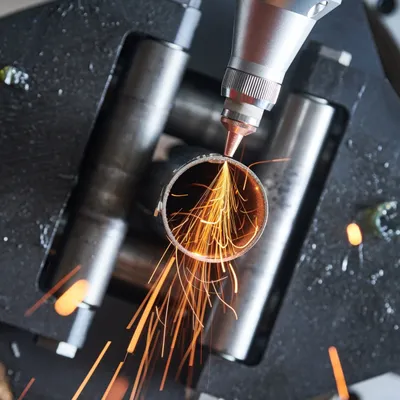
The thermodynamic principles of forming and expansion of metals are the science behind laser-aided forming. When a beam of laser falls on a given part of a metal sheet, it heats that part in a very hot and fast manner. The heat causes the metal to start expanding and after cooling it to shrink. Controlled deformation is brought about by the repetition of this cycle.
Laser forming techniques are used to form the desired curvature or geometry as opposed to traditional steel forming, which very much depends on the mechanical pressure. The technique is highly productive in creating lightweight constructions as it minimizes the usage of extra materials or complicated construction processes.
Lightweight steel structures based on laser-aided forming ensure the accuracy of beam control to form bends, curves, and angles both at the micro and macro scales. Manufacturers can design components that compromise structural integrity with reduced mass using fine-tuning of such parameters as laser power, scan speed and beam diameter.
The Emerging Lightweight Structures in the Contemporary Engineering
The worldwide move towards sustainability and fuel efficiency has aroused an urgent demand of lightweight structures in industries. In industries such as automotive and aerospace, the saved gram will help generate better energy use, performance and emission. The difficulty, though, is the ability to preserve the strength, rigidity and safety level of steel.
In this case, the lightweight steel structure laser aided forming is an innovative solution. Laser forming technologies allow the manufacturers to produce thinner but stronger profiles by forming high-strength steel alloys without affecting their mechanical properties. This reduces the amount of material used as well as the number of operations involved in the assembly as fewer reinforcements need to be used.
Laser-aided forming has become such a critical aspect of current steel forming strategies that it provides the solution between design liberty and structural dependability by combining accuracy and lightweighting.
Precision Steel Forming: Why It Matters
Precision steel forming is essential in those industries that have a direct relation between dimensional accuracy and performance and safety. Be it the arching of an aircraft wing or the shape of a car chassis, the beam of the structure of a high-rise building, precision is the key to durability.
Laser forming processes make this accuracy a reality as it allows die wear to be removed, the amount of residual stress to be minimized and tolerances to be kept constant. Laser-aided forming also provides low fatigue and best surface finish as opposed to the traditional metal forming processes which tend to introduce undesirable mechanical strain or distortion.
This accuracy is especially useful in high level metal forming that involves high strength steels, stainless steels and alloys. Such materials are normally difficult to manipulate using mechanical application, whereas they can be manipulated using laser forming methods to make them soft using the controlled distribution of heat.
Benefits of Laser Forming in Steel Manufacturing
The advantages of laser shaping in steel production are much more than precision and flexibility of the design. The reason that manufacturers are moving towards the use of laser-aided forming is more about its high technological advancement rather than its cost- and time-efficiency.
The process will also remove the necessity of costly tooling enabling a fast prototyping process and customization - important strengths in industries where innovation is central. Furthermore, the lightweight steel structure is also formed by laser-aided process that makes components much lighter without any loss in the strength which leads to the fuel economy and optimization of resources.
The other significant factor is energy efficiency. Laser forms consume a lot less energy than the large scale mechanical or furnace forms as the process of laser forming is based on localized heating. What is achieved is a sustainable solution to steel forming that fits the world trend on green manufacturing.
| Aspect | Traditional Metal Forming | Laser-Aided Forming |
| Contact Method | Mechanical pressure | Non-contact laser beam |
| Tooling Requirement | High (dies and molds) | Minimal or none |
| Precision | Moderate | Extremely high |
| Energy Efficiency | Low | High |
| Material Damage | Possible deformation | Controlled and minimal |
| Suitability for Lightweight Structures | Limited | Excellent |
This table identifies the role of laser-aided forming in changing the face of metal forming by bringing unprecedented precision and flexibility of design at the same time encouraging manufacturing procedures that are eco-friendly.
Applications of Laser Forming in Metal Fabrication
Laser forming in metal fabrication has a broader range of application in industries. The automotive industry can be used to make intricate body parts, brackets and chassis parts that satisfy the lightweighting targets without compromising strength. In the aerospace industry, laser assisted forming of light weight steel frameworks is used in ensuring the accurate shaping of aircraft skins, turbine blades and fuselage frameworks.
Laser-aided forming is used in construction and civil engineering to help in the production of curved steel beam, facade components, and architectural elements with a combination of aesthetic and structural stability. In addition, technology in shipbuilding helps in forming large hull panels more precisely and less distorted than the traditional metal forming methods.
In addition to these, laser-powered advanced metal forming is also used in the energy sector, especially in production of wind turbine and pipeline components, which need excellent geometries to optimize performance.
Laser forming methods are also the most suitable method due to their adaptability and scalability, which make them suitable in the mass production systems as well as in the custom production that involves small-scale production. It is this flexibility that has seen laser-aided forming become the key to the future of steel forming.
Market Insights: Growth of Laser-Aided Forming in Industry
Market analysts have described the global laser-aided forming industry as one that will experience a growth of exponentiating levels in the next decade. This increase is being driven by the push of lightweight structure in electric vehicle, aircraft, and sustainable construction material.
Manufacturers are also spending large sums of money on laser forming methods because they can be automated and integrated into digital manufacturing systems. Embarkation of robotics and AI-based control systems further improves precision steel forming, which guarantees repeatability and zero-defect manufacturing.
Compared to the conventional metal forming systems, laser-aided forming consumes less maintenance and downtimes that are translated into better productivity and profitability. This economic gain in conjunction with the advantage of the environment highlights the benefits of laser forming in the steel manufacturing that continues to be increasing.
Areas like Asia-pacific and Europe are becoming the forefront of implementing the use of laser-guided forming in lightweight steel structures due to the strictness of the standards in emission and the requirement of high-performance and sustainable products.
The Future of Advanced Metal Forming
The future of advanced metal forming is the seamless combination of lasers and digital simulation and machine learning and real-time monitoring systems. With the advent of Industry 4.0 and smart factory ideologies in industries, laser forming methods are becoming more flexible, smart, and environmentally friendly.
Consider a factory where an imaginary temperature gradient is monitored by sensors in real time, the intensity of laser is altered by AI to achieve the best deformation and predictive analytics is used to guarantee flawless precision steel forming. This is not a far-fetched dream - it is the next stage of the development of laser-aided forming technology.
The future is also characterized by hybrid processes which merge the laser-aided forming with additive manufacturing or 3D printing. This hybridization will be revolutionary in the production of lightweight structures, whereby the designers will be able to make components with complex geometries, minimal joints, and high-durability components.
Conclusion: Shaping tomorrow’s Structures with Light
Laser-aided forming represents the overlap of the fields of science, engineering, and sustainability. Its capacity to change the concept of steel forming into a highly technical, computer-aided process is a big breakthrough in the world of industry.
Laser forming methods are also empowering manufacturers to come up with lightweight structures by offering them better accuracy, design flexibility, and environmental advantages, which is in line with the demands of the modern engineering field. Laser forming is being adopted by the metal fabrication industry at an unprecedented rate due to the need of industries who have been keen on efficiency, sustainability, and high-performance.
Essentially, laser assisted forming of lightweight steel buildings is not only a breakthrough in technological development, but it is an indication of the new era in the advanced metal forming, with light itself becoming the instrument in the future of production. The advantages of laser forming in steel production will still spread in the industries creating some innovations, less wastage, and the changed perceptions of accuracy and integrity in the contemporary world.
 Media Pack Download
 Newsletters
 Industrial Events