Steel Technology Trends: What B2B Buyers Need to Know for 2025?
The steel industry is a very important player and trendsetter in the global economy providing products such as construction, automotive, aerospace, and manufacturing. So as the world awaits the year 2025, the steel industry is experiencing a lot of technological changes that will affect how companies and industries get their steel supplies and how those who supply the steel products will interact with them. All in all, B2B buyers themselves require such information to make better procurement decisions, sustain competitive advantage, and respond to the innovations. In this article, we will analyze the major steel technologies that will be crucial for the market in 2025 and what B2B buyers should expect to get from the shift.
The Growing Influence of Smart Manufacturing
Currently, smart manufacturing is well-advanced in the steel industry and there are strong indications that it would become the norm in the production of steel by 2025. The implementation of IoT and AI and ML will aid in the striving of efficiency in throughput chain, resource utilization and quality of manufacture for steel manufacturers. These technologies enable surveillance of production lines, and this enables them to have details that might enable them to use on making enhanced production of various lines as well as enable them to have a chance to make, some forms of predictions of various equipment breakdowns.
But for the B2B buyers, it is vital to know how use of the smart manufacturing technologies has affected the process of making steel. As the use of analyzing tools rise and automated systems gain more importance more products produced will be of improved quality and better fit for the industry. Buyers who select those suppliers which adopt smart manufacturing technologies to create steel products will not only get better product quality, but will also likely to save money due to efficient supply chain procedures.
Sustainability and Green Steel
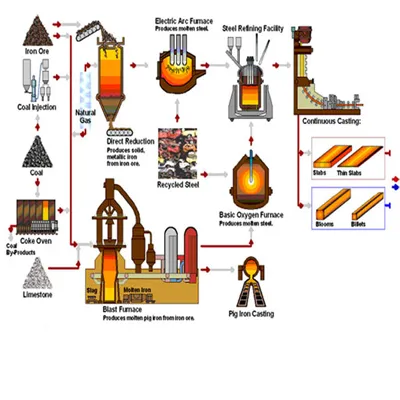
Since sustainability remains a crucial factor for most firms globally, there is a growing trend of green processes in the steel industry. Ideas for making green steel technologies will have advanced by 2025, thus creating realistic chances for producing environmentally sustainable steel at scale. Prevailing processes of making steel by using coal and coke in blast furnaces emits a lot of carbon. That said, there are new technologies like hydrogen based direct reduction and electric arc furnaces (EAFs) which are reducing the carbon footprint of the steel industry.
It has gained traction over the recent years because this method of steel production emits close to zero carbon. This process replaces coke by hydrogen, which makes the reduction process almost free of CO2 emissions. EAF, however, employs scrap steel and electricity in the manufacturing of new steel, as such it is environmentally friendly than the blast furnace mode of production. As organization across the globe actively engage in reduction of pollution, their buyers will prefer steel products made by such green technologies. The focus on green steel helps organizations grow sustainably while also satisfying customers’ demands for environmentally friendly products that adhere to sustainability standards that are likely to toughen in the future.
3D Printing and Additive Manufacturing in Steel
Additive manufacturing or 3D printing making new waves in changing how steel is made and how it is used in particular industries. The following predictions are made based on further improvements to the 3D printing technology; by 2025 advanced steel products will be custom made with great complexity using 3D printing. This allows manufacturing of metal part in a layered manner, which comes in handy in industries like aerospace, automobile industries and construction industries where the specifications that are required are unique and specific.
Benefits of 3D printing in steel available to B2B buyers are as follows. First, it enables organizations to achieve shorter cycle times and or lead times, this is important in sectors where timely delivery is very important. Second, it enables the production of unique and refined parts with low plate tools needed to manufacture molds. Third, it can support less waste generation in terms of material, which is important in attaining cost-ineffective and sustainable production by the companies. As the use of 3D printing is set to rise buyers will have to understand how they will be used in the industry at large and thus be integrated in the sourcing process.
| Also Read: Steel Technology Collaboration across Borders: Key Projects to Watch |
Advancements in Steel Coatings and Surface Treatments
This material is used extensively mainly for its excellent mechanical characteristics like strength, elasticity etc., but it undergoes corrosion and wear, therefore the life cycle of the product containing steel is shortened in very demanding conditions. In response to these difficulties which have been highlighted by automotive producers, steel makers are always working on upgrading the coating and or the surface treatment technology. Coating technologies shall have evolved by 2025 and deliver improved protection against corrosive forces, abrasive forces or any force that would wear out the surface that is being coated.
| Also Read: Top Innovations in Steel Technology to Watch in 2025 |
High tech coatings like zinc coatings, powder coating and anodizing are being enhanced by new materials and technology. For instance, self-healing coatings, which are capable of healing a damaged surface themselves are becoming possible – which will make them even more long-lasting and functional. Meanwhile, there is also the use of protective coatings that eliminate the extensive use of poisonous chemicals. These innovations will go a long way in aiding industries like; construction, oil and gas, and marine, as steel usually experiences harsh conditions. B2B buyers will benefit from a clear appreciation of the current developments in steel coatings and surface treatments. When buying steel with these improved layers, it will be possible for businesses to enjoy better and improved product durability and performance hence fewer repair and replacement jobs are needed in future. Furthermore, steel products that have enhanced coatings offer a competitive advantage where reliability and reliability are critical for the industry.
The Role of Digital Twins and Virtual Reality
Digital twins and virtual reality (VR) solutions are innovations that have decisively shifted the approach of steel producers to modeling and improving production processes. Digital twins can be applied to the ride of an actual system like a steel production line or a certain type of steel product and can serve as a reference for analysis of performance, mapping out the probable problems or as a means for improving efficiency. In the steel industry there have been experiments in use of digital twin and its effectiveness has been identified for enhancing production efficiency, consistent quality and minimizing losses.
On the other hand, VR is being incorporated in the training and simulation systems that offer the workers the realistic experience. This is especially paramount in steel production companies as safety is very crucial and operational productivity is paramount. Subsequently, VR enables the training of employees on new systems and enables them to appreciate certain processes without exposing them to certain catastrophic errors.
B2B buyers should therefore follow how the use of digital twins and VR influences steel production. Suppliers, who apply these technologies, can provide improved designs of products, increased accuracy of production and better quality of final results. Moreover, identifying how such technologies augment safety and minimize mistake rates would enable the buyers to make better decisions in selecting dependable and innovative suppliers of steel.
Steel Recycling and Circular Economy
The discussions regarding the circular economy and, in particular, recycling and recycling rates, are increasingly popular within the steel industry. Modern aperture is steel as one of the most recyclable material in the world and more efficiency steel will be recycling by the help of new technologies available in 2025. New technologies like star sorting, shredding and new methods of melting are allowing steel producers to recycle scrap steel and reduce the ore and energy demands tremendously.
It will help the B2B buyers looking for products made out of recycled steel and avail the benefit of lower cost, less depicting effects on the bigger environment and high quality products. Moreover, the companies that apply the circular economy become more prepared for the expectations of regular future changes and requirements in the sphere of sustainability and remain. For buyers who wish to contribute towards the sustainability of the environment, partnering with steel suppliers who need to recycle and reuse the materials is the right way to improving the sustainability of supply chains.
Artificial Intelligence in Steel Production
AI becomes an essential component for steel production for its effectiveness in enhancing operations efficiency, enhancing product quality, and lowering the overall expenses. As the fabrication process becomes more digitized, AI and, in particular, machine learning algorithms will be utilized to analyze the production data and extrapolate maintenance requirements and enhance steel production. AI can assist the steel industry to realize the weaknesses of production and quality in reality, then improve the quality of the products.
The use of AI in the processes of B2B suppliers can result in improved trustworthy steel products at reduced prices for the buyers. AI technologies also improve the reliability of the environment through predictive maintenance where the company can experience less breakdown hence leading to shorter production down times. It can be pointed out that AI is here to stay, and will be a major determining factor in the future of steel production, so buyers will have to learn more about it as time goes on.
Conclusion: Embracing the Future of Steel Technology
It is precisely by the development of those technologies that the giants of the steel industry are preparing for the shifts in the near future, towards the 2025 line. It is thus paramount for B2B buyers to develop as much insight as possible on the said trends with a view of optimizing their purchasing decisions and general value supply chain; specifically for the steel industry. Through these technologies, companies are able to stay relevant, bring prices down and cater to the ever demanding markets for better quality and sustainable steel products.
By 2025, several significant evolutions in the behavior of the steel industry will emerge, including smart manufacturing, sustainability, 3D printing, coatings, and AI. For B2B buyers, it is critical to aware of these trends to enhance their procurement and supply management decisions and create fit-for-purpose steel supply systems. With these technologies integrated into the various industries, businesses will be able to operate competitively, optimize costs, and make production to meet the ever increasing market need for superior quality and environmentally sustainable steel products.
By incorporating these trends, the potential of B2B buyers will not only be in a better place to handle the emergent nature of steel but will also be in a position to champion their respective industries in issue espousals such as innovation, sustainability and future business resiliency.
 Media Pack Download
 Newsletters
 Industrial Events