Electric Arc Furnace (EAF) Steelmaking Process: Working, Types, and Applications
Introduction:
The global steel industry is undergoing one of its most significant transformations in decades. As manufacturers face increasing pressure to reduce carbon emissions, improve energy efficiency, and adopt circular production models, the electric arc furnace (EAF) has emerged as a cornerstone of modern steel production.
Unlike traditional steelmaking methods that primarily depend on iron ore and coke, EAF steelmaking leverages recycled scrap metal, electricity, and advanced process controls to produce high-quality steel with lower environmental impact. This shift is enabling steel producers to become more flexible, cost-efficient, and responsive to fluctuating market demands.
Today, automotive manufacturers, construction companies, renewable energy projects, infrastructure developers, and industrial equipment manufacturers increasingly rely on steel produced through electric arc furnace technology. As investments in sustainable manufacturing continue to rise, understanding the EAF process has become essential for engineers, procurement professionals, plant operators, and manufacturing decision-makers.
This article explores how the electric arc furnace works, the different types of EAF systems, the complete steel production process, and its growing industrial applications.
What is an Electric Arc Furnace?
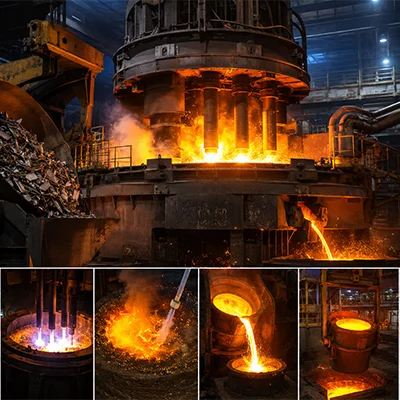
An electric arc furnace is a steelmaking system that melts metal using high-powered electrical arcs generated between graphite electrodes and the metal charge.
Rather than burning coke to create heat, the furnace converts electrical energy into thermal energy. Temperatures inside the furnace can exceed 3,500°C, making it possible to melt scrap steel and other metallic feedstock quickly and efficiently.
A typical steel electric furnace consists of:
- Furnace shell
- Refractory lining
- Graphite electrodes
- Electrode lifting system
- Transformer
- Furnace roof
- Water cooling system
- Slag door
- Oxygen injection equipment
- Tap hole
Modern EAF plants integrate digital automation, AI-based process optimization, and energy management systems to maximize productivity while minimizing power consumption.
Why EAF Steelmaking is becoming the Preferred Choice
Several global trends are driving the rapid adoption of EAF technology.
Sustainability
Electric arc furnaces emit considerably less carbon dioxide than conventional blast furnace operations, especially when powered by renewable electricity.
Recycling
EAFs support the circular economy by converting discarded steel products into new steel without degrading material quality.
Production Flexibility
Manufacturers can rapidly change steel grades, production volumes, and product specifications based on market demand.
Lower Capital Investment
Compared to integrated steel plants, EAF facilities generally require lower initial investment and shorter construction timelines.
Faster Production Cycles
Electric arc furnaces typically complete melting operations much faster than conventional steelmaking routes.
The Electric Arc Furnace Steel Production Process
Understanding the electric arc furnace steel production process helps illustrate why this technology has become central to modern steel manufacturing.
1. Scrap Collection and Preparation
Production begins with collecting recyclable ferrous materials from various industries.
Common feedstock includes:
- End-of-life vehicles
- Construction steel
- Industrial scrap
- Manufacturing offcuts
- Demolition waste
- Direct Reduced Iron (DRI)
- Hot Briquetted Iron (HBI)
Before charging, the scrap is sorted to remove contaminants such as plastics, copper, aluminum, rubber, and non-ferrous metals.
2. Charging the Furnace
Large scrap baskets transport prepared metal into the furnace.
Modern EAFs often use multiple charging baskets depending on production capacity.
Additional raw materials may include:
- Lime
- Dolomite
- Carbon
- Alloying elements
These materials assist slag formation and improve steel chemistry.
3. Arc Generation
Once the furnace roof closes, graphite electrodes lower toward the scrap.
Electric current flows through the electrodes, creating powerful electrical arcs that rapidly generate intense heat.
This stage represents the heart of the arc furnace process.
The arcs gradually melt the entire scrap charge into molten steel.
4. Oxygen Injection
Modern furnaces inject oxygen directly into the molten bath.
Benefits include:
- Accelerated melting
- Removal of impurities
- Reduced energy consumption
- Improved furnace efficiency
Oxygen also reacts with carbon to generate additional heat.
5. Slag Formation
Flux materials combine with impurities to form slag.
The slag layer serves multiple purposes:
- Protects molten steel
- Removes phosphorus
- Removes sulfur
- Reduces oxidation
- Improves thermal efficiency
Operators periodically remove excess slag during production.
6. Refining
Once the scrap has melted completely, operators refine the steel composition.
Adjustments may include:
- Carbon control
- Manganese addition
- Silicon adjustment
- Chromium addition
- Nickel addition
- Vanadium addition
- Temperature correction
Advanced sensors continuously monitor steel chemistry throughout refining.
7. Tapping
When the desired composition is achieved, the furnace tilts.
Molten steel flows into a ladle while slag remains inside the furnace.
The steel then moves to secondary metallurgy for additional treatment.
8. Continuous Casting
After refining, molten steel enters continuous casting machines where it solidifies into:
- Billets
- Blooms
- Slabs
These semi-finished products later undergo rolling into finished steel products.
EAF Steel Manufacturing Steps
The complete EAF steel manufacturing steps can be summarized as follows:
- Scrap collection
- Scrap sorting
- Furnace charging
- Arc generation
- Scrap melting
- Oxygen injection
- Slag formation
- Steel refining
- Furnace tapping
- Secondary metallurgy
- Continuous casting
- Rolling and finishing
This streamlined workflow allows many EAF plants to complete a heat in approximately 40–60 minutes, depending on furnace size and operating conditions.
How Electric Arc Furnace Produces Steel from Scrap Metal Step by Step
Many industrial professionals ask how electric arc furnace produces steel from scrap metal step by step.
The process is relatively straightforward:
- Recycled steel scrap enters the furnace.
- Graphite electrodes create intense electric arcs.
- Electrical energy melts the scrap.
- Oxygen accelerates melting and removes unwanted elements.
- Flux materials capture impurities inside slag.
- Alloying materials produce the required steel grade.
- Molten steel transfers into a ladle.
- Secondary refining improves cleanliness.
- Steel solidifies through continuous casting.
- Finished steel moves to rolling mills.
The remarkable aspect of EAF technology is that steel can be recycled repeatedly without losing its fundamental mechanical properties, making it one of the most sustainable industrial materials.
EAF Steelmaking Process Explained with Diagram and Stages
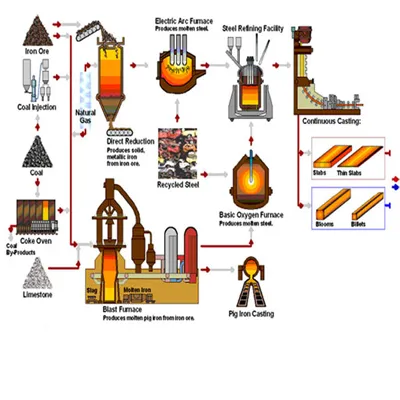
Below is a simplified representation of the EAF steelmaking process explained with diagram and stages.
Steel Scrap Collection
│
▼
Scrap Sorting & Preparation
│
▼
Furnace Charging
│
▼
Electric Arc Melting
│
▼
Oxygen Injection
│
▼
Slag Formation
│
▼
Steel Refining
│
▼
Furnace Tapping
│
▼
Secondary Metallurgy
│
▼
Continuous Casting
│
▼
Rolling & Finished Products
Each stage contributes to product quality, process efficiency, and operational sustainability.
Types of Electric Arc Furnaces
Modern steel plants use several EAF configurations depending on production objectives.
AC Electric Arc Furnace
Alternating Current (AC) furnaces use three graphite electrodes.
Advantages include:
- Proven technology
- High productivity
- Suitable for large steel plants
- Lower capital cost
These remain the most widely used EAF systems worldwide.
DC Electric Arc Furnace
Direct Current (DC) furnaces use one top electrode and one bottom electrode.
Benefits include:
- Reduced electrode consumption
- Lower electrical losses
- Improved arc stability
- Reduced noise
- Better energy efficiency
They are increasingly adopted in specialized steel production.
Ultra High Power (UHP) Electric Arc Furnace
These furnaces operate at significantly higher electrical power inputs.
Advantages include:
- Faster melting
- Higher throughput
- Reduced production time
- Lower energy per ton
Many modern mini-mills employ UHP technology.
Twin Shell Electric Arc Furnace
Twin-shell furnaces alternate between two furnace shells.
While one shell melts steel, the other undergoes charging or tapping.
Benefits include:
- Reduced idle time
- Increased productivity
- Improved transformer utilization
Difference between Electric Arc Furnace and Blast Furnace Steelmaking
Understanding the difference between electric arc furnace and blast furnace steelmaking is important when evaluating production strategies.
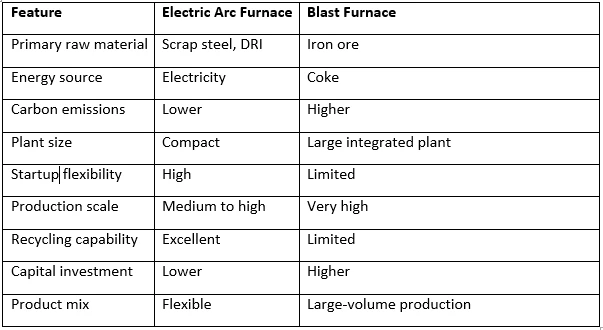
Although blast furnaces remain essential for producing primary steel from iron ore, EAF technology is becoming increasingly attractive due to its environmental and economic advantages.
Industrial Applications of EAF Steel
Electric arc furnace steel serves a wide range of industries.
Construction
Structural beams, reinforcing bars, bridges, commercial buildings, and infrastructure projects extensively utilize EAF-produced steel.
Automotive Manufacturing
Vehicle manufacturers use EAF steel for:
- Chassis
- Wheels
- Suspension components
- Frames
- Body structures
Advanced refining enables production of high-strength automotive grades.
Renewable Energy
Wind turbines, solar mounting systems, hydroelectric facilities, and energy storage infrastructure increasingly rely on recycled EAF steel.
Machinery Manufacturing
Industrial equipment manufacturers use EAF steel for:
- Machine frames
- Heavy equipment
- Mining machinery
- Agricultural equipment
- Material handling systems
Oil and Gas
Steel plates, pipelines, pressure vessels, and drilling equipment frequently originate from EAF production routes.
Shipbuilding
Marine-grade steel produced through EAF technology supports commercial vessels, offshore platforms, and naval applications.
Emerging Innovations in EAF Steelmaking
The next generation of EAF plants is becoming increasingly digital and intelligent.
Some of the latest advancements include:
- Artificial intelligence for process optimization
- Digital twin technology
- Predictive maintenance
- Automated electrode regulation
- Real-time chemistry monitoring
- Smart energy management
- Robotic sampling systems
- Hydrogen-assisted steelmaking
- Renewable electricity integration
- Carbon capture technologies
These innovations help manufacturers improve productivity while supporting global decarbonization goals.
Challenges Facing EAF Steelmaking
Despite its advantages, EAF technology presents several operational challenges.
Scrap Availability
Growing global demand for recycled steel can create supply constraints and price volatility.
Electricity Costs
Since electricity is the primary energy source, fluctuating power prices significantly influence production costs.
Scrap Quality
Contaminated scrap may introduce unwanted residual elements that affect steel quality.
Electrode Consumption
Graphite electrodes remain a major consumable cost requiring careful management.
Grid Stability
Large EAF facilities require stable, high-capacity electrical infrastructure to operate efficiently.
Continuous investment in automation, energy optimization, and feedstock management is helping steel producers address these challenges.
The Future of Electric Arc Furnace Steelmaking
As governments and industries pursue ambitious decarbonization targets, electric arc furnace technology is expected to play an even larger role in global steel production. Increasing availability of renewable energy, improvements in scrap collection systems, and advancements in digital manufacturing are accelerating this transition.
Many steel producers are also integrating EAFs with direct reduced iron (DRI) produced using low-carbon hydrogen, creating pathways toward near-zero-emission steel. Combined with AI-driven process optimization, predictive maintenance, and advanced metallurgy, the next generation of EAF facilities will deliver higher productivity, improved product quality, and greater operational resilience.
For manufacturers seeking to balance sustainability with profitability, the electric arc furnace represents more than an alternative steelmaking route—it is becoming the foundation of the industry's future.
Conclusion
The electric arc furnace has transformed steel production by enabling manufacturers to produce high-quality steel through an energy-efficient and recycling-focused approach. By replacing traditional dependence on iron ore with scrap-based feedstock, EAF steelmaking supports circular manufacturing while reducing environmental impact.
From the arc furnace process and electric arc furnace steel production process to the complete EAF steel manufacturing steps, modern EAF technology offers speed, flexibility, and operational efficiency that align with the evolving needs of today's industrial landscape.
As innovations in automation, renewable energy integration, and low-carbon metallurgy continue to advance, electric arc furnace steelmaking will remain a critical driver of sustainable growth across construction, automotive, energy, machinery, and infrastructure sectors. For steel producers and industrial manufacturers alike, investing in EAF technology is not just a response to market trends—it is a strategic step toward a more resilient and environmentally responsible future.
 Media Pack Download
 Newsletters
 Industrial Events