Enhancing Safety and Efficiency through Robotics in Steel Manufacturing
The use of robotics in the steel production process is not merely a technological improvement in an industry as taxing and risky as steel production, but a revolution. They are considered to be one of the most demanding industrial environments of the planet due to the heat, dust, and mechanical intensity of the steel plants. However, it is this challenge that is making the innovation happen, thanks to robots in steel plants. Automation is changing the process by which steel is produced, handled, and refined, whether through automation of hazardous processes in steel manufacturing or implementation of AI-powered robots to work in the heavy industry.
The Rise of Robotics in the Steel Industry
The history of robotics in steel making was a test, more than a test how the robots, which are used in computerized assemblies of the automobiles, survive and work in such harsh environments as in molten metal and the heat of the furnace? The solution, as it now appears, is amazingly good. Current industrial robots used in steel industries are able to work in temperatures up to 1,200°C, in areas with no visibility, and they can work with millimeter accuracy.
With the increasing demand for steel worldwide, currently fuelled by infrastructure building, green energy initiatives, and motor vehicle production, automation in steel plants is not only preferable but vital. The rate at which smart robotics is being adopted in steel production has increased significantly over the previous decade, which bears a sign of increased awareness: safety and efficiency cannot be separated when robots are put at the forefront.
Why Safety Comes First in Steel Manufacturing
Steelmaking is itself a dangerous business. It is also a hotbed of injuries since workers usually work around furnaces, molten slag, and heavy machinery. Automation in hazardous areas comes in handy here. Robots in steel plants can now complete the same tasks in a safe and steady manner instead of exposing human operators to the hazardous heat or deadly gases.
Making work less dangerous through robotics is not a fantasy - it is a reality. An example is that robotic manipulators are capable of eliminating slag, working with ingots, and keeping casting processes under continuous operation in dangerous locations without the need for human operators. These inventions make workers preoccupied with monitoring and optimization instead of putting their lives at risk on the production floor.
During the last ten years, steel firms that have used robotic technology in manufacturing steel have reported a quantifiable reduction in the number of accidents in the workplace. This not only enhances employee well-being but also helps in improving the reliability of operation within the organization, as the number of disruptions that are caused by injury-related downtime reduces.
Efficiency beyond Human Capability
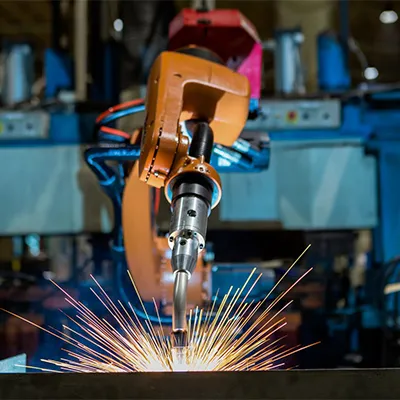
Although safety is the emotion driver, efficiency is the economic driver. Robotics in the steel production industry, combined with AI-based analytics, has brought new dimensions of uniformity and productivity. Manual skills, such as welding, casting, cutting, and packaging, can be left to AI-controlled welding robots to serve the heavy industry and minimize the amount of errors and improve throughput.
There is also smart robotics in the steel production that reduces the waste of materials. Robots have accurate control systems and real-time sensors that allow them to measure, adjust, and streamline processes in real-time, which human workers can only be able to do at a fraction of the speed and with an equal fraction of accuracy. Robots used in manufacturing steel also guarantee an even quality of products so that rejections will be reduced and the satisfaction of customers will be enhanced.
We may illustrate this change by a mere analogy:
| Parameter | Traditional Manual Steel Production | Steel Plant Automation Using Robotics |
| Safety Level | High risk of burns, exposure, and fatigue | Significantly reduced risk through automation in hazardous environments |
| Productivity | Limited by human fatigue and manual control | Consistent 24/7 operation with smart robotics |
| Quality | Inconsistent due to human error | Precise, repeatable quality via robotic control |
| Energy Use | Often inefficient | Optimized through an AI-powered process regulation |
| Labor Utilization | Intensive and risk-prone | Skilled supervision with minimal direct exposure |
The comparison shows vividly how the automation of steel plants transforms the safety, as well as the efficiency, aspects of present-day steelmaking.
Dangerous Environment Automation: Change of Direction
You can think of a robot, who works 24 hours around the clock in a furnace, and does not feel the heat, the poisonous fumes, and does what a human being would have done it. This is the philosophy of automation in dangerous places.
Some of the most hazardous operations in steel foundries are tapping molten metal, pouring the molten metal into molds, or even checking the hot billets. These jobs are currently performed with the aid of robots in steel plants via remote-controlled systems, heat-resistant coating, and more sophisticated sensors. Such robotic mechanisms can identify structural abnormalities, temperature variation, or leaks during their occurrence so that they can respond more promptly and prevent disastrous failures.
Moreover, steel manufacturing robots have vision-guided systems that enable them to make accurate cuts, stacking, and transportation in the dusty and low-visibility areas. That is to say, these industrial robots in the steel industry setting do not simply displace human labor - they enhance its potential, making it safer, more intelligent, and more data-driven.
AI-Powered Robots: Redefining Steel Plant Intelligence
Artificial intelligence is the next stage of automation of steel plants. The heavy industry AI robots are now able to independently learn, adjust, and optimize the work according to real-time situations. To illustrate the point, a slag composition robot will be able to automatically adjust the pouring speed or temperature to obtain the optimal alloy mix.
The integration of machine learning algorithms in smart robotics in steel production will guarantee that robots are developed with each batch, and they become better in their operation as time goes by. They are compatible with other systems that comprise industrial IoT, predictive maintenance applications, and cloud analytics, which are the core of what the experts refer to as the smart steel factory.
According to a report by MarketsandMarkets, it is believed that implementing AI-controlled robots to work in the heavy industry will help decrease the total cost of steel production by up to 20 percent by 2030, and at the same time, the number of accidents will also fall by almost fifty percent. These statistics confirm the reason why major manufacturers are putting substantial money into robotics in steel production, not only as a cost reduction tool, but also as a safety and efficiency plan in the long run.
Automating Dangerous Tasks in Steel Production
There are some processes of steel making that are notorious due to the risk involved- loading furnaces, deslagging, and handling molten materials, among others. As robotic systems are incorporated in the production of the steel industry, such hazardous operations are being automated at an alarming rate.
As an example, the cleaning of ladles, moving billets, and sampling of hot metal can be done through robots in steel plants that do not necessarily require human intervention. The automation of dangerous workplaces in the continuous casting factories has enabled the machines to measure the amount of liquid metals, cast with a high degree of accuracy, and even sense flaws in quality before hardening.
Automation of hazardous processes in steel production prevents the loss of lives of workers as well as improves the consistency of the process. Robots are not affected by fatigue, distraction, or error during stressful situations and hence are the best allies when it comes to repetitive and high-hazard tasks.
How Robotics Strengthens Human Roles
One of the misconceptions is that robotics in the steel industry kills human jobs. As a matter of fact, it changes them. Employees who used to work in physically punishing environments are moving to supervisory and analytical positions where they control robotic systems that produce steel and read performance data.
This is the human-robot cooperation of smart robotics in steel production.
Plants are attaining greater flexibility and innovation by integrating human decision-making with robotic accuracy. Rather than eliminating the human skill, robots in steel plants enhance it.
This is leading to the retraining of employees in fields such as robot maintenance, programming, and AI surveillance - producing a more skilled generation of steel industry workers.
Market Insights: Global Adoption of Robotics in Steel Manufacturing
The market has witnessed a double-digit growth in the use of industrial robots in the steel industry operations around the world. The International Federation of Robotics (IFR) revealed that the number of robot installations in the metal and steel industries has increased by more than 15 percent every year during recent years. This has been the most dramatic in Asia, especially China, Japan, and India, where infrastructure and automotive-grade steel are in demand.
European manufacturers, in turn, are in the first place to supply AI-controlled robots in heavy industry aimed at sustainability - increasing the efficiency of energy consumption, minimizing emissions, and recycling scrap material. North America is shifting to minimize work-related injuries by means of robotics, and it is incorporating safety-first systems, which are in line with OSHA and ISO.
In India, leading steel manufacturers such as Tata Steel and JSW are leading the way on automation of their steel plants, introducing robotic inspection systems, and building predictive artificial intelligence to keep track of the well-being of their plants. These innovations not only make Indian steel-making modern, but also make the country one of the potential leaders in smart steel technology.
The Future of Steel Manufacturing: A Robotic Revolution
Going forward, robotics in the steel industry, artificial intelligence, and data analytics will bring a new concept of industrial production through synergy. The steel plant of the future will be a place where automation of hazardous environments is the rule and not the exception, and where all processes, including raw material handling, progress to final rolling are optimized with intelligent and connected robots.
The vision is quite long-term: it is to provide fewer work-related injuries with robotics, maintain uniform quality, and have sustainable and cost-effective production. With the further development of AI-centered robots in the heavy industry, they will not only make the steel plants safer but also more comfortable, versatile, and competitive in a global market.
Conclusion
Robots introduction in steel plants is bringing in a new dawn where safety, efficiency, and sustainability are being realized in a balanced state. Industries are discovering through the automation of steel plants that it is not light and dark, but that being able to save human lives and increase productivity go hand in hand.
Since it can be seen in automation of hazardous activities in the steel production to the smart robotics deployed in the steel production, each innovation brings the steel industry nearer to the point where the risks get reduced, the performance gets optimal, and the machines complement human skills rather than substituting them.
Lastly, the idea of robotics in the steel production does not mean the replacement of human workers with machines. It has to do with empowering them with safer, smarter and even more sustainable tools to create a future of one of the most essential industries of the world.
 Media Pack Download
 Newsletters
 Industrial Events