Copper Ore Mining and Processing: Extraction, Concentration, Technologies and Industrial Applications
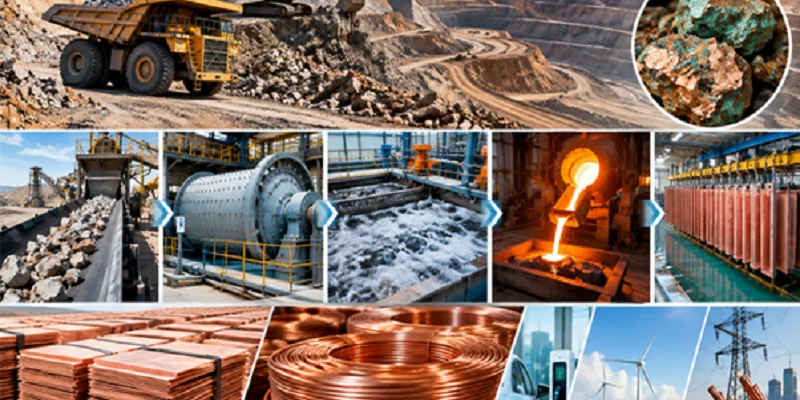
Copper has been powering human civilization for thousands of years, and today it sits at the center of the global shift toward electrification, renewable energy, and advanced manufacturing. From the wiring in your home to the motors in electric vehicles, almost nothing modern runs without copper. But before copper reaches a factory floor, it goes through a long and technically demanding journey - one that starts deep underground or in open pits and ends with a refined, high-purity metal ready for industrial use.
This article breaks down how copper ore mining works, how copper ore beneficiation transforms raw rock into usable concentrate, the technologies driving modern copper extraction, and the equipment that makes it all possible.
What Is Copper Ore Mining?
Copper ore mining is the process of extracting copper-bearing rock from the earth. Copper rarely occurs in a pure, usable form in nature. Instead, it's found combined with other elements in minerals such as chalcopyrite, bornite, chalcocite, and malachite. These ores typically contain only 0.5% to 2% copper by weight, which means enormous volumes of rock must be mined and processed to produce a relatively small amount of usable metal.
There are two primary mining methods used depending on the depth and location of the deposit:
- Open-pit mining - used when copper deposits lie close to the surface. Large benches are cut into the earth in a stepped pattern, and ore is removed using massive haul trucks and excavators. This is the most common method globally, accounting for the majority of copper production.
- Underground mining - used when deposits are too deep for open-pit extraction to be economical. Techniques like block caving and sublevel stoping are used to access ore bodies hundreds of meters below the surface.
Both methods begin with drilling and blasting to break the rock into manageable pieces, which are then loaded and transported to a processing facility.
How Copper Ore Is Extracted and Concentrated
Once ore is mined, the real technical work begins. Since raw ore contains a low percentage of copper, it must be concentrated before it can be smelted or refined economically. This is where copper ore beneficiation comes in.
The general sequence of how copper ore is extracted and concentrated looks like this:
- Crushing - Large chunks of ore from the mine are reduced in size using jaw crushers, cone crushers, and gyratory crushers.
- Grinding - The crushed ore is further reduced to a fine powder using ball mills or SAG (semi-autogenous grinding) mills, increasing the surface area for chemical or mechanical separation.
- Concentration - The ground ore is treated to separate valuable copper minerals from waste rock (gangue), producing a copper concentrate.
- Extraction - The concentrate or leached copper solution is processed further to produce metallic copper, either through smelting or electrochemical methods.
This staged approach is standard across nearly every copper operation worldwide, though the specific techniques used at each stage can vary based on ore type and deposit characteristics.
Copper Ore Processing Stages Explained
Understanding copper ore processing stages in detail helps clarify why copper production is such a capital- and energy-intensive industry.
Stage 1: Comminution (Crushing and Grinding)
This is the foundation of the entire process. Ore must be broken down to a particle size fine enough that copper minerals are physically liberated from surrounding rock. Poor comminution leads to inefficient downstream recovery, so mining companies invest heavily in optimizing crusher and mill performance.
Stage 2: Beneficiation (Concentration)
After grinding, the ore slurry moves into concentration circuits where copper minerals are separated from waste material. The two dominant approaches are froth flotation and hydrometallurgical leaching, both discussed in detail below.
Stage 3: Smelting or Leaching
Depending on the ore type - sulfide or oxide - copper concentrate is either smelted at high temperatures or leached with acid solutions to dissolve the copper.
Stage 4: Refining
Whether copper comes from smelting or leaching, it typically needs further purification through electrorefining or electrowinning to reach the 99.99% purity required for electrical applications.
Stage 5: Casting and Finishing
The final refined copper is cast into cathodes, rods, or wire bar forms ready for shipment to manufacturers.
Copper Ore Concentration Methods
There are several established copper ore concentration methods, each suited to different ore mineralogy:
Froth Flotation
Froth flotation is the most widely used method for concentrating sulfide copper ores like chalcopyrite. Finely ground ore is mixed with water and chemical reagents in flotation cells. Air bubbles are introduced, and hydrophobic copper mineral particles attach to the bubbles and rise to the surface as froth, while unwanted gangue sinks. The froth is skimmed off, producing a copper concentrate that typically contains 20–30% copper - a massive upgrade from the original 0.5–2% ore grade.
Hydrometallurgical Leaching (SX-EW)
For oxide ores, which don't respond well to flotation, leaching is preferred. Sulfuric acid is applied to the ore - either in heaps (heap leaching) or vats - dissolving copper into a pregnant leach solution (PLS). This solution then goes through Solvent Extraction and Electrowinning (SX-EW), a process that purifies and concentrates the copper before depositing it as pure metal onto cathode plates using electrical current.
Gravity Concentration
Used less frequently today, gravity separation relies on density differences between copper minerals and waste rock. It's sometimes used as a pre-concentration step ahead of flotation.
Magnetic and Electrostatic Separation
These methods are typically supplementary, used to remove magnetic impurities or separate specific mineral fractions in more complex ore bodies.
Copper Extraction: From Concentrate to Metal
Once concentrate is produced, copper extraction proceeds through one of two main pathways:
Pyrometallurgical Route (Smelting): This is used for sulfide concentrates. The concentrate is smelted in a furnace at extremely high temperatures, producing a molten copper matte. This matte is further processed in a converter to produce blister copper, which is then fire-refined and electrorefined to achieve high purity.
Hydrometallurgical Route (Leach-SX-EW): As described above, this pathway is used mainly for oxide ores and produces copper cathodes directly through electrowinning, without the need for smelting.
Roughly 80% of the world's copper is produced via the pyrometallurgical route, while the remainder comes from hydrometallurgical processing, which is generally more environmentally favorable due to lower emissions.
Technologies Used in Copper Mining
Modern mining operations rely on a growing range of advanced technologies used in copper mining to improve efficiency, safety, and environmental performance:
- Autonomous haul trucks and drilling rigs that reduce labor costs and improve site safety
- Sensor-based ore sorting, which uses X-ray or near-infrared sensors to separate high-grade ore from waste before it even enters the mill
- AI-driven process optimization for flotation circuits, grinding efficiency, and predictive maintenance
- Bioleaching, which uses naturally occurring bacteria to accelerate copper dissolution from low-grade ores
- Real-time geological modeling using drone surveys and satellite data to guide mine planning
- Water recycling and dry stacking of tailings, reducing the environmental footprint of processing operations
These innovations are especially important as the industry moves toward processing lower-grade ores, since easily accessible high-grade deposits become increasingly scarce.
Copper Mining Equipment and Applications
A wide range of specialized copper mining equipment supports each stage of the process:
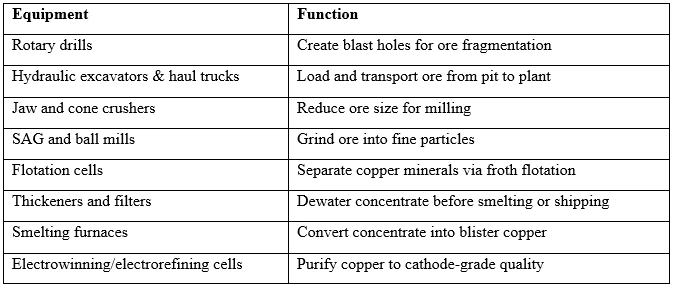
This equipment is applied not just in standalone copper mines but also in polymetallic operations that recover copper alongside gold, silver, molybdenum, and other valuable metals - improving the overall economics of a mining project.
Industrial Applications of Refined Copper
Once processed, copper feeds into nearly every major industry:
- Electrical and electronics — wiring, circuit boards, motors, and transformers
- Construction — plumbing, roofing, and architectural fittings
- Renewable energy — solar panels, wind turbines, and EV batteries and motors
- Telecommunications — cabling and connective infrastructure
- Industrial machinery — heat exchangers, bearings, and alloys like brass and bronze
As global demand for electrification and clean energy grows, copper's role as a foundational industrial metal continues to expand.
Frequently Asked Questions
How is copper ore extracted and concentrated?
Copper ore is crushed and ground into fine particles, then concentrated through froth flotation or leaching to separate copper minerals from waste rock, producing a copper concentrate or leach solution for further processing.
What is the difference between copper mining and copper beneficiation?
Mining refers to extracting raw ore from the earth, while beneficiation refers to the processing steps - crushing, grinding, and concentration - used to upgrade that ore into a higher-grade copper concentrate.
What is the most common copper concentration method?
Froth flotation is the most widely used method, particularly for sulfide ores, because it efficiently separates fine copper mineral particles from surrounding gangue material.
What technologies are improving copper mining today?
Sensor-based ore sorting, autonomous equipment, AI-driven process control, and bioleaching are among the key technologies improving efficiency and reducing environmental impact in modern copper mining.
Final Thoughts
Copper ore mining and processing is a multi-stage, technology-driven industry that transforms low-grade rock into one of the world's most essential industrial metals. From crushing and flotation to smelting and electrorefining, each stage plays a critical role in ensuring copper meets the purity standards required for electrical, construction, and renewable energy applications. As demand grows and ore grades decline, continued innovation in extraction and concentration technology will remain central to keeping copper supply chains efficient, sustainable, and ready to power the future.
 Media Pack Download
 Newsletters
 Industrial Events