Ironmaking Efficiency and Productivity: Causes of Quality and Performance Losses
Quick Answer
Ironmaking efficiency and productivity fall when something disturbs the furnace’s gas flow, thermal balance, or liquid drainage. The most common triggers are weak or inconsistent coke, poor burden size and quality, late or inconsistent process control, and hearth or cast house problems. These losses usually start small, then compound into higher fuel rates, lower output, and off-spec hot metal.
Most of them are predictable, which means most of them are fixable.
Ironmaking Efficiency vs. Ironmaking Productivity: What’s the Difference?
People use these terms interchangeably, but they measure different things.
Ironmaking productivity is how much hot metal you produce, usually expressed as tonnes per cubic metre of working volume per day (t/m³/day). Furnace productivity in well-run blast furnaces often falls somewhere around 2.0 to 2.5 t/m³/day, though it varies with furnace design and raw materials.
Ironmaking efficiency is how little you spend to get that output. It covers fuel rate (coke plus injected coal per tonne of hot metal), energy use, and how well the reducing gas is used inside the furnace. Blast furnace efficiency is often tracked through gas utilization and fuel rate.
Ironmaking quality is the third leg. It describes whether the hot metal comes out on specification: the right silicon, sulfur, carbon, and temperature, cast after cast.
A furnace can be pushed for tonnage while efficiency and quality quietly suffer. The best operators watch all three together.
Factors Affecting Ironmaking Productivity and Efficiency
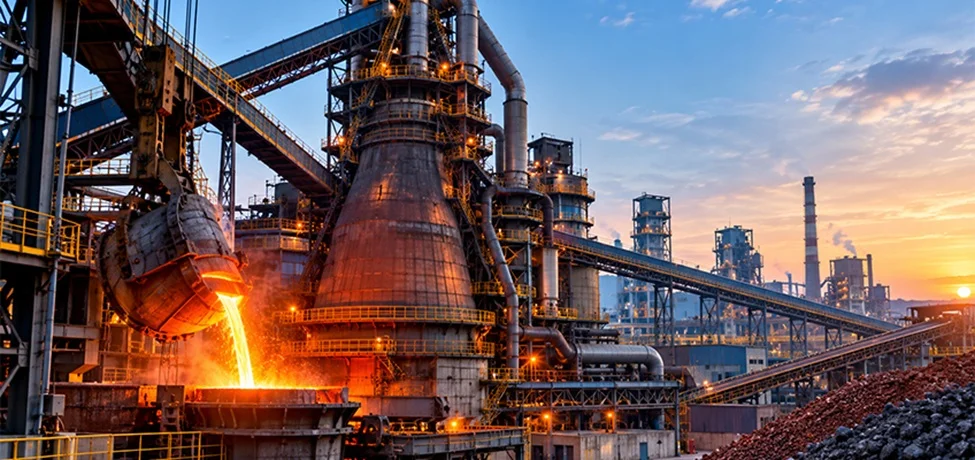
Think of a blast furnace as a giant counter-current reactor. Hot gas rises, solids descend, and liquids drain to the hearth. Anything that disturbs the flow of gas up or the flow of material down costs you money. These are the main factors affecting ironmaking productivity and efficiency.
1. Coke quality and consistency
Coke is both fuel and structure. In the hot lower furnace, it’s the solid framework that keeps gas and liquid paths open. Low strength after reaction (CSR), high reactivity (CRI), and too many fines all reduce permeability. When permeability drops, pressure drop rises, operators cut the wind, and productivity falls with it.
2. Burden quality and size distribution
Fines in sinter, ore, or pellets fill the gaps between larger particles and block gas flow. Poor reduction-degradation behavior in sinter, or abnormal swelling in pellets, makes it worse. Gas then channels through the easy paths and skips the rest of the stack, which hurts blast furnace efficiency directly.
3. Burden distribution and charging practice
Where material lands on the stockline matters as much as what the material is. Too much central gas flow wastes heat at the top. Too much wall flow damages refractory and cooling staves. Worn chute components and inconsistent charging programs are common and often overlooked causes.
4. Blast conditions and stove performance
Hot blast temperature, oxygen enrichment, moisture, and blast volume set flame temperature and gas volume. If the stoves can’t hold their dome temperature, you end up compensating with more coke. Lost blast temperature shows up directly in your fuel rate.
5. Hearth condition and drainage
When tapping is slow or incomplete, liquid builds up in the hearth. That disturbs the raceway, lifts the dead man, and creates thermal swings. Poor drainage cuts productivity and shortens campaign life.
6. Unplanned stoppages
A tuyere leak, a cooling water fault, or a charging equipment failure can force a bank or a long wind reduction. Short stoppages add up faster than most plants realize.
Causes of Poor Hot Metal Quality in Ironmaking
Hot metal quality is usually judged on silicon, sulfur, temperature, and carbon, along with cast-to-cast consistency. Typical targets are silicon around 0.4 to 0.8%, sulfur below roughly 0.03 to 0.04%, and tapping temperature around 1,480 to 1,520°C. Every plant has its own specification, but the causes of poor hot metal quality in ironmaking are surprisingly similar everywhere.
|
Quality problem |
Common causes |
|
High silicon |
Excess heat in the lower furnace, high flame temperature, high coke rate, unstable gas flow |
|
High sulfur |
High sulfur input from coke or coal, low slag basicity, cold furnace, poor slag fluidity |
|
Low hot metal temperature |
Low thermal state, irregular burden descent, delayed or long casts |
|
Wide cast-to-cast variation |
Variable raw materials, unstable burden, slow response to process changes, slips and hanging |
|
Off-spec slag chemistry |
Variable ash in coke and coal, inaccurate basicity control, inconsistent flux additions |
The common thread is variability. A furnace can run well under almost any steady set of conditions. What damages quality is the swing: today’s coke differs from yesterday’s, the descent stutters, and the response comes a few hours too late.
Why Stability Matters More Than Averages
Here’s something that rarely makes it into textbooks. A plant with average but stable raw materials will often outperform a plant with excellent but variable materials.
The reason is that a blast furnace has a long memory. Burden takes roughly six to eight hours to descend, so every disturbance echoes through a full shift or more. That’s why experienced ironmakers focus on three kinds of stability:
1. Stable inputs: consistent size, chemistry, and moisture
2. Stable descent: no hanging, no slips
3. Stable thermal state: small early corrections instead of big late ones
If you only fix one thing, fix variability.
Ironmaking Process Control: Where Most Gains Hide
Good ironmaking process control is the difference between reacting and anticipating. Modern furnaces produce huge amounts of data, but the value comes from acting on it early.
- Watch leading indicators. By the time silicon moves in the cast, the cause is hours old. Top gas temperature, gas utilization, stack pressure drop, and stave heat loads shift much earlier.
- Use thermal state models. Predicting silicon and hot metal temperature from process signals lets operators make small adjustments before quality drifts.
- Standardize response rules. When two shifts react differently to the same signal, you create artificial variation. Clear playbooks reduce it.
- Link raw material data to control decisions. Coke CSR, size, and moisture should inform operating moves, not just end up in a quality report.
- Protect data quality. A drifting sensor can mislead a whole crew. Calibration is dull and extremely valuable.
Ways to Improve Blast Furnace Productivity and Efficiency
These are the practical ways to improve blast furnace productivity and efficiency, roughly in order of payback.
Step 1: Fix the inputs first
Tighten screening for coke, sinter, and ore at the stockhouse. Even a small reduction in fines reaching the furnace improves permeability. Set clear acceptance limits for coke strength and reactivity, and enforce them.
Step 2: Stabilize the burden
Use consistent charging programs, inspect the chute regularly, and monitor the stockline profile. Aim for a steady gas distribution rather than constant tweaking.
Step 3: Balance fuel injection and oxygen enrichment
Pulverized coal injection (PCI) replaces expensive coke, and oxygen enrichment raises flame temperature and output. The key is balance. Pushing injection too far can overload the raceway and hurt permeability.
Step 4: Maximize hot blast temperature
Better stove operation, clean checkers, and good heat recovery deliver higher blast temperature with less fuel. It’s one of the most reliable efficiency gains available.
Step 5: Tighten cast house practice
Timely, complete tapping keeps the hearth clean and the furnace stable. Invest in runner maintenance, tap-hole clay quality, and consistent drilling and plugging.
Step 6: Build predictive maintenance
Monitor the cooling system, inspect tuyeres on a routine, and use condition-based checks on charging equipment. These prevent the stoppages that erase weeks of good performance.
Step 7: Train for consistency
Technology matters, but people run furnaces. Scenario-based training and disciplined shift handovers lead to quieter, steadier operation.
Quick Diagnostic Checklist
Before blaming a single cause, ask:
- Has coke CSR or size changed in the past week?
- Are fines in the burden trending up?
- Is pressure drop rising for the same wind volume?
- Has gas utilization dropped?
- Are taps getting longer or less complete?
- Are silicon and temperature swinging more from cast to cast?
Two or three “yes” answers usually point you toward the root cause.
Frequently Asked Questions
What is the most common cause of low blast furnace productivity?
Poor permeability, most often from weak coke or excess fines in the burden. It forces operators to reduce blast volume, which cuts output directly.
What causes poor hot metal quality?
Mainly variability in raw materials, unstable gas flow, and a thermal state that drifts too high or too low. High sulfur input and low slag basicity add to sulfur problems.
How does coke quality affect ironmaking efficiency?
Weak or reactive coke breaks down in the furnace, reduces permeability, and raises fuel rate. High ash and sulfur in coke also increase slag volume and sulfur load.
What is a good blast furnace productivity figure?
It depends on furnace size, raw materials, and operating strategy. Many well-run furnaces fall around 2.0 to 2.5 t/m³/day, but compare against your own design and history.
How can I reduce fuel rate without hurting stability?
Improve burden quality and distribution first. Then raise hot blast temperature and tune PCI and oxygen use in small steps, watching permeability throughout.
Can automation or AI improve ironmaking process control?
Yes, particularly for predicting thermal state and flagging early signs of instability. It works best with clean data and clear operating rules.
Final Thoughts
Ironmaking efficiency, productivity, and quality are three views of the same system. When gas flows evenly, burden descends smoothly, and the thermal state stays steady, output rises, fuel use falls, and hot metal comes out on spec. When any of these slip, losses compound quietly in the background.
Start with the fundamentals: input quality, burden stability, and early detection. Get those right, and every other improvement will actually hold.
 Media Pack Download
 Newsletters
 Industrial Events