Metallurgical Coke in Ironmaking: Role, Quality and Blast Furnace Performance
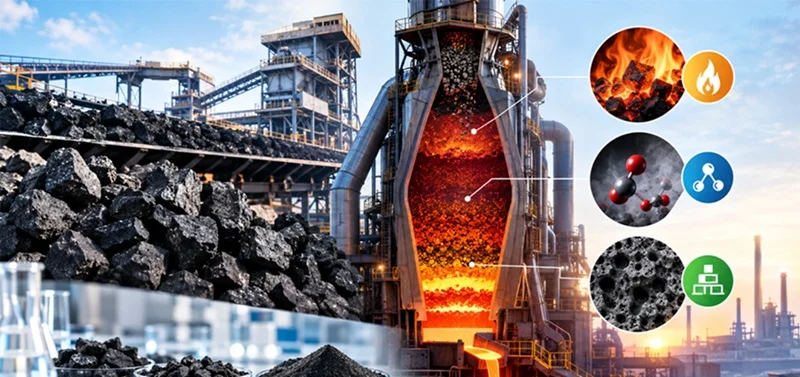
Why Every Ironmaker Talks About Coke
A blast furnace can burn through hundreds of kilograms of coke for every tonne of hot metal it makes. At that scale, even a small slip in coke quality shows up on the cost sheet within days. That’s why metallurgical coke is a boardroom topic as much as a furnace-floor one.
Metallurgical coke is a hard, porous, carbon-rich solid made by heating coking coal without air. In ironmaking it works as fuel, as a chemical reducing agent, and as the physical skeleton that holds up the furnace burden and lets gas flow through it.
No other material in the furnace does all three jobs at once. That’s why, even with pulverized coal injection, natural gas and hydrogen trials making headlines, coke in ironmaking still sits at the heart of the process. This guide covers what coke does, what separates good coke from bad, and how coke quality shows up in daily furnace performance and cost.
What Is Metallurgical Coke?
Metallurgical coke (often just “met coke”) is the solid residue left when coking coal is heated to around 1,000-1,100°C in an oxygen-free oven. The volatile matter burns off or is captured as by-products, and the coal softens, swells and resolidifies into a strong, porous lump of mostly carbon.
Not just any coal can do this. Only coking coal, which has the right plastic properties when heated, turns into coke strong enough for a blast furnace. That’s why prime coking coal commands a premium, and why countries without domestic reserves, India among them, depend heavily on imports.
How Coke Production Works (In Plain Words)
Coke production follows a fairly steady routine:
1. Coal blending. Several coals (hard coking, semi-soft, PCI-grade and so on) are mixed to hit a target for ash, sulphur, volatile matter and coking behaviour. Blend design is as much craft as science.
2. Crushing and charging. The blend is crushed to a fine size and charged into narrow slot ovens, or into stamp-charged ovens in some plants.
3. Carbonization. The coal bakes for roughly 14-18 hours (sometimes longer) at about 1,000-1,100°C.
4. Pushing and quenching. The red-hot coke is pushed out and cooled, either by water (wet quenching) or by inert gas (coke dry quenching, or CDQ). CDQ recovers heat and usually gives drier, more uniform coke.
5. Screening. Coke is sized (typically around 25-80 mm for the blast furnace). Smaller “nut coke” often goes into the burden separately.
As a rough rule, about 1.3-1.4 tonnes of dry coal gives one tonne of coke, and the by-products (coke oven gas, tar, benzol) are used elsewhere in the plant.
The Role of Metallurgical Coke in Ironmaking
The role of metallurgical coke in ironmaking comes down to three functions. Miss any one and the furnace struggles.
1. It’s the main fuel
Coke burns in front of the tuyeres, where hot blast hits it at the bottom of the furnace. That combustion generates the heat, with flame temperatures above 2,000°C, needed to melt iron and slag and keep the hearth around 1,450-1,550°C.
2. It’s the reducing agent
The burning coke produces carbon monoxide (CO). That gas rises through the stack and strips oxygen from iron ore (Fe₂O₃ → Fe₃O₄ → FeO → Fe). Coke carbon also takes part in direct reduction in the hotter lower zone. Without that gas, you don’t get iron.
3. It’s the structural support
This is the least appreciated job. Deep in the furnace, ore and flux have softened and melted, but coke stays solid. It forms a permeable “coke bed” that supports the burden above, lets molten iron and slag trickle down, and lets hot gas pass upward.
Think of it as the scaffolding inside a building under construction. Take the scaffolding away or let it crumble, and everything above it gets into trouble.
That’s the real importance of coke in the blast furnace process: it can’t be fully replaced by injected fuels, which can substitute for some of the fuel and reducing duty but not for the load-bearing role.
Coke Quality Parameters: What the Numbers Mean
When people talk about coke quality, they mean a short list of numbers on the lab report. Here’s what each one tells you, with typical targets for modern blast furnaces (exact limits vary by furnace size and practice).
| Parameter | What it measures | Typical good-practice range* |
| CSR (Coke Strength after Reaction) | Strength after reacting with CO₂ | ≥ 62-68% (higher for large furnaces) |
| CRI (Coke Reactivity Index) | How readily coke reacts with CO₂ | ≤ 22-28% |
| M40 | Resistance to breakage (shatter) | ~ 78-88% |
| M10 | Resistance to abrasion (fines generation) | ≤ 7-8% |
| Ash | Mineral matter left after burning | ~ 10-13% (lower is better) |
| Sulphur | Contaminant that passes into hot metal | ≤ 0.6-0.7% |
| Moisture | Water content (affects heat balance) | Low and stable |
| Alkalis | Potassium/sodium that cause scaffolding | As low as practical |
*Indicative ranges; always follow your own furnace’s specification.
A quick note on CSR and CRI, because they’re the pair people confuse. CRI says how reactive the coke is. CSR says how strong it stays after that reaction. In the furnace, coke degrades as it descends and reacts with CO₂, so CSR is a better predictor of how coke behaves in the lower furnace than cold-strength numbers alone.
How Coke Quality Affects Blast Furnace Performance
This is where theory meets the cost sheet. Here is how coke quality affects blast furnace performance, one effect at a time.
Permeability and stability
Weak coke breaks down into fines, and fines clog the voids the gas needs. Result: higher pressure drop, unstable burden descent, hanging and slips. High-CSR coke keeps the bed open, so the furnace “breathes” smoothly and operators can push more blast.
Coke rate and fuel cost
Coke consumption (the coke rate) is usually quoted in kg per tonne of hot metal (kg/thm). Well-run modern furnaces sit around 300-400 kg/thm with injection support, while less favourable operations run higher. Better coke typically means you can hold a lower coke rate without hurting stability.
Ash is the classic example. Ash is dead weight: it carries no heat, and it adds slag volume that has to be melted. As a rule of thumb, each additional 1% of ash raises the coke rate by roughly 1.5-2% and cuts productivity. For a large furnace, that’s real money every day.
Hot metal quality
Sulphur in coke ends up in the hot metal. More sulphur means more desulphurization work (and cost) downstream in the steel shop. Alkalis recycle inside the furnace, attack refractories and promote scaffold formation.
Productivity and injection rates
Good blast furnace coke is what makes high PCI (pulverized coal injection) rates workable. As injectants replace coke, the remaining coke has to work harder, bearing more load for longer. Mills that run high injection rates generally demand higher CSR, because there’s less coke in the bed and every lump matters more.
Furnace life
A stable furnace with fewer thermal swings and less scaffolding is gentler on the lining. Poor coke shortens campaign life indirectly, through repeated disturbances.
The Role of Coking Coal Quality
You can’t make great coke from average coal. The old saying holds: coke quality is largely decided before the coal enters the oven.
What matters most in coking coal:
• Rank and vitrinite reflectance, which influence strength development
• Fluidity and swelling, which determine how well particles fuse
• Ash and sulphur, which carry straight through to the coke
• Alkali content, which hurts reactivity and furnace behaviour
• Consistent supply, because shifting blends make a coke battery hard to run
Many plants blend premium hard coking coal with cheaper semi-soft coals and use petroleum coke or other additives to manage cost. It works, but only with disciplined testing and tight control of the blend.
Practical Ways to Improve Coke Quality and Cut Coke Rate
If you operate or advise on a plant, these levers pay off most:
1. Wash and beneficiate coal to bring ash down before the ovens.
2. Optimize the blend using coal petrography and lab oven trials, not just price.
3. Control moisture and particle size at charging for consistent bulk density.
4. Run batteries steadily, with good heating control and regular oven maintenance.
5. Use coke dry quenching where feasible for stronger, drier coke.
6. Screen out fines before charging, and use nut coke thoughtfully in the burden.
7. Monitor coke at the furnace, not only at the coke plant. Handling and transport breakage is common.
None of these is glamorous. But small, steady gains in coke quality compound into lower fuel cost and steadier hot metal output.
The Future of Coke in Ironmaking
Decarbonization pressure is real, and steelmakers are testing hydrogen injection, biomass-based fuels and direct reduction routes. Still, the blast furnace route produces the majority of the world’s steel today, and those furnaces will run for years yet. Until they’re replaced, metallurgical coke remains central, and getting more performance from less of it is both a cost and a carbon-reduction strategy.
Frequently Asked Questions
What is metallurgical coke used for?
It’s used mainly in blast furnaces to make iron. It supplies heat, produces the reducing gas that converts iron ore to metal, and supports the burden so gas and liquids can flow.
Why is coke important in the blast furnace process?
Because it does three jobs no other fuel can do together: it burns for heat, it reduces ore chemically, and it stays solid to keep the furnace permeable. Injected fuels can replace part of its fuel and reduction role, not its structural one.
What is a good CSR value for blast furnace coke?
Most modern blast furnaces aim for CSR of about 62-68% or higher, with larger and higher-injection furnaces wanting the upper end. The exact target depends on furnace design and practice.
How much coke does a blast furnace consume?
Typically, about 300-500 kg of coke per tonne of hot metal, depending on furnace size, burden quality and injection rates.
How does ash in coke affect ironmaking?
Higher ash lowers the carbon content, increases slag volume and raises energy use. A general rule of thumb is that each additional percent of ash increases coke rate by around 1.5-2%.
What is the difference between coal and coke?
Coal is the raw material. Coke is what’s left after coking coal is heated without air, giving a stronger, purer, more porous carbon product suitable for the furnace.
Final Thoughts
Metallurgical coke isn’t the flashiest topic in steelmaking, but it quietly decides how smoothly a blast furnace runs and how much each tonne of hot metal costs. Understand its role, watch CSR, CRI, ash and strength, and respect the link between coking coal and coke quality, and you’re already ahead of many operations.
If there’s one takeaway, it’s this: in ironmaking, coke quality is money. Treat it that way.
 Media Pack Download
 Newsletters
 Industrial Events