Automation in Steel Manufacturing: Boosting Efficiency and Quality
The Strategic Shift toward Automation in Steel Manufacturing
The global steel industry is experiencing a paradigm shift that is caused by the growing cost of operation, growing quality demands, sustainability, and the intense competition witnessed around the world. The steel manufacturing processes, which were highly reliant on manual operations, fail to satisfy the current production requirements. Consequently, automation in the steel making process has ceased being a competitive advantage to a strategic need. Steel production with automation allows manufacturers to have a better throughput, greater quality control, safer and more efficient energy consumption and less reliance on manual work.
The steel manufacturers are turning to the smart steel production models that incorporate the use of digital technology, live tracking, and smart decision making throughout the value chain. Since the processing of raw materials through to the rolling mills and finishing lines, automation technologies are changing the ways steel plants are run in today of a more data-driven industrial environment.
Evolution of Automation in Steel Production Facilities
The use of automation in steel plants has been developing considerably within the few decades. The initial automation was based on mechanization and simple process control systems that aimed at stabilizing the operations. The modern complex automation of steel plants is much more than mere control loops. They integrate programmable logic controllers, distributed control systems, industrial sensors, machine vision, robotics and artificial intelligence into extremely responsive production areas.
Contemporary automation of steel manufacturing allows real-time process optimization of the blast furnaces, electric arc furnaces, continuous casting machine, and the rolling processes. These systems are constantly gathering and processing information on temperature, pressure, chemical content and mechanical performance enabling steel manufacturers to maintain consistent quality of the products besides reducing wastes and rework.
Smart Steel Manufacturing and the Rise of Digitalized Steel Plants
Smart steel manufacturing is the merger of automation, digitalization, and intelligent analytics in the steel production facilities. The machines, systems and individuals are connected through the industrial networks and digital platforms in a smart factory steel production setup. It is connected and hence enables the smooth flow of data among the production units, quality systems, maintenance teams, and the enterprise level planning tools.
Smart steel plants are based on automation technologies in steel manufacturing, which allow making decisions proactively and not reactively. High level automation systems will be able to predict the process deviation, equipment failure or quality defects before it happens. This transformation of the corrective to the predictive operations assists the steel manufacturers in the enhancement of the availability of plants, the production scheduling and minimizing the unexpected downtime.
Industrial Automation Steel Solutions Across Core Production Stages
The steel automation solutions in the industry are used in all the processes involved in the steel manufacturing process beginning with preparation of the raw materials and up to the finished product delivery. Automated material handling systems guarantee accurate dosing and regular feeding of raw materials in furnaces to produce consistent variation and better metallurgical results.
During the steelmaking and refining processes, steel production forms a way of automation that helps to accurately regulate the chemical composition and the heating temperature. The alloy addition systems, temperature control units and automated ladle metallurgy systems enhance uniformity and reduce the dependency on operators. Automation technologies in the continuous casting and rolling processes are needed to provide consistent thickness, surface quality, and dimensional accuracy of steel products.
The steel plants are also automated with the downstream processes including heat treatment, surface finishing, inspection and packaging which helps to have end-to-end quality assurance and traceability.
Robotics in Steel Production and High-Risk Operations
The use of robotics in the production of steel has gained more and more importance because the steelmaking conditions are unsafe. Extremely high temperatures, the work with molten metals, and the heavy movement of the material bring great dangers to the human workers. By automating and robotizing, these risks are minimized as they are replaced with hazardous, monotonous and physically challenging jobs.
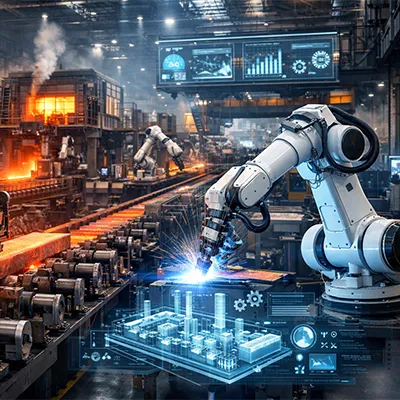
Robotic systems are vastly employed in the steel plants in inspection of furnaces, refractory maintenance, welding, cutting, and handling of slabs. The use of vision-controlled robots with sophisticated sensors can be used to carry out precision work in hot environment with minimal human involvement. When robotics is combined with automation in the steel production process, the company can enhance the safety at the workplace, as well as enhance the consistency of the operational processes.
How Automation Improves Steel Production Efficiency
To determine how automation affects the efficiency of steel making, one will be required to research into the effects of automation on throughput, use of resources and operations stability. The automation of steel production does away with variability of processes due to manual adjustments making operations consistent despite varying circumstance of raw material or energy.
Highly automated systems used to manage steel plants can optimize energy use by controlling the operation of furnace, minimizing the heat loss, and enhancing thermal efficiency. Automation in the control of the process reduces wastage of materials as well as enhancing yield rates due to the accuracy in the production recipes being followed. The automation of steel manufacturing allows sustaining a high level of production without deteriorating the quality or raising the costs due to the opportunity to make changes in real time.
Quality Enhancement through Automation Technologies
One of the most crucial issues in steel production is the quality consistency when it comes to providing such industries as automotive, building, and energy. Automation of steel production is at the center of provision of close quality limits and adherence to intercontinental requirements.
Machine vision and machine-non-destructive testing systems are automated inspection systems that identify surface and internal defects, as well as dimensional deviations at a nipple stage. There will be corrective measures taken immediately by these systems and this will ensure that a product that is defective does not proceed any further along the production line. Granting full accountability and customer trust, automation within steel plants also helps with the full traceability, correlating production parameters with the end produced quality information.
Benefits of Automation in Steel Manufacturing for Business Performance
Automation in steel manufacturing is not only viable in terms of improving operations but also in business performance. Automated steel plants also have less operating cost because they are less dependent on labor, have a high energy efficiency, and less rework. The outcome is an increase in process stability, which results in a predictable output, which can be used in making better commitments on delivery and customer satisfaction.
The optimization of the workforce in steel production is also supported by automation which changes the roles of the employees as manual ones and provides supervisory, analytical, and maintenance-oriented activities. Such a change enhances the productivity of the workforce and matches the skills to the contemporary industrial demands. Moreover, intelligent steel production projects enhance better sustainability performance through cutting of emissions, energy use, and waste of materials.
Advanced Automation Systems for Steel Plants and Industry 4.0 Integration
New progressive automation systems of steel plants gain more and more compliance with the Industry 4.0 principles. These systems combine automation and industrial internet of things platforms, cloud-based analytics, and artificial intelligence to establish self-optimizing production environments. The real-time dashboards allow managers of the plant to see the production data, equipment status, and quality indicators.
Steel manufacturing automation and AI-based analytics allow the development of predictive maintenance plans, which eliminate the unforeseen failure of equipment. Steel productions Digital twins are computer simulations of the processes of operating a specific factory, enabling the manufacturer to test different changes and assess the implications prior to implementation, minimizing the risks and increasing the accuracy of the decisions. Such intelligence will make steel plants dynamic data-driven operations that can be used to respond swiftly to the needs of the market.
Smart Factory Steel Production and Supply Chain Connectivity
The concept of smart factory steel production is not restricted to the shop-floor automation, but it also spreads into supply chain integration and enterprise-level co-ordination. Automation of steel plants links the production information to the inventory control, logistical, and customer order solutions so that there is an efficient flow between raw materials and finished goods.
Steel production automation enhances supply chain visibility by providing the status of product production, material and delivery times in real-time. This visibility enables steel producers to streamline the inventories, lead time, and enhance sensitivity to the requirements of customers. Such connectivity is one of the elements of differentiation in a highly competitive market.
Challenges and Considerations in Steel Manufacturing Automation
Although the benefits are quite convincing, automation in steel production needs to be thought over and invested. Implementing new automation systems inside the current steel plants may prove complicated because of the restrictions of the old equipment and infrastructure. Another aspect that can be taken as a critical consideration is cybersecurity, as the systems related to steel production are increasingly linked and data-driven.
Automation strategies of a successful kind entail the combination of steel producers, automation solution providers and technology partners. Employee skills must be enhanced via upskilling so that they are able to operate, maintain, and optimise automated systems positively. Even with this, there are enormous advantages of automation in steel plants long term, which far surpasses the initial resistance.
The Future of Automation in Steel Production
The future of automation in the steel manufacturing is defined by greater autonomy, intelligence, and sustainability. With the ever-growing automation technologies in the steel manufacturing industry, steel plants will be shifted to autonomous operations with very little human participation. Artificial intelligence will be more important in optimization of processes, predicting quality, and forecasting demand.
Smart steel production will also aid the industry to shift to greener form of production by efficiently using the energy and providing the ability to incorporate the other forms of energy. Automation within the steel production will continue to be a very vital enabler to the steel manufacturers who are struggling to achieve competitiveness, resilience, and sustainability in a changing global market.
Conclusion: Automation as a Catalyst for Steel Industry Transformation
Automation in the manufacturing of steel is basically transforming the way steel is manufactured, handled and delivered. Automation of the steel production process offers manufacturers a chance to be more efficient, produce of higher quality, increase their safety, and improve business performance. Since robotics is utilized in the steel production sector and smart factory steel production models, automation technologies form the basis of the contemporary, future-compliant steel plants.
With the steel industry still struggling economically, environmentally, and operating-wise, industrial automation steel solutions will be at the heart in spearheading innovation and sustainability in the long run. In the current fast changing industrial environment, automation is no longer a choice, it has become a necessity to the steel manufacturers who want to remain competitive.
 Media Pack Download
 Newsletters
 Industrial Events