Smart Manufacturing in Steel Forming & Finishing: AI, IIoT, and Digital Transformation
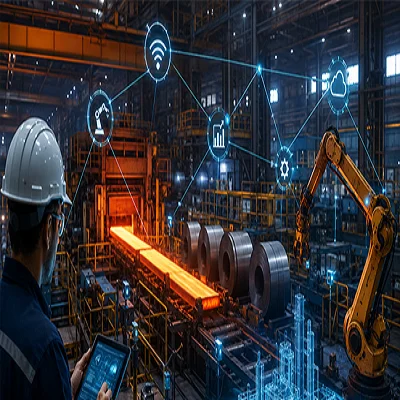
Walk onto the floor of almost any steel forming or finishing plant today, and you'll notice something different from even five years ago. The mills are still loud, the coils still glow orange, and the rollers still groan under tons of pressure — but tucked into the corners are sensors, screens, and dashboards that weren't there before. Steel manufacturing, one of the oldest heavy industries in the world, is quietly going through one of its biggest transformations since the invention of the continuous casting process.
This shift has a name: Smart Manufacturing. And it's built on three pillars that keep coming up in every serious conversation about the future of the industry — Industrial IoT, Artificial Intelligence, and Digital Twin technology. Together, they're changing how steel is formed, finished, inspected, and delivered, and they're doing it in ways that go far beyond simple automation.
Why Steel Forming and Finishing Needed a Digital Upgrade
Steel forming and finishing operations — rolling, forging, annealing, pickling, coating, cutting — are notoriously difficult to optimize. They involve extreme heat, high mechanical stress, and dozens of interdependent variables like temperature, roll pressure, tension, and material composition. A tiny deviation in one stage can cause defects that only show up several steps later, after a lot of time, energy, and raw material have already been spent.
For decades, plants relied on experienced operators, manual inspections, and scheduled maintenance to keep things running. That approach worked, but it left a lot on the table: unplanned downtime, inconsistent quality, energy waste, and safety risks that were hard to predict until something actually broke.
Smart manufacturing exists to close that gap. It connects machines, sensors, and software into one continuous feedback loop, so that decisions — whether made by a person or an algorithm — are based on real, current data instead of guesswork or gut feel.
Industrial IoT: The Nervous System of the Modern Steel Plant
If smart manufacturing has a foundation, it's Industrial IoT. IIoT refers to the network of connected sensors, controllers, and devices that continuously capture data from machinery and processes — vibration levels, temperature gradients, motor load, material thickness, roll speed, and more.
In steel forming and finishing specifically, industrial IoT applications in steel manufacturing plants typically show up in a few key places:
- Rolling mills: Sensors track roll force, torque, and thickness in real time, helping detect early signs of wear or misalignment before they cause defects.
- Furnaces and annealing lines: IoT-enabled temperature sensors ensure heat treatment stays within precise tolerances, which directly affects the mechanical properties of the final product.
- Coating and pickling lines: Flow sensors and chemical concentration monitors help maintain consistent surface quality while reducing chemical waste.
- Material handling and cranes: Position and load sensors improve safety and reduce collisions or overloading incidents.
What makes IIoT powerful isn't the sensors themselves — it's the connectivity. Data from every stage of production flows into a central system, giving plant managers a live, plant-wide view instead of isolated snapshots from individual machines. This connected data layer is also what makes Artificial Intelligence and digital twin systems possible in the first place; without clean, continuous data, there's nothing for AI to learn from.
Artificial Intelligence: Turning Data Into Decisions
Collecting data is only half the job. The real value comes from what's done with it, and that's where Artificial Intelligence takes over.
AI-driven process optimization for steel production works by analyzing huge volumes of historical and real-time process data to identify patterns that humans would struggle to catch. For example, machine learning models can learn the subtle relationship between roll speed, temperature, and final surface finish across thousands of past production runs. Once trained, these models can recommend — or even automatically apply — adjustments that keep quality consistent even as raw material properties vary batch to batch.
Some of the most impactful AI use cases in steel forming and finishing include:
- Defect detection: Computer vision systems trained on thousands of surface images can spot cracks, scale, pitting, or coating inconsistencies far faster and more consistently than manual visual inspection.
- Yield optimization: AI models can suggest cutting patterns and process parameters that minimize scrap and maximize usable output from each coil or billet.
- Energy optimization: Since reheating furnaces and rolling operations are energy-intensive, AI can recommend the most efficient temperature and speed profiles without compromising quality.
- Predictive maintenance: AI algorithms analyze vibration, temperature, and load data from IIoT sensors to flag equipment that's likely to fail soon, rather than waiting for a scheduled inspection or, worse, a breakdown.
This last point deserves its own spotlight, because it's one of the clearest, most measurable returns on investment in the entire smart manufacturing stack.
Predictive Maintenance: From Reactive to Proactive
Unplanned downtime is one of the most expensive problems in steel manufacturing. A single failed bearing or misaligned roll can halt an entire line for hours, sometimes days, and the cost isn't just repair — it's lost production, missed delivery windows, and, in some cases, safety incidents.
Predictive maintenance flips the traditional maintenance model on its head. Instead of fixing equipment on a fixed schedule (which often means replacing parts that still have useful life left, or missing failures that happen between scheduled checks), predictive maintenance uses continuous sensor data and AI models to estimate the actual condition and remaining life of equipment.
In a steel forming environment, this might look like:
- Vibration analysis on rolling mill bearings to detect early-stage wear
- Thermal imaging on motors and drives to catch overheating before failure
- Oil analysis sensors on hydraulic systems to flag contamination or degradation
- Acoustic sensors on gearboxes to detect abnormal noise patterns
The result is maintenance that happens exactly when it's needed — not too early, not too late. Plants that adopt predictive maintenance typically see fewer emergency shutdowns, longer equipment life, and better allocation of maintenance labor.
Digital Twin: A Virtual Mirror of the Physical Plant
Perhaps the most exciting piece of the smart manufacturing puzzle is the Digital Twin — a virtual, continuously updated replica of a physical asset, process, or entire production line.
Digital twin technology in steel forming and finishing operations allows engineers to simulate changes before making them on the real production floor. Want to test a new rolling schedule, a different alloy mix, or a modified cooling rate? Instead of risking a costly trial run on live equipment, engineers can model it first in the digital twin, using real sensor data to make the simulation as accurate as possible.
This has a few major benefits specific to steel forming and finishing:
- Process validation without production risk: New parameters can be tested virtually before being applied to actual steel, reducing scrap and trial costs.
- Root cause analysis: When a defect occurs, engineers can trace it back through the digital twin's historical data to pinpoint exactly which stage and parameter caused it.
- Operator training: New staff can practice on the digital twin without the risk of damaging expensive equipment or producing defective material.
- Continuous improvement: Because the digital twin updates with live IIoT data, it becomes more accurate over time, improving the reliability of every future simulation.
Digital twins essentially act as a bridge between the physical and digital worlds — the same principle used in aerospace and automotive manufacturing, now adapted for the unique thermal and mechanical demands of steel processing.
Manufacturing Execution System: Tying It All Together
None of these technologies work in isolation. A Manufacturing Execution System (MES) is the software layer that connects IIoT data, AI insights, digital twin outputs, and shop-floor operations into a single coordinated system.
An MES tracks work orders, material genealogy, quality data, and machine status in real time, giving plant managers a single source of truth. In a steel forming and finishing context, MES platforms typically handle:
- Scheduling and sequencing of forming and finishing operations
- Real-time quality tracking tied to specific coils, batches, or heat numbers
- Integration with ERP systems for order fulfillment and inventory management
- Compliance and traceability documentation, which is critical in industries like automotive and construction that require certified material properties
Without an MES, even the best IIoT sensors and AI models end up as isolated pockets of insight rather than a coordinated system. The MES is what turns smart manufacturing from a collection of technologies into an actual operating strategy.
Process Automation: The Practical Outcome
At the end of the day, all of this — IIoT, AI, digital twins, predictive maintenance, MES — feeds into one practical outcome: process automation. Automated systems can now adjust rolling speeds, furnace temperatures, and coating thicknesses in real time, based on live data and AI recommendations, with minimal manual intervention.
This doesn't mean human operators become unnecessary. If anything, their role shifts from manually adjusting dials to overseeing systems, interpreting AI recommendations, and handling exceptions that automation can't resolve on its own. It's less about replacing expertise and more about amplifying it with better information.
Common Questions About Smart Manufacturing in Steel
What is the biggest benefit of digital transformation in steel manufacturing?
Most plants see the fastest returns from predictive maintenance and AI-driven process optimization, since both directly reduce downtime and scrap — two of the largest cost drivers in steel forming and finishing.
Do smaller steel plants need a full digital twin to benefit from smart manufacturing?
No. Many plants start with IIoT sensors and an MES, then add AI-based analytics and predictive maintenance before investing in a full digital twin. Digital transformation is usually a gradual, layered process rather than a single overhaul.
How does AI improve steel quality specifically?
AI models can detect subtle process deviations that lead to inconsistent surface finish, thickness variation, or mechanical property drift — catching them earlier than manual inspection typically would.
Looking Ahead
Steel forming and finishing will always be a physically demanding, high-stakes industry. But the way plants are run is changing fast. Industrial IoT gives plants the eyes and ears they never had. AI turns that data into actionable decisions. Digital twins let engineers test ideas safely before committing real material and time. Predictive maintenance keeps equipment running longer with fewer surprises. And a solid MES ties everything together into one coordinated, automated system.
None of these technologies are silver bullets on their own. But together, they represent a real shift — from steel plants that react to problems, toward ones that anticipate and prevent them. That's what smart manufacturing actually means in practice: not a buzzword, but a steady, data-driven upgrade to an industry that's been waiting for one.
 Media Pack Download
 Newsletters
 Industrial Events